Showing posts with label Jesus. Show all posts

Friday, November 18, 2022

The Christmas Hikes

   Have you ever thought deeply about what life must have been like for the people we read about in the Bible? I mean, what was it really: like when Joseph found out Mary was pregnant ... and then when he was told he must pay his taxes in Bethlehem. Have you ever thought about how difficult the trip must have been as Joseph traveled with Mary, who was nearing her time of delivery? How did they traverse the mountains, what did they eat, and where did they sleep? These real people, who were forced into a difficult situation. Would you travel with them if you could? 
   You can! Through a guide entitled Advent Journeys, available on Amazon.com
   You can also meet and travel with the Magi, on their way from Parthia to Bethlehem. (And you will be in the room when they meet King Herod!)
Sheep eating leaves of an Olive Tree in Israel

   This guide will allow you to listen in on the voices of the Shepherds as they watched their sheep in the fields near Bethlehem.

   The book  Advent Journeys is designed to lead you into Christmas through short daily readings, beginning the Sunday after Thanksgiving. Please order the book today, so you can read it this season and begin to experience the journeys described in the Bible.


Friday, April 10, 2020

DIY Easter

What are you doing for Easter this year. For many families this season is heartily anticipated. There is a 40 day period of preparation called Lent; then comes Palm Sunday when people begin to remember Jesus’ last week on earth; and finally there is the weekend with Maundy Thursday (Passover), Good Friday, and Resurrection Day. Churches prepare huge celebrations, dramas, cantatas, and special services (which will be remote this year). People purchase Sunday clothing, plan Easter Egg Hunts, and large family gatherings. BUT ...

This is the year that everything External will be different. There will be no large community gatherings because of the COVID-19 epidemic. We must stay home. So what will Easter be like? Perhaps, in its own way, for one year, better, because, if we will, we can focus on the internal meaning rather than the external events.

So, what is Easter? Is it the clothing, the chocolates, the choir specials, or the crowds? Not really! Easter celebrates the atoning death and the surprising resurrection of Jesus. Easter celebrates LIFE (not life with gusto, which only distracts us from real life - but LIFE that connects with God and goodness). So, what will you be doing this Easter?

It is time for a do it yourself Easter.

How can you do that? Plan! If you have children, here is a recommendation. Purchase a Kindle version of the book “The Case of the Missing Body.” (It is 99¢, hope that does not break the bank!) It contains a nine act play, and some added stories and facts. Most of the acts only require 2-4 actors, and are written so children can understand. Pass the book around, and read the parts. Then talk about how each scene fits into the larger Easter story.
Order this book today on Amazon.com
Children learn by doing … not by sitting in a church service. This play is doing! Your family will greatly benefit if you will spend the hour you normally spend in church, reading through this play. Don’t fight the system, don’t mourn the loss of normal … just do something different, and you will be glad you did! (And talk about it for years!)

The book is on Amazon.com - click here!

This Easter is a great time for something different! A great time for DIY, with help, of course. So try it out.

And please pass this idea on, so others can enjoy Easter, wrapped in its full meaning also.

Friday, March 20, 2020

When Things are Hopeless, There are Friends!

Pandemics are not respectors of people. In every age throughout history disease has impacted the wealthy and the poor alike. The wealthy, because they travel to diverse regions and pick up sicknesses unknown at home. The poor, because they live in cramped quarters where disease spreads easily from house to house. We are experiencing this today with Coroanavirus, as we did in the past with the Ebola (2014), MERS (2012), Swine Flu (2009), SARS (2002), Hong Kong flu (1968), Spanish Flu (1918), Yellow Fever (1668, 1793, 1878, 1898)

The above diseases (and others) have resulted in terrible physical suffering, many deaths, and great loneliness. One of the results of sickness is isolation, whether self-imposed, brought about because of physical weakness, or caused by fear of infection (so people stop visiting). If a disease goes on long enough, acquaintances and friends stop visiting because their life has gone in other directions. (Friendship is often a two way street. If one of the friends is too sick to stay in contact, the other friend forgets to call).

But sometimes friends come from unexpected places. Consider the case of Naaman, commander of the armies of Ben-Hadad II of Syria in 850BC. This great man was stricken with the feared disease called Leprosy in the Bible (see my last blog post), a communicable disease which required quarantine. When his sickness was discovered, his friends backed away in fear, because it was contagious. Naaman was forced into isolation.

However, one of his wife’s servants, a slave-girl who was captured in Israel during one of Naaman’s raids, felt sorry for him. Crossing social, ethnic, religious, and strict social barriers, this girl sent a message to the great commander that she knew of a prophet in her home country that could bring him healing.

Naaman was ecstatic. He was willing to try anything to get well. He contacted King Ben-Hadad II, who sent an order for king Joram in Samaria to receive leoprous Naaman, and provide him proper introduction to the prophet-healer. Naaman took “ten talents of silver, six thousand shekel of gold and ten sets of clothing.” to provide for his healing.

King Joram, who had to meet Naaman was in fear of the disease. When his messenger gave Ben Hadad’s order to the king, he blurted out, “Am I God? Can I kill and bring back to life? Why does this fellow send someone to me to be cured of his leprosy? See how he is trying to pick a quarrel with me!” And he dragged his feet, making the general with the feared disease wait.

But God spoke to Elisha, on behalf of the servant girl who befriended Naaman, and the prophet sent this message to the king, “Why have you torn your robes? Have the man come to me and he will know that there is a prophet in Israel.” King Joram gladly sent Naaman away to the prophet.

Naaman was told, “Go, wash yourself seven times in the Jordan,” a place considered a muddy creek by the aristocratic Syrians. Naaman debated, “Are not Abana and Pharpar, the rivers of Damascus, better than all the waters of Israel? Couldn’t I wash in them and be cleansed?” He turned away in rage, and headed home.
The Muddy Jordan River near where Jesus was baptized
But at the bequest of the servant-girl who befriended the great general, other servants told him, ““If the prophet had told you to do some great thing, would you not have done it? How much more, then, when he tells you, ‘Wash and be cleansed’!” So Naaman went to the Jordan River and was cleansed. (2 Kings 5)

The Bible never records whether Naaman thanked or freed the servant-girl. She risked her life out of obedience to God, who desires for us to befriend others who are in need. It does not matter if we like them or if they like us. It does not matter if they are above us or below us in status. They are people in need. As the Coronavirus takes hold in our community, we need to listen for needs, and help our neighbors. Look for people who are sick, and get them help. Look for people out of work and meet their needs. Look for those in fear, and bring calmness for their spirits. Be a neighbor and a friend, like the servant-girl in this time of need.

The big thing is to hear God. I speak more about this in my book: Spring: Connecting with God. If you have time during the crisis, read this book, available in paperback or on kindle reader.

Wednesday, March 18, 2020

Self Quarantine in the Bible

Self Isolation orders are being imposed in the United States and around the world. This methodology is being used to fight a terrible disease. This is not the first time social distancing has been used for protection of society and personal safety. Self and community imposition of restricted movement can be found in many places and for many reasons in Scripture.
The Desert of Zin, a place Israel might have visited when distanced.

Government ordered restrictions for health reasons were imposed by Moses in the Bible. The disease of the day that brought about the need for isolation was leprosy. This highly communicable disease begins with “a swelling or a rash or a shiny spot” on the skin. Anyone infected must go to the Priest for testing. If the test is positive, “the priest is to isolate the affected person” for fourteen days, with a visit for observation in the middle. (Numbers 13)

Social distancing was imposed on people with confirmed leprosy until they were either cured or died. There were enough people with the disease in Israel that colonies were formed. (2 Kings 7:3) The diseased person was ordered to “wear torn clothes and let his hair hang loose, and he must cover his mouth and cry out, 'Unclean, unclean!'” (Leviticus 13:45) The quarantined person was forced to live outside the city. Some of these people eventually came together and formed a community of illness.

Forced quarantine was imposed on people for a multitude of reasons in the Bible. One interesting case is that of Noah and his family (Genesis 6-9). God placed Noah and his family into isolation in an ark in order to prevent an infection from evil that had become rampant in the world. The healthy family was placed in an Ark, so they would not be infected. They were confined for almost a year before they were released.

In a similar fashion, the Hebrew people were isolated from the world during their forty year journey in the wilderness. Through Israel’s social distancing God was able to create a nation of people who were taught about healthy living while in the desert. Moses instructed this band of former slaves in all matters of wellness: spiritual, mental, social and physical health.

The Bible tells of many people who choose to self-isolate for wellness and betterment in life. It should be noted that these people had a plan when they went into seclusion. They had a dream of using their time apart from others that would better them. The Bible tells of how Jesus socially distanced himself (and sometimes his disciples) many times. These were to prepare the teacher for times of trials, or when strength is needed.

It appears to me that troublesome days are upon our nation. Many have gone into isolation (by force or by choice). We could all use a plan that will help us come through these days of trial for the better and not for the worse. Spring: Connecting with God tells about things that will make a nation strong in times of crises.

Sunday, November 4, 2018

Christmas is Coming!

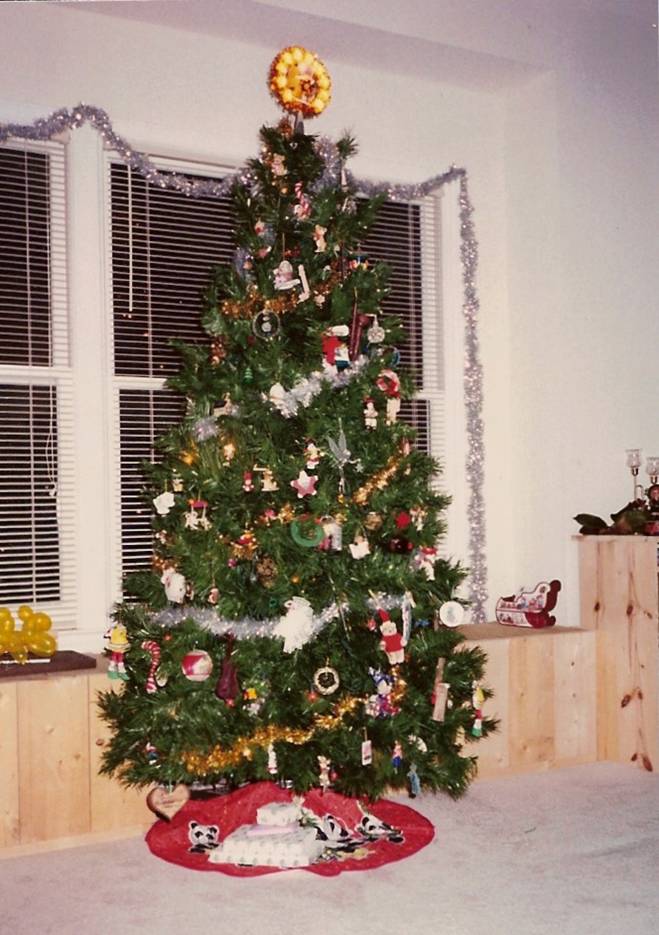
Christmas Tree
     November marks a season of change. Gone are the months of September and October that mark the beginning of the school season. Gone is the season of shifting from summer’s vacations to a normal schedule (whatever that might mean). Gone is the season when we can depend on warmth to return after every cold snap. We have come fully into the season called autumn, when leaves are either colored or gone.
     November marks the beginning of the holiday season. It is a time for making Thanksgiving plans and thinking about what items to purchase on Black Friday. The time of Indian Summer is upon us and we all begin to realize that Christmas is just around the corner.
     For me personally, November marked the time when the organization of a new church year came to an end, and things were beginning to run smoothly. November for me, and for the Pilgrims, and for many farmers marks a time of rest, when recovery is possible after a hectic year. But it was not time to stop planning completely, the busy month of December was just ahead.
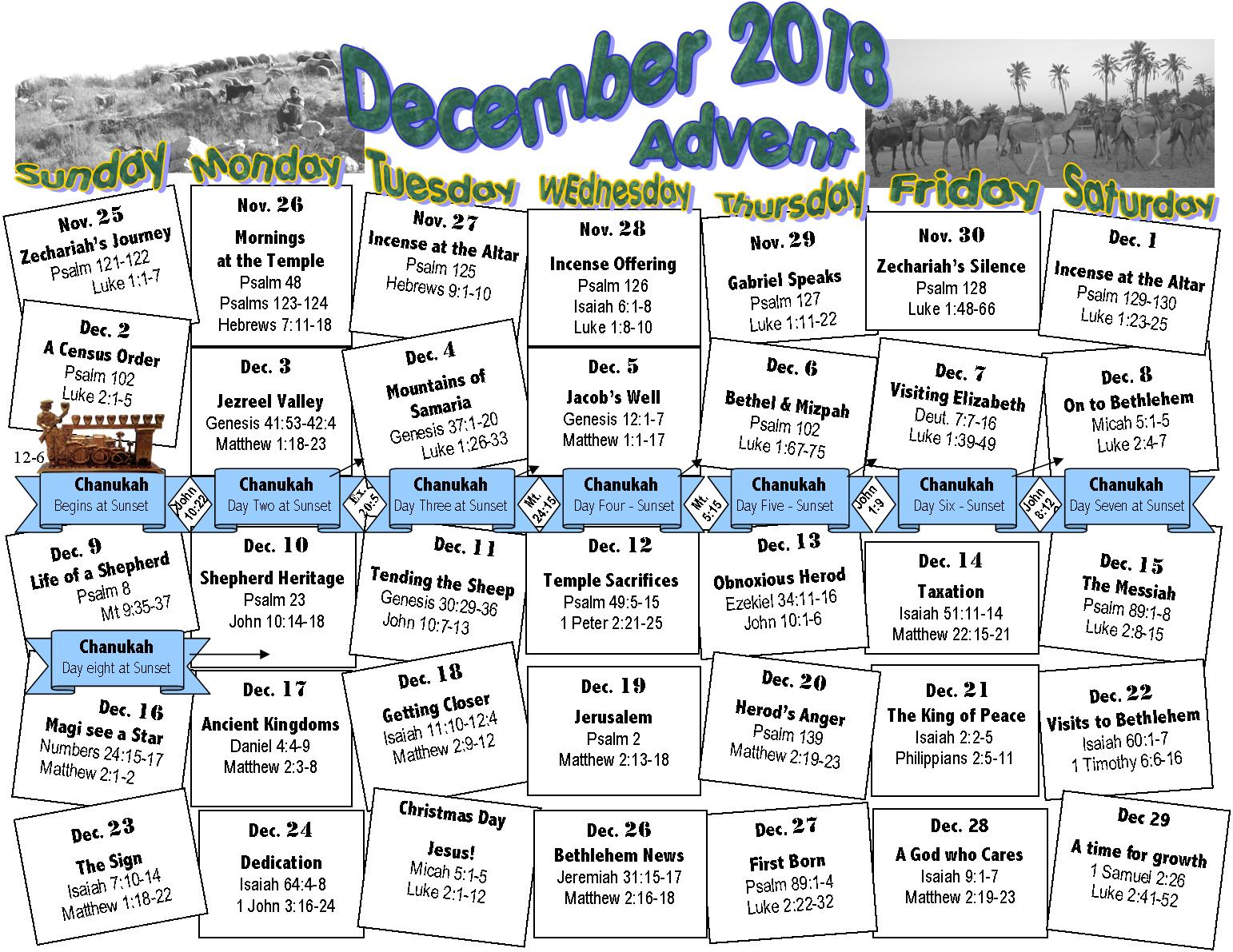
Advent Calendar
     November was the time I planned for December. I placed the multitude of church activities, parties, school programs and community events on my calendar. But I did not stop after these plans were input into my calendar. I went on to plan something much more important: My children’s Christmas (Advent) celebration.
     Soon after my first daughter was born, it came to my awareness that there is something more important than events and more eternal than presents, Jesus’ birthday. I could not and should not forget to plan family events that would help my children understand my faith. I set an agenda to share a Bible verse with my family each day at breakfast, and also a special seasonal event every day.
Children's Christmas Activities
     All these plans are included at www.KosherCopy.com under the Advent tab. I have produced a pamphlet of ideas to share with your children, and also an advent calendar. Many of the ideas do not take long to accomplish, but set one by one, each day of december, they have a profound effect on faith (and greed). Through providing an activity every day of Advent, the emphasis is taken off the giving of presents and placed on the celebration of Christ’s birth.
     With the free resources at my website, www.KosherCopy.com, it does not take long to plan a great Christmas. It only takes a decision and a couple hours of time. There is a great reward when your children find joy in Jesus rather than “what’s in it for me.”

Monday, October 29, 2018

A Dig at Zippori

During my two month visit to Israel, I participated in four archaeological digs, at Gezer, Tel Hadid, Zippori and at Tel Dan. My favorite experience was the work at Zippori.
Arches Reservoir at Zippori
Zippori was the capital city of Galilee in the first century AD. It is located a few miles from Nazareth, and many feel that Joseph the father of Jesus worked on government projects at Zippori.
Merchants sidewalk along main street
The cardo of this city is amazing. It is actually two roads that cross each other at the main intersection. Buildings have been recovered along both roads.
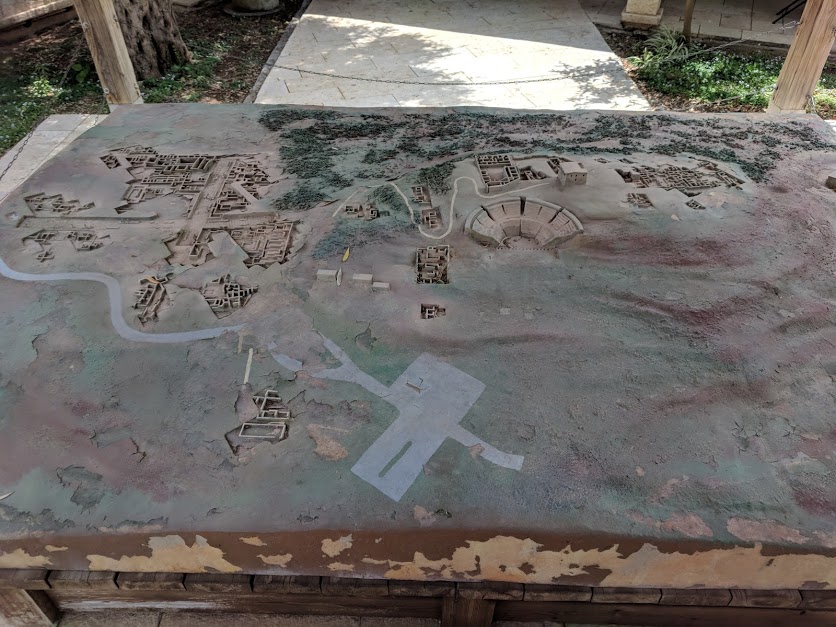
Site map of Zippori
The city also contains amazing mosaics. Some are located in what is called the Nile house.
Centar at the Nile House
Other mosaics can be found at the Dionysus House.
Mona Lisa of Galilee
There is also an amazing mosaic in the Synagogue.
Mosaic on the floor of the Synagogue
We worked at the first century water project. This is a cistern that held water that flowed down hill from spring along the Nazareth ridge.
Nazareth Ridge above Zippori
There are actually two cisterns. The first was untouched since the first century.
Arches Reservoir at Zippori
The second was developed into a wine press.
First view of the Arches Reservoir
Wine was stomped at one end of the cistern
First view of the Arches Reservoir
It flowed into a mikvah that was more than seven feet deep.
Shade tarp over the Arches Reservoir
There was also a stone reception area with pavers.
Measuring the Mikvah
We helped excavate the mikvah area.
Debris and stones above the Mikvah
It started by clearing roofing members which fell. The roof was a system of arches and coverings to keep the water in the dark until it was needed.
Digging Team at Zippori
We hauled lots of dirt out of the system, and also rocks. We found coins, pottery and other items as we dug.
Pottery found during our dig at Zippori
We worked with several archeologists who taught us about the site. They showed us the difference between first and second century plaster, as well as showing us areas of the cistern (structure) that was not plastered.
Filling dirt buckets at Zippori
I have included some stories from the hills of Galilee in my new book, Israel:Stories for Your Journey.
New book on Israel
Some of the places I visited during the two weeks of my tour were places I visited before, but since I helped plan the tour, there were some new places also.

Sunday, June 3, 2018

Climbing Mount Arbel

The mountain of Galilee called Arbel is an amazing place. The mountain, at just under 600’ above sea level on first hearing is a bit anemic, but normal statistical facts are just one way of looking at the mountain. The more impressive number comes as one begins to understand that Mount Arbel overlooks the Sea of Galilee, which is currently 700’ below sea level. This means a climb up the mountain (and the view off the mountain) is about 1,300 feet. Both the view and the climb are worth the effort it takes to reach the top.
The northern view from Mt. Arbel
An ascent up Mount Arbel begins at a trail head between Magdala and Migdal near the intersection of highways 90 and 807. We got off of a bus, but there is probably also a place for cars. The beginning of the trail is a moderate, but continual ascent with very few stairs.
Mount Nital next to Mount Arbel
The trail enters the national park across a cattle guard in an area where bovine are grazing. One web posting said, “If you don’t bother them, they won’t bother you.” The cattle add to the scenic appeal along with wild flowers and various types of plants along the trail.
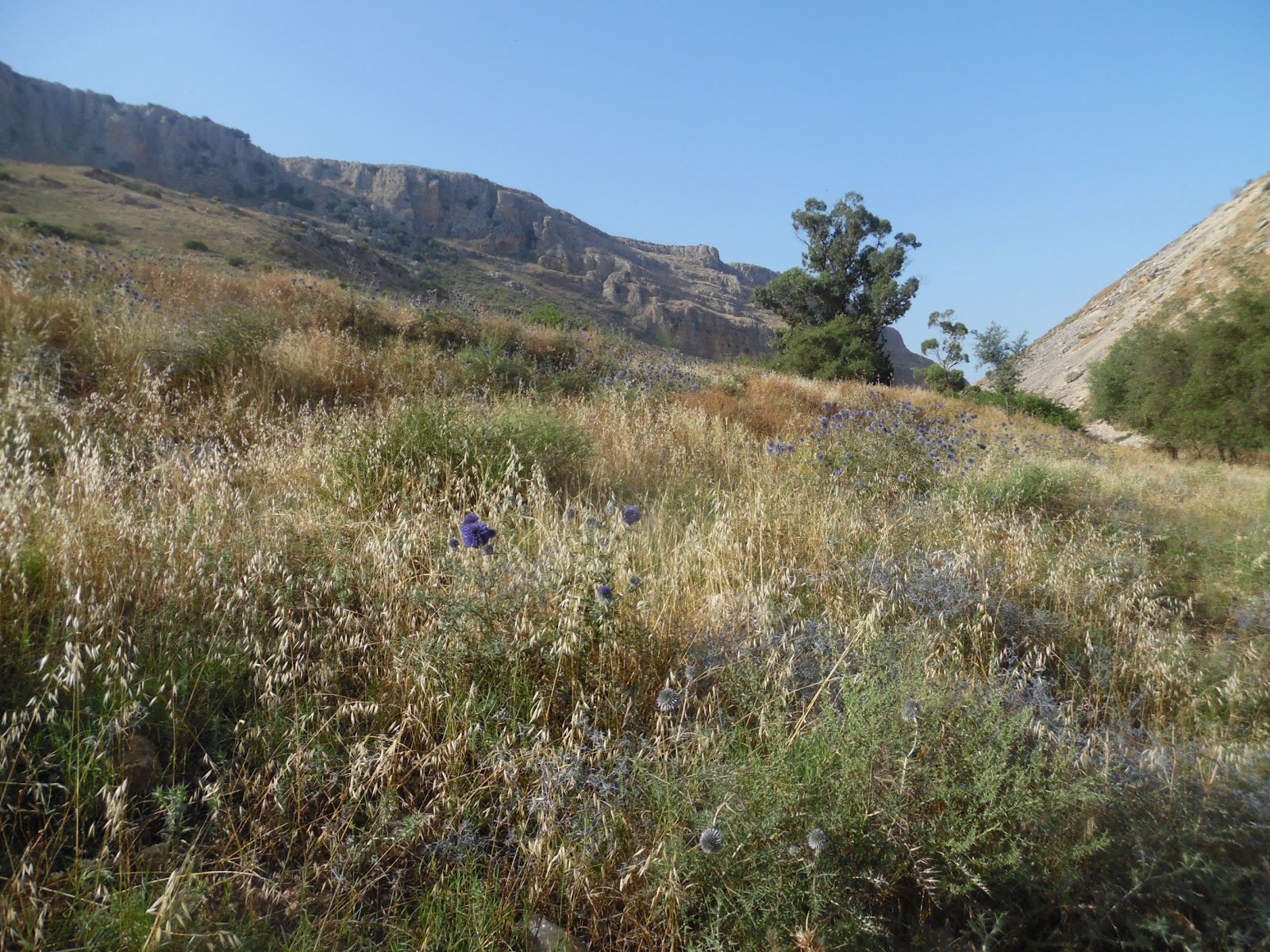
Spring flowers on the trail
The trail ascends between two peaks: Mount Arbel and Mount Nitai (named after a Rabbi of the 2nd Century BC, who is quoted in the Mishnah as saying, “Keep your distance from bad neighbors, ally yourself not with the wicked and do not abandon hope when faced with calamity.”) Notice as you hike the caves on both mountains.
The Horns of Hattin seen from our trail
Rising between the two mountains the hiker will notice the Horns of Hattin, an important battle site where the European Crusaders faced a humiliating defeat to Ayyubid sultan Salah ad-Din, (AKA, Saladin). The actual peak is an old volcano crater.
A stop at the tall rock
The trail ascends to an area with rock outcroppings, which provide seating so the view below can be enjoyed. This is a good time to take a break, because the trail will become steeper beyond this point, and most who take the trail will be ready for a rest. The villages of Migdal, Hamaam, and Ginosar can be seen below. The rest can be short, for the view gets better as one ascends.
Trail signs ... and decisions
The next stop, along an ascent and several steps is at a set of trail markers. At this point it is time to explore some of the nearby caves and to take pictures of the caves on Mount Arbel and Mount Nitai. When it comes time to move on, a choice must be made between two trails. The trail to the left ascends to the top of Arbel with scenic views of the Sea of Galilee. The trail to the right goes through areas of caves towards the visitor center, away from the lake. Both are very beautiful in their own way. The trail along the caves is more difficult.
The Sea of Galilee from Mt. Arbel
The trail to the left crosses many rock outcroppings, contains teps and metal handholds. It ascends between Kinneret and Caro lookouts. The beauty is outstanding. There are many places to sit and enjoy the views, so climbers should not be in a rush to get to the top.
A Cave Dwelling on Mt. Arbel
The cave route gives the climber opportunities to visit the Ottoman Fortress and the caves of Refuge. The caves are interesting because they provided safety zones in times of battle. They were large enough for families and many men to live within, but the arrival pathway was very narrow. Attacking armies were required to travel single file, and could easily be pushed off the mountain upon reaching cave entrances.
Caves on top of caves, a high-rise complex
The caves became hideouts in 161 BCE, when Seleucid commander Bacchides came to fight Judah Maccabee. They were used again in 25 BCE when the people of Galilee resisted a new governor named Herod the Great. They found use again during the great revolts of 70 and 132 AD.
The steep ascent at the top
It could be said that the modern elevator was invented at Arbella. During the revolt of 37 BCE, Governor Herod would not tolerate any resistance, and required his generals to find a way of rooting out the rebels. They finally created a box car which could be lowered from the top of the cliff down to the caves. The car afforded safety railing which prevented soldiers from being shoved off the cliffs.
Reconstructed elevator from 37 BCE

Several Jewish communities existed atop Mount Arbel. Jesus visited the mountain often with his disciples, and it is possible the transfiguration took place at this site.

Friday, August 25, 2017

The Sea of Galilee

A voyage on the Sea of Galilee will be one of the activities during our 14 day trip to the Holy Land in May 2018. This body of water, also known as Lake Kinneret, Sea of Ginosar, or Lake Tiberias is a large freshwater body which was gone out upon frequently by Jesus and his disciples. Lake Kinneret was an oasis along a route used by ancient travelers through the land. An excursion on the Sea of Galilee is a highlight for many travelers to Israel.
The Sea of Galilee from Ginosar
The Sea of Galilee is a very wide spot in the Jordan River basin.  The river enters on the north side of the Sea near Bethsaida and exits on the south side of the sea near Kinneret. Within the pool of Tiberias, the collected water is 13 miles long and 8 miles wide. The level of the water sits at 700 feet below sea level, with a water depth which reaches 140 feet. The basin is made largely of basalt rock which can be picked up from the bottom as smooth stones.
The Sea of Galilee from Maagan Holiday Village
Lake Kinneret sits along the main trade route from Mesopotamia to Egypt. Caravans would have traveled along the Euphrates river, across the desert near Damascus, down the Hula Valley, and through Galilee to the Horns of Hattin and the Jezreel Valley. Settlement in the area has existed since prehistoric times with the archeological site of Ohalo at the southern end of the lake being called “one of the best preserved hunter-gatherer archaeological sites of the Last Glacial Maximum.
The Sea of Galilee from the East
During New Testament times, the Sea of Galilee was known for its fishing industry. Josephus records that as many as 230 fishing vessels sailed on the lake daily. We know the names of several fishermen from the New Testament including Peter, James, John, Andrew, and Zebedee. They caught a variety of fish including Musht, Biny, and Sardine.4
The Jesus Boat at Ginosar
On our trip we will visit the museum at Kibbutz Ginosar, where we will see “the Jesus Boat,” a fishing vessel which dates to the time of Jesus. This boat, made from twelve types of wood, is in good condition for its age. We will watch a video detailing its recovery and see the site where this boat was found.
The Jesus Boat at Ginosar
During our voyage on the Sea of Galilee, we will become acquainted with the surrounding villages as seen from the sea. We will enjoy watching windsurfing and other sailing endeavors from our boat. We will hear about the storms often stirred up because of the unique geography of the region and we will be told the story of how Jesus calmed the sea.
Looking north from a boat on the Sea of Galilee
The journey on the Sea of Galilee will help us visualize where a major portion of the Gospels took place. Throughout this journey we will not only walk where Jesus walked, but we will also ride a boat atop the lake where he often sailed. To find out more about the trip, click this link. To sign up for the trip click here. I hope you will travel with us during our 14 day trip to the Holy Land in May 2018.

Friday, August 18, 2017

Capernaum

In May 2018 I will be taking a group on a 14 day trip to the Holy Land. During this trip we will visit the Galilee region and Capernaum, a city where Jesus lived for several years. This city on the shores of the Sea of Galilee is an interesting place to visit. The site is maintained by the Franciscans, who have added walkways and benches and maintained the landscape so the story of Jesus’ residence can be told without too many modern intrusions.
Gate at the Franciscan Monastery of Capernaum
During our visit to Capernaum, we will enter the archaeological site through gates situated by a Catholic church. Once on the property we will be seated on shaded benches where our tour leaders will explain what can be seen at the site and share associated Bible stories so we can take away a memorable experience.
Shade trees which protect seating area of Capernaum
From the benches we will be directed into a fourth century synagogue constructed from imported limestone. Limestone was chosen for the exterior of the Synagogue to give a white (pure) appearance in a village constructed mostly out of the black basalt rock, which was easily available in the region. The fourth century building is well-maintained and enables the visitor to walk within and understand construction and practices in ancient places of worship. Tall pillars and an intact anterior provide photo opportunities and an ambiance to the visit.
Anterior of the Capernaum Synagogue
On the south side of the Synagogue, a portion of the earlier basalt synagogue has been uncovered where visitors are able to see a portion of the building in which Jesus and the disciples worshipped.
Remains of a first century synagogue at Capernaum
Outside the Synagogue, we will walk through a large area of foundational ruins. Many of the foundations are several feet in height and display steps and other features which will help us visualize the city Jesus called home (Matthew 9:1)
Ruins of Capernaum from the Synagogue
Over one area of ruins we will be able to enter a twentieth century church which sits above a residence believed to be the home of Peter’s mother-in-law. The modern church has a glass floor which allows visitors to see foundations of a first century home and a fifth century church. Diagrams give explanation of the existing foundations.
Looking across ruins of Capernaum to the new octagonal church
Beyond the ruins we will be able to walk down to the Sea of Galilee. We will visualize the beaches from which Peter, Andrew, James, and John departed on their fishing excursions. These shores are also the place recorded in Matthew 4 where Jesus meets Peter and says, “Come, follow Me, and I will make you fishers of men.”
Looking from Capernaum across the Sea of Galilee
On our trip within Galilee we will see Capernaum from several different vantage points. We will see the village from our boat ride on the Sea of Galilee, from the top of Mount Arbel, and if we strain our eyes from Kibbutz Ma’agan, where we will spend three nights. Once we walk through the village of Capernaum in Galilee, each sighting will give us a new perspective as we discover the shores along which Jesus often walked.
A view of Capernaum from the top of Mt. Arbel
If you would like to join us on our 14 day trip to the Holy Land click this link. To sign up for the trip click here. I hope you will travel with us during our 14 day trip to the Holy Land in May 2018.