Showing posts with label Herod the Great. Show all posts

Thursday, December 12, 2019

Philo, Josephus and John

The Christmas Story began in the mind of God, long before the creation of the world.
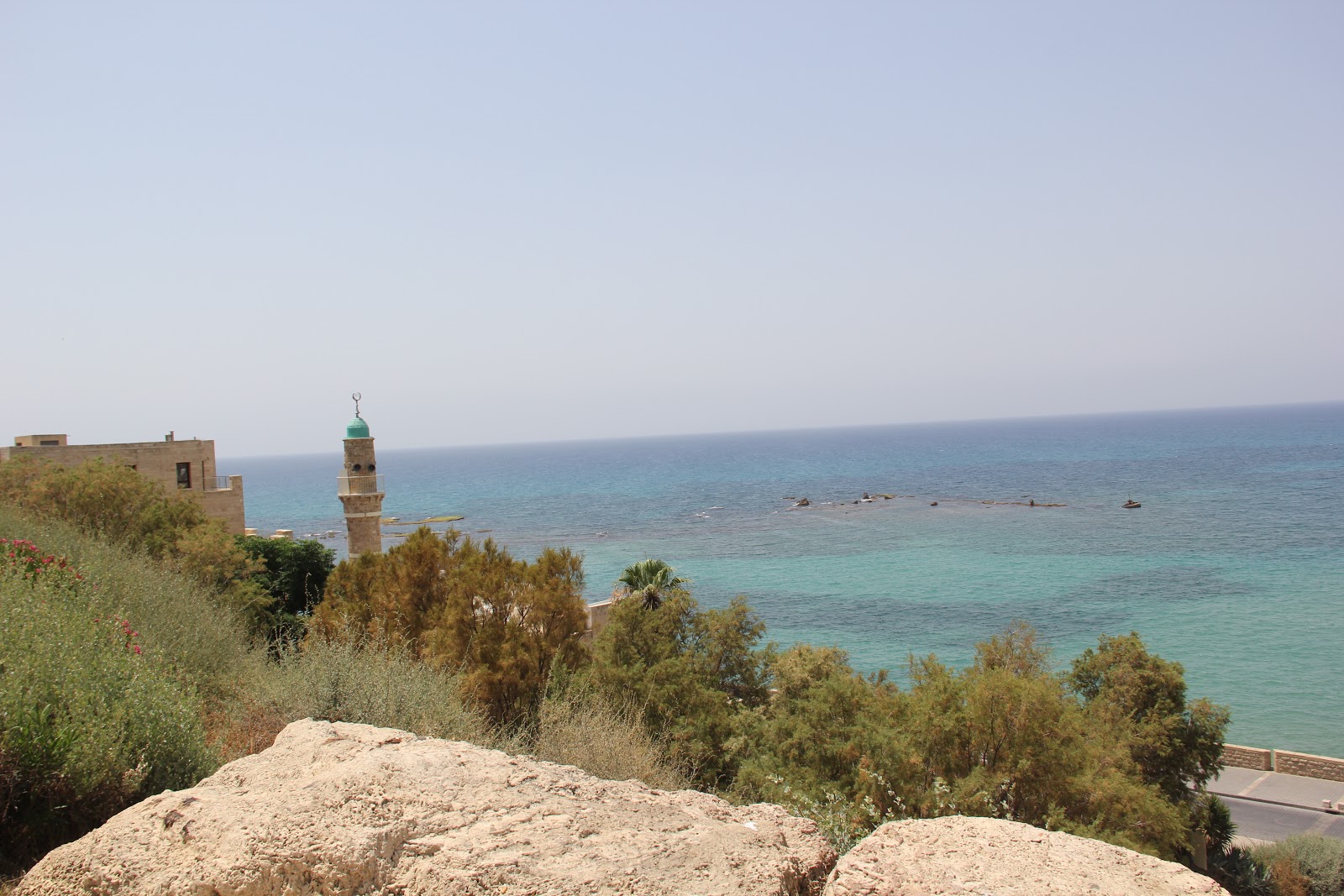
The Sea from Joppa
Josephus the Historian writes it this way: About this time there lived Jesus, a wise man, if indeed one ought to call him a man. For he was one who performed surprising deeds and was a teacher of such people as accept the truth gladly. He won over many Jews and many of the Greeks. He was the Christ. And when, upon the accusation of the principal men among us, Pilate had condemned him to a cross, those who had first come to love him did not cease. He appeared to them spending a third day restored to life, for the prophets of God had foretold these things and a thousand other marvels about him. And the tribe of the Christians, so called after him, has still to this day not disappeared. (Book 18, Chapter 3, 3)
A path down to the Sea of Galilee
Philo says it this way: “Of other lawgivers, some have set forth what they considered to be just and reasonable, in a naked and unadorned manner, while others, investing their ideas with an abundance of amplification, have sought to bewilder the people, by burying the truth under a heap of fabulous inventions. But Moses, rejecting both of these methods, the one as inconsiderate, careless, and unphilosophical, and the other as mendacious and full of trickery, made the beginning of his laws entirely beautiful, and in all respects admirable, neither at once declaring what ought to be done or the contrary, ... embracing the creation of the world, under the idea that the law corresponds to the world and the world to the law, and that a man who is obedient to the law, being, by so doing, a citizen of the world, arranges his actions with reference to the intention of nature, in harmony with which the whole universal world is regulated. accordingly no one, whether poet or historian, could ever give expression in an adequate manner to the beauty of his ideas respecting the creation of the world; for they surpass all the power of language, and amaze our hearing, being too great and venerable to be adapted to the sense of any created being.” (On the Creation)
Synagogue where Jesus taught
John the Apostle says, “In the beginning was the Word, and the Word was with God, and the Word was God. He was with God in the beginning. Through him all things were made; without him nothing was made that has been made. In him was life, and that life was the light of all mankind. The light shines in the darkness, and the darkness has not overcome it.” (John 1)
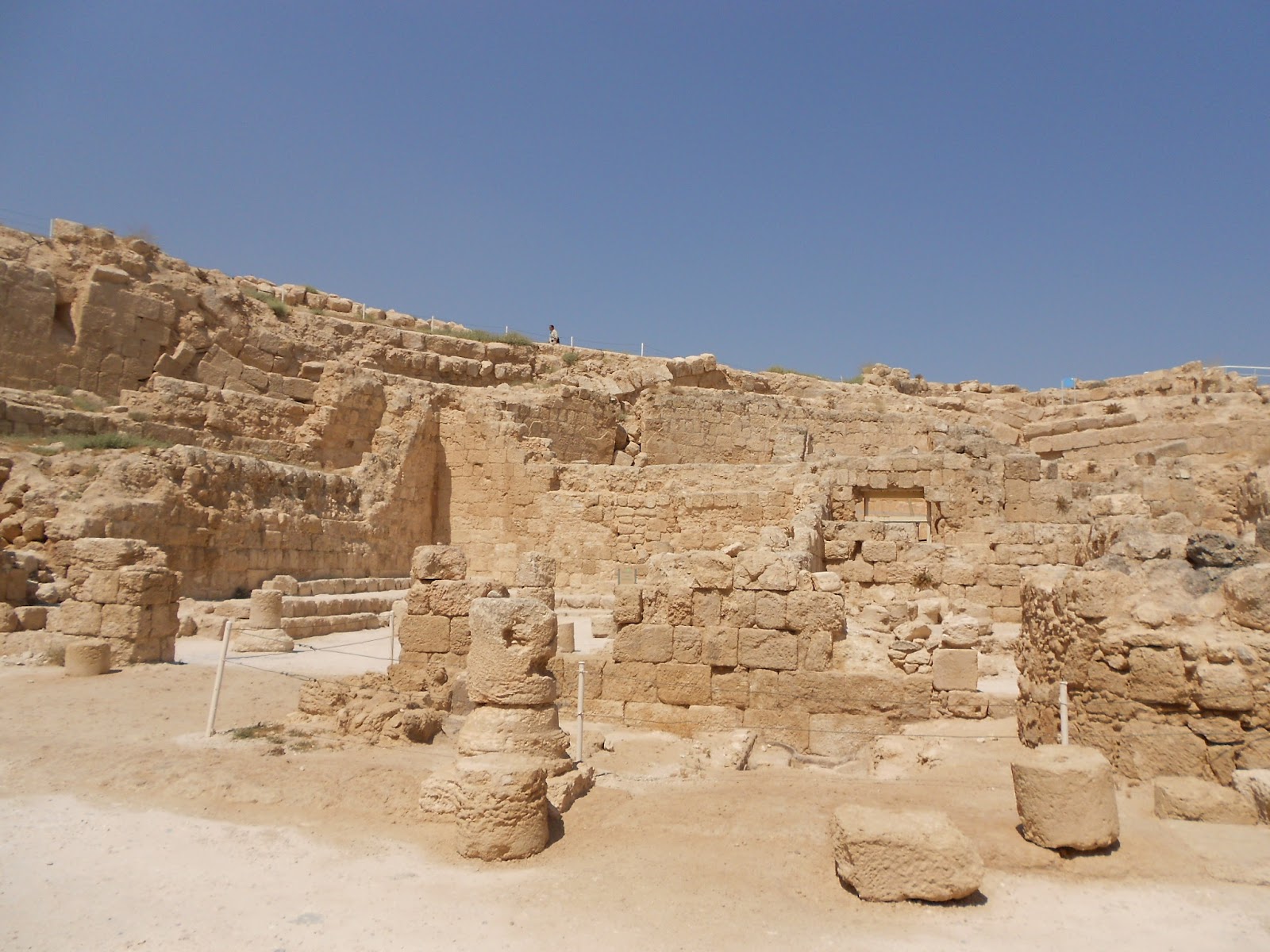
Herodium, favorite home of Herod the Great

“This is the verdict: Light has come into the world”... “For God so loved the world that he gave his one and only Son, that whoever believes in him shall not perish but have eternal life. For God did not send his Son into the world to condemn the world, but to save the world through him. Whoever believes in him is not condemned, but whoever does not believe stands condemned already because they have not believed in the name of God’s one and only Son.” (John 3:16-19)

Sunday, June 3, 2018

Climbing Mount Arbel

The mountain of Galilee called Arbel is an amazing place. The mountain, at just under 600’ above sea level on first hearing is a bit anemic, but normal statistical facts are just one way of looking at the mountain. The more impressive number comes as one begins to understand that Mount Arbel overlooks the Sea of Galilee, which is currently 700’ below sea level. This means a climb up the mountain (and the view off the mountain) is about 1,300 feet. Both the view and the climb are worth the effort it takes to reach the top.
The northern view from Mt. Arbel
An ascent up Mount Arbel begins at a trail head between Magdala and Migdal near the intersection of highways 90 and 807. We got off of a bus, but there is probably also a place for cars. The beginning of the trail is a moderate, but continual ascent with very few stairs.
Mount Nital next to Mount Arbel
The trail enters the national park across a cattle guard in an area where bovine are grazing. One web posting said, “If you don’t bother them, they won’t bother you.” The cattle add to the scenic appeal along with wild flowers and various types of plants along the trail.
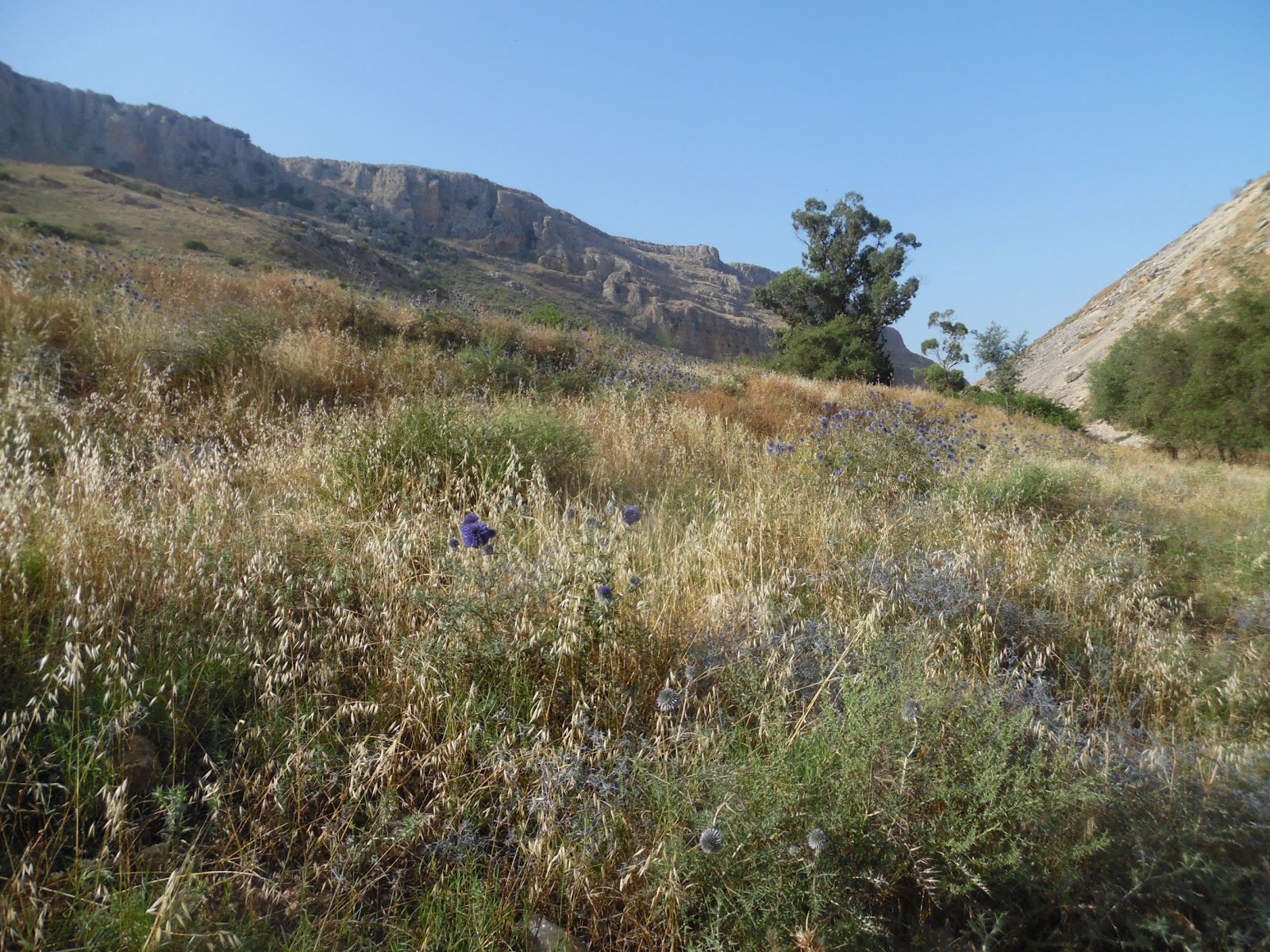
Spring flowers on the trail
The trail ascends between two peaks: Mount Arbel and Mount Nitai (named after a Rabbi of the 2nd Century BC, who is quoted in the Mishnah as saying, “Keep your distance from bad neighbors, ally yourself not with the wicked and do not abandon hope when faced with calamity.”) Notice as you hike the caves on both mountains.
The Horns of Hattin seen from our trail
Rising between the two mountains the hiker will notice the Horns of Hattin, an important battle site where the European Crusaders faced a humiliating defeat to Ayyubid sultan Salah ad-Din, (AKA, Saladin). The actual peak is an old volcano crater.
A stop at the tall rock
The trail ascends to an area with rock outcroppings, which provide seating so the view below can be enjoyed. This is a good time to take a break, because the trail will become steeper beyond this point, and most who take the trail will be ready for a rest. The villages of Migdal, Hamaam, and Ginosar can be seen below. The rest can be short, for the view gets better as one ascends.
Trail signs ... and decisions
The next stop, along an ascent and several steps is at a set of trail markers. At this point it is time to explore some of the nearby caves and to take pictures of the caves on Mount Arbel and Mount Nitai. When it comes time to move on, a choice must be made between two trails. The trail to the left ascends to the top of Arbel with scenic views of the Sea of Galilee. The trail to the right goes through areas of caves towards the visitor center, away from the lake. Both are very beautiful in their own way. The trail along the caves is more difficult.
The Sea of Galilee from Mt. Arbel
The trail to the left crosses many rock outcroppings, contains teps and metal handholds. It ascends between Kinneret and Caro lookouts. The beauty is outstanding. There are many places to sit and enjoy the views, so climbers should not be in a rush to get to the top.
A Cave Dwelling on Mt. Arbel
The cave route gives the climber opportunities to visit the Ottoman Fortress and the caves of Refuge. The caves are interesting because they provided safety zones in times of battle. They were large enough for families and many men to live within, but the arrival pathway was very narrow. Attacking armies were required to travel single file, and could easily be pushed off the mountain upon reaching cave entrances.
Caves on top of caves, a high-rise complex
The caves became hideouts in 161 BCE, when Seleucid commander Bacchides came to fight Judah Maccabee. They were used again in 25 BCE when the people of Galilee resisted a new governor named Herod the Great. They found use again during the great revolts of 70 and 132 AD.
The steep ascent at the top
It could be said that the modern elevator was invented at Arbella. During the revolt of 37 BCE, Governor Herod would not tolerate any resistance, and required his generals to find a way of rooting out the rebels. They finally created a box car which could be lowered from the top of the cliff down to the caves. The car afforded safety railing which prevented soldiers from being shoved off the cliffs.
Reconstructed elevator from 37 BCE

Several Jewish communities existed atop Mount Arbel. Jesus visited the mountain often with his disciples, and it is possible the transfiguration took place at this site.
Monday, January 29, 2018

When King Herod was Little

While Beit Guvrin and Maresha, towns not familiar to most people who study the Bible, knowing what happened in these towns will give clues to the formation of King Herod’s personality. In all probability King Herod the great was born and grew up in the region of these cities. Josephus contains a reference to this fact in the Antiquities of the Jews 14.13.9. The town of Maresha is very ancient, Joshua makes a note that this village was part of the inheritance of the tribe of Judah. (15:20, 44). Rehoboam fortified the city (2 Chronicles 11: 5-8) and later Nebuchadnezzar depopulated the region.
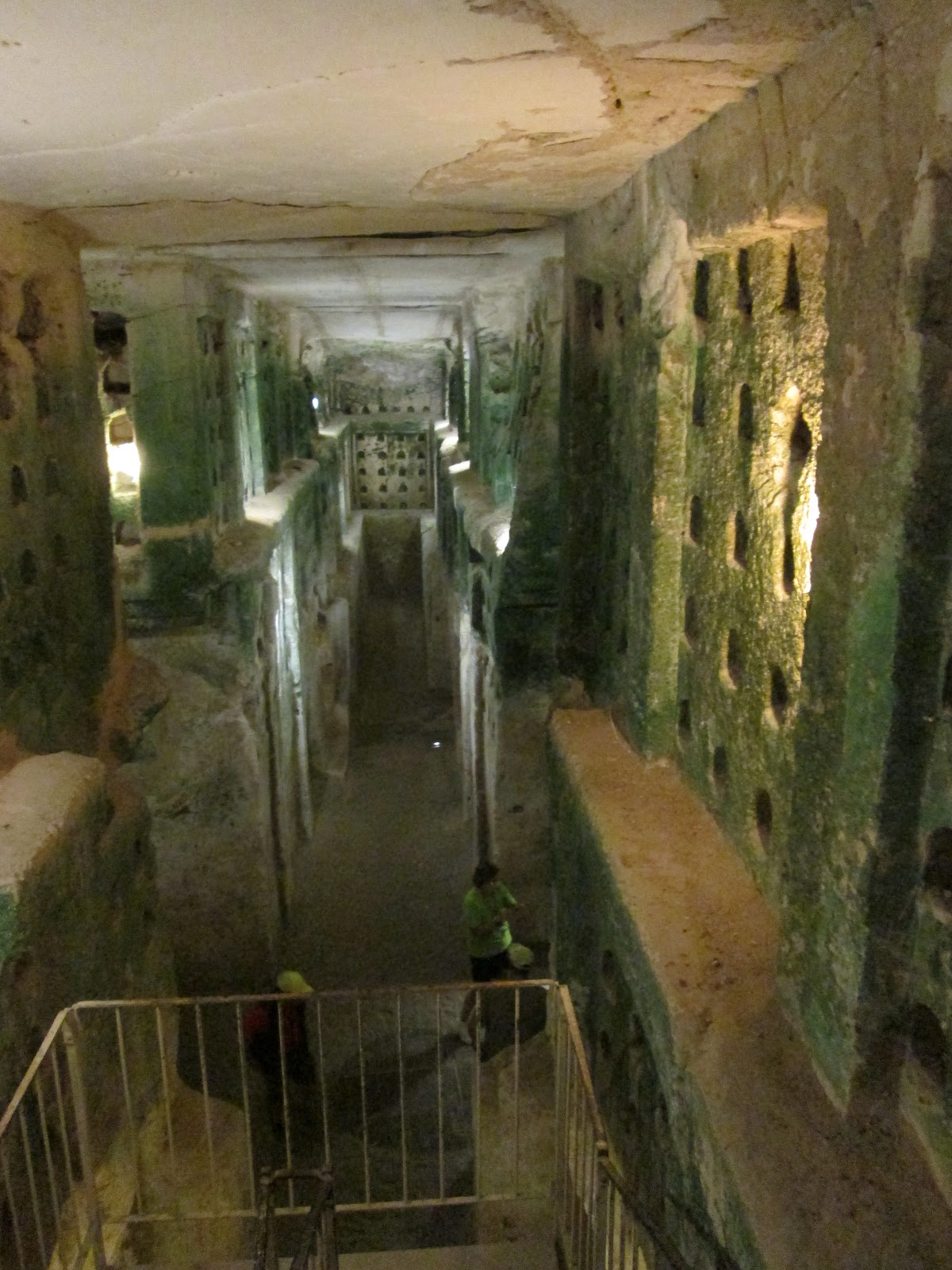
The Dove Farm at Beit Guvrin
When the people of Judah were away in captivity to Babylon, Nabateans, then Edomites (Idumeans), and finally Greeks entered the land in the Guvrin valley. These new people adopted the vacated olive groves (which originally drew them to the land), and brought with them textile and dove breeding industries which prospered in the valley.
   After the Maccabees came to power, Beit Guvrin and Maresha became a target for their new Hebrew state, because it was in the former territory of Judah. In battle they defeated the people who lived in the valley and once captured, Maresha became a regional capital for the Jews, who forcibly converted its inhabitants to Judaism. One of the Idumean inhabitants, Antipater, posed a challenge to the new Jewish rulers.
The Dove industry was large when Herod was a boy
Antipater was Herod’s father. History records he was a very rich, politically active, and seditious man who owned a great amount of property in Maresha (which is what the village was called at that time). He inherited these from his father, who carried the same name. Josephus wrote; ‘’Tis true, that Nicolaus of Damascus says, that Antipater was of the stock of the principal Jews who came out of Babylon into Judea. But that assertion of his was to gratify Herod, who was his son; and who, by certain revolutions of fortune, came afterward to be King of the Jews.” (Ant. 14.1.3)
The short stories in this book illustrate Herod's childhood

In my new book I develop a story about how the young boy Herod grew up in Maresha and received early training from his father in the textile and then the dove industry. He learned valuable lessons in leadership when his father placed in in management. The future king learned his cruelty by observing personality types while tending the doves his father owned. I share stories about how Herod’s childhood in Beit Guvrin and Maresha shaped events of the New Testament in my book, Israel: Stories for Your Journey, available on Amazon.com.

Tuesday, December 8, 2015

Ahab and Herod: builders

Kings like to build.  The larger and more ornate the building, the better.  To show off their building projects they hold huge banquets and parties.  They do this to show off how great they are.  Rulers have sought to preserve their names in construction projects since the days Nimrod built his tower.
Solomon once wrote: “I did great things: I built houses and planted vineyards for myself. I made gardens and parks, and I planted all kinds of fruit trees in them. I made pools of water for myself and used them to water my growing trees. I bought male and female slaves, and slaves were also born in my house. I had large herds and flocks, more than anyone in Jerusalem had ever had before. I also gathered silver and gold for myself, treasures from kings and other areas. I had male and female singers and all the women a man could ever want. I became very famous, even greater than anyone who had lived in Jerusalem before me. My wisdom helped me in all this.” (Eccl 2:4-9)
In today’s reading of Advent Journeys Joseph, the father of Jesus, comments on Ahab’s construction on the hill at Samaria.  Ahab built a number of palaces for himself, including the royal home overlooking the road Joseph probably used as he traveled to Bethlehem.  The palace and other buildings were decorated with ornate ivory carvings.  Ahab was quite a builder.  He erected numerous temples for himself or for his wife Jezebel.  He rebuilt other high places, such as the one in Dan, which was reconstructed over the high place of Jeroboam I.  Ahab desire for a safe kingdom produced fortifications in Megiddo, Hazor and Dan.  He is also credited with the massive water system at Megiddo with its 260 foot long tunnel.  The Bible notes in
King Herod, likewise was known for his building.  His most famous project was the Temple itself.  Herod’s Temple was larger than any of the other, but only lasted ninety years before being destroyed by Titus.  Herod also built (or re-built) fortresses for himself at Masada, Machaerus, Jericho, Herodium, Sebaste, Antonia.  He built Caesarea and other cities.  He reconstructed Abraham’s tomb in Hebron.  And Herod built many projects around the world including Olympic stadiums, Temples, Theaters and Hippodromes.
As a builder himself, Joseph probably admired these massive projects with innovations by each of the builders.  Joseph might have worked on some of these projects.  Some of the projects remain until this day.