Showing posts with label King Herod. Show all posts

Monday, May 7, 2018

The Shfela

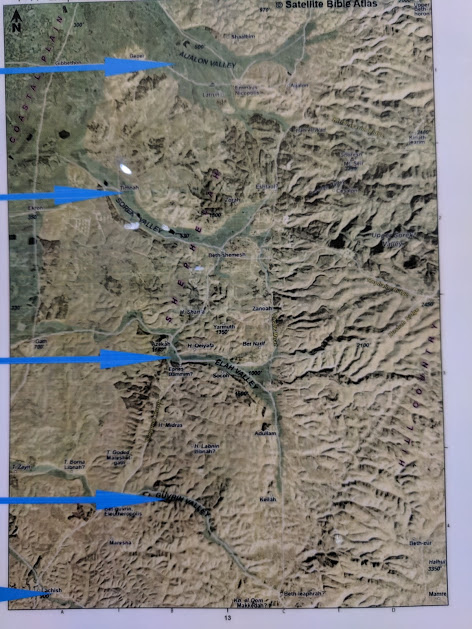
Today’s journey took us through the Shfela, or the low foothills between the Via Maris (way of the sea) and the Judean highlands. This would be similar to the foothills leading up to the mountains in North Carolina. All roads leading up to the interior highlands follow streams and valleys. Strong walled cities guard the entrance to each valley in order to control the travel corridor.
Five Valleys in Israel
The five valleys from north to south are the Ayalon, Sorek, Elah, Guvrin and Lachish valleys. The map above will show these clearly.
The Canaanite section of Tel Gezer
Our first stop of the day was at Tel Gezer, a site we are familiar with because Sarah participated in the dig for two years. (Video). Tel Gezer has a long history, with more than twenty levels within the tel. Gezer controls the Ayalon Valley. Excavations include a Middle Bronze period gate and water tunnel, and also a portion of the city from Solomonic times, when Pharaoh of Egypt gave the city to his daughter and his new son-in-law Solomon.
The Solomonic Gate at Gezer
From Gezer we traveled to Beit Shemesh in the Sorek Valley. This was the area where Samson lived. It is also the place where God returned the Ark of the Covenant to Israel after its capture by the Philistines. There is a new archeological dig at this site.
New Digs at Beit Shemesh
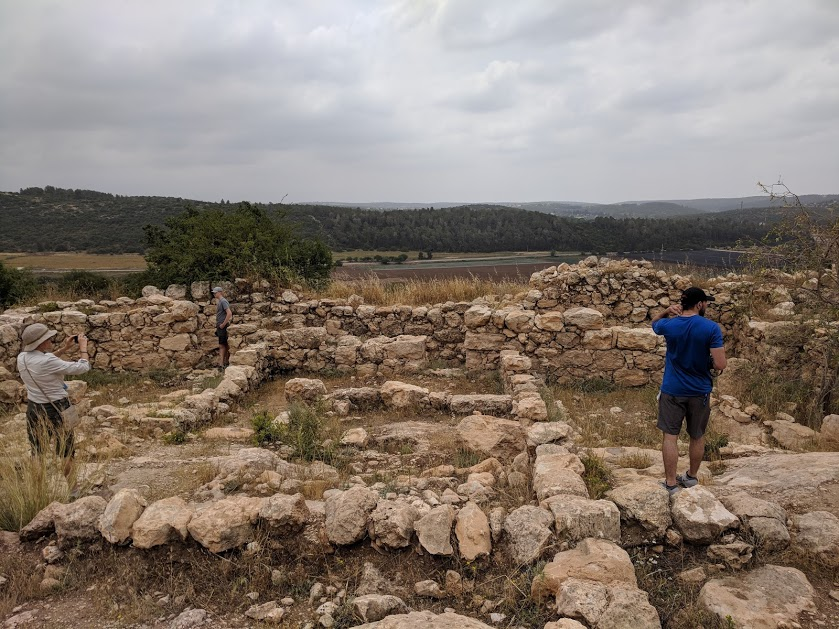
We then visited the Elah Valley, where a boy named David fought the giant Goliath. We were able to get a good view of the valley from Shaaraim or Shaaraim, a city with two gates which dates to the time period of King David. Our guide laid out the entire battle plan so we could see exactly where events took place.
Shaaraim, a village of Two Gates
We visited Gath, the city protecting the Elah Valley. This city is also the hometown of Goliath. It is a massive tel with a long history.
The Philistine Village of Gath
Our journey continued with a stop at Beit Guvrin, this is were King Herod grew up. There are multiple columbarium (caves for doves) that are carved out of the chalk to produce underground caves.
Dove Housing at Beit Guvrin
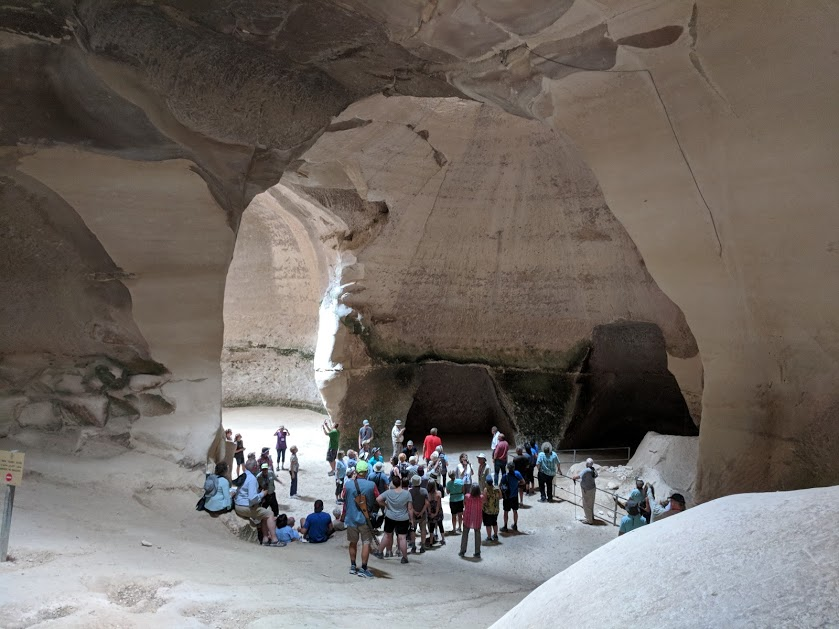
There are also massive caves left behind from the mining of chalk. These bell shaped caves are very beautiful and have great acoustics.
The Bell Caves at Maresha

We finished the day at the motel in Beer-Sheva.

Saturday, July 30, 2016

Sharing Jericho from our tour in Israel

Recently I taught Adult Vacation Bible School at Fairview Baptist Church. The lessons were simple, and well known: Zacchaeus (little man up in a tree), Samaritan Woman (came to the well), Nicodemus (came to Jesus at night), Blind Bartimaeus, and Jesus’ rebuff to his disciples of “Let the children come to me.”
Fairview Baptist Church, Statesville, NC
The group I was teaching was well versed in the scripture, and I knew some of them had studied the Bible stories twenty or more times. I did not feel comfortable moving away from the curriculum lessons, so I prayed, and the Lord showed me how to teach the all too familiar lessons in a different way.
Ben Gurion Airport on our 2012 trip to Israel
The inspiration came because of my recent trip to Israel. I could see, feel, and hear elements of the Bible stories through my experiences at the locations and on the very streets these events took place.  I decided to take my class “on location” so they could experience the stories also.
"Elisha's Well" in Jericho
For the first lesson I brought my class to the well in Jericho, Israel. As we sat facing the well, I told them how important water was for the land of Israel. Elijah had visited this well and healed its waters.
Bedouin village in Jordan. Mt. Nebo is in the background
Not only had Elijah visited Jericho, but also Joshua as Israel was entering the land. The people came down from the mountains of Nebo and crossed the Jordan River (on a familiar trade route). They prayed at Gilgal, and then approached the walled city of Jericho.
Excavated walls of Jericho. Notice the different types of walls.
After marching around the walls seven times, the walls fell down. They gave the first city taken in the land as a “first fruits” offering totally dedicated to God. Only Rahab and her family were saved.
Date Palm farm south of Jericho near the Dead Sea
I showed the class that Jericho is in a rich agricultural valley. In addition to commercial opportunity which came from Jericho sitting on the trade routes, they raised sheep, camels, dates, bananas, and other produce. Taxes were collected on each commodity and at every opportunity.
A village in Jordan Valley. Olive Trees in foreground.
The amenities of Jericho drew the richest people in the world. Jericho is well below sea level, so winters are mild.  The air is dry and allergies are few. Herod had a palace in Jericho and Cleopatra had business interests in the area.
Ruins of King Herod's Winter Palace in Jericho
Zacchaeus was the Roman-backed IRS. Within the lessons monologues were given by the toll collectors on the roads, the agricultural tariff takers, the commercial tax agents who received a portion of goods sold, and the real estate tax assessors. All of these “publicans” worked for Zacchaeus, the chief tax collector. He was very rich.
Camel for Tourists entering Jericho
The Bible tells us Jesus entered Jericho from the north. As he approached the city gates a blind man called out for healing. Jesus healed him before entering the city. As the report of the healing spread through the city gates, Zacchaeus heard. Because he was short, he could not fight the crowd and climbed up in a Sycamore tree (the saviour he wanted to see).
Perhaps Zacchaeus climbed a tree like this in Jericho city square
Jesus called him down, and ate lunch at his home that day. The discussion at the home of Zacchaeus is not recorded in the Bible, but the results are. This man of wealth, who in a sense lorded over the people of Jericho, gave half of his wealth to the poor. Then he restored fourfold all that he had taken illegally.
Class members shared with me what they received from the lesson. My journeys to Israel enabled me to share the old story in a refreshing way. Can a trip to Israel refresh and bring a new sense of reality to your understanding of God’s word?
Join me next time
I am planning a trip to Israel in 2018, probably in June. To accomplish this I need 45 people who will travel with me to Israel. The cost will be about $5,000 per person (start saving money now)! … Let me know you are interested … and I will put you on the mailing list (no obligation at this point).
I will let you know through e-mails the steps in the planning process. If you are interested, you can help confirm the date (June 2018), or help set another date. I will be asking along the way what you want to see in Israel. Over the next year (until March 2017) I will be collecting ideas in order to plan. Then I will be talking to an experienced tour leader who will help put the trip together. (The price and plans will be complete about a year before the trip). My e-mail is KosherCopy@gmail.com. (Write to let me know you are interested, or to ask questions).
I will let you know of other plans as they develop, such as a potential add-on dig in the land, or an add-on side trip. What I need now is simply people who are interested (no obligation) and ideas for the trip.

Tuesday, December 8, 2015

Ahab and Herod: builders

Kings like to build.  The larger and more ornate the building, the better.  To show off their building projects they hold huge banquets and parties.  They do this to show off how great they are.  Rulers have sought to preserve their names in construction projects since the days Nimrod built his tower.
Solomon once wrote: “I did great things: I built houses and planted vineyards for myself. I made gardens and parks, and I planted all kinds of fruit trees in them. I made pools of water for myself and used them to water my growing trees. I bought male and female slaves, and slaves were also born in my house. I had large herds and flocks, more than anyone in Jerusalem had ever had before. I also gathered silver and gold for myself, treasures from kings and other areas. I had male and female singers and all the women a man could ever want. I became very famous, even greater than anyone who had lived in Jerusalem before me. My wisdom helped me in all this.” (Eccl 2:4-9)
In today’s reading of Advent Journeys Joseph, the father of Jesus, comments on Ahab’s construction on the hill at Samaria.  Ahab built a number of palaces for himself, including the royal home overlooking the road Joseph probably used as he traveled to Bethlehem.  The palace and other buildings were decorated with ornate ivory carvings.  Ahab was quite a builder.  He erected numerous temples for himself or for his wife Jezebel.  He rebuilt other high places, such as the one in Dan, which was reconstructed over the high place of Jeroboam I.  Ahab desire for a safe kingdom produced fortifications in Megiddo, Hazor and Dan.  He is also credited with the massive water system at Megiddo with its 260 foot long tunnel.  The Bible notes in
King Herod, likewise was known for his building.  His most famous project was the Temple itself.  Herod’s Temple was larger than any of the other, but only lasted ninety years before being destroyed by Titus.  Herod also built (or re-built) fortresses for himself at Masada, Machaerus, Jericho, Herodium, Sebaste, Antonia.  He built Caesarea and other cities.  He reconstructed Abraham’s tomb in Hebron.  And Herod built many projects around the world including Olympic stadiums, Temples, Theaters and Hippodromes.
As a builder himself, Joseph probably admired these massive projects with innovations by each of the builders.  Joseph might have worked on some of these projects.  Some of the projects remain until this day.

Friday, December 4, 2015

Courses of Priests & Retirement age

I find as I talk to people many do not understand the organization or the purpose of the Temple in Jerusalem.  We want to relate the Temple to something familiar in our world, to the church.  But the Temple was not the church. The Temple was the place of prayer and sacrifice.
In our world there are many churches and many denominations.  In the world of Jesus’ time there was one … and only one Temple.  The Temple was located in Jerusalem on Mount Moriah.  The Temple was the most important institution in Jewish life, instituted by God in the days of Moses, and built first by Solomon, and rebuilt by Zarubabel and then by King Herod.  While there were many synagogues, there was one … and only one Temple.
In our world we go to church on Sunday, or as the Jews refer to Sunday, the first day of the week.  We attend church on Sunday to worship God and to remember that Jesus arose from the grave on the first day of the week.  The Jews go to Synagogue on the seventh day (Sabbath).  They go to the Temple when needed.  The scripture specifically instructs, “Three times a year all your men must appear before the LORD your God at the place he will choose: at the Festival of Unleavened Bread, the Festival of Weeks and the Festival of Tabernacles. No one should appear before the LORD empty-handed:” (Dt 16:16)  The Jews also go to the Temple to make a desired or required sacrifice (See Leviticus 1-7).  Some would go regularly for prayer.
In our world we sing hymns and worship, and the same could be done in the Temple.  There was not a real song leader or time of singing, however, some of the priests who were musicians would stand between the Court of Israel and the Court of the Women to sins Psalms to the people.  There were prescribed Psalms people sang as they ascended to the Temple, prescribed daily psalms sung by the priests, and other psalms people would sing in worship.
In our world we hear a pastor or a priest give a sermon.  In the Temple there was no sermon, that is not what the Temple was about.  The Temple was a place of sacrifice.  People would come, and give their offerings to the priest.  They could not enter the Holy Place, only the priests could enter.  The people stayed outside.  The people prayed.  They heard music if the priests were singing.  Occasionally there were men, such as Peter, who came to the Temple courtyard and preached.  But it was a sideline activity.  The main purpose of the Temple was to give offerings to God and to pray.
In our world the pastor is called by the church or sent through the denomination.  In the days of Jesus there were no denominations.  We read of the Saducees, they served the Temple.  We read of the Pharisees, they were lawyers, and worshipped in the Synagogues.  The Essenes were a monastic group who lived in their own communities.  And there were the Jewish people who connected with the Temple (because the law of Moses ordered this), and the Synagogue, which was a community of faith near their home.
In our world pastors can and do move.  In the times of Jesus the Priesthood was by birth.  Men were not called to go to a church, they were born into their place of service.  Father passed on to son the traditions of the faith and the practice of the priesthood.  Men served between the ages of 25 and 50.  After 50, men retired and would mentor younger priests.
Through Advent Journeys you will visit a world which is very different that our world.  The world of Jesus is worth reading about and studying, for in so doing you understand Jesus, the people around him and the New Testament in a much fuller way.