Showing posts with label Zechariah. Show all posts

Thursday, December 1, 2016

The Temple’s Missing Item

The priests performed many tasks in the Temple. We attempt to relate these tasks as Zechariah might have perceived them in our book Advent Journeys. Zechariah served many roles during his twenty-five years of active service before retirement. In all, and even with even with the politics and toil which comes with a heavy work cycle, Zechariah never lost his zeal.
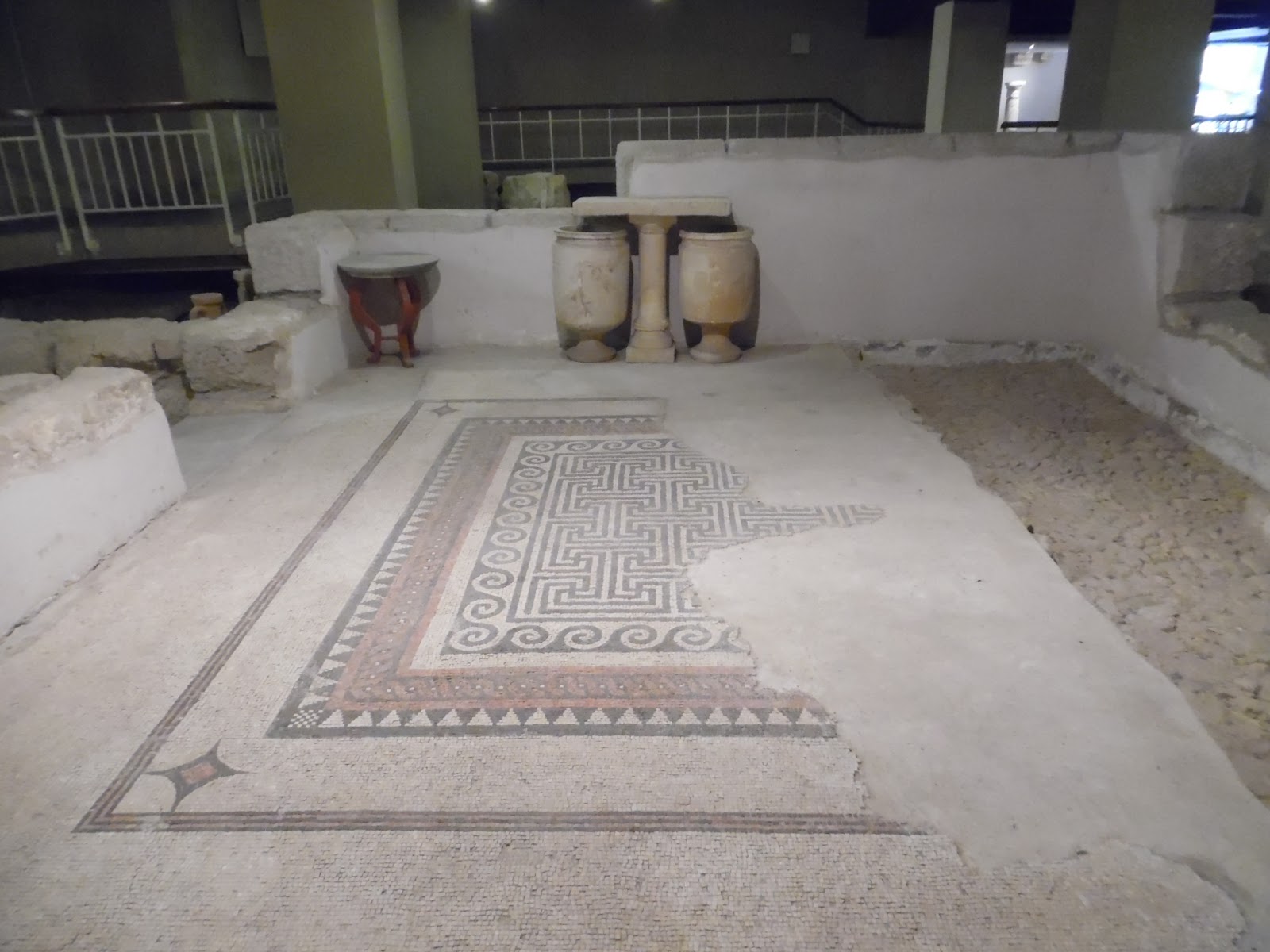
Looking int the Tower of David Museum
With all of its magnificence (see the previous two blog posts) and all of its organization, the Temple of Zechariah lacked one thing. The most important piece of furniture, the throne of God, the box which was called the Ark of the Covenant, was missing. This box which held Israel’s treasures: the Ten Commandments, Aaron’s rod and a jar of manna, was sacred and the place where in history God had resided. The Ark of the Covenant had gone before Israel in battle and it was the first item brought to Jerusalem for Solomon’s Temple.
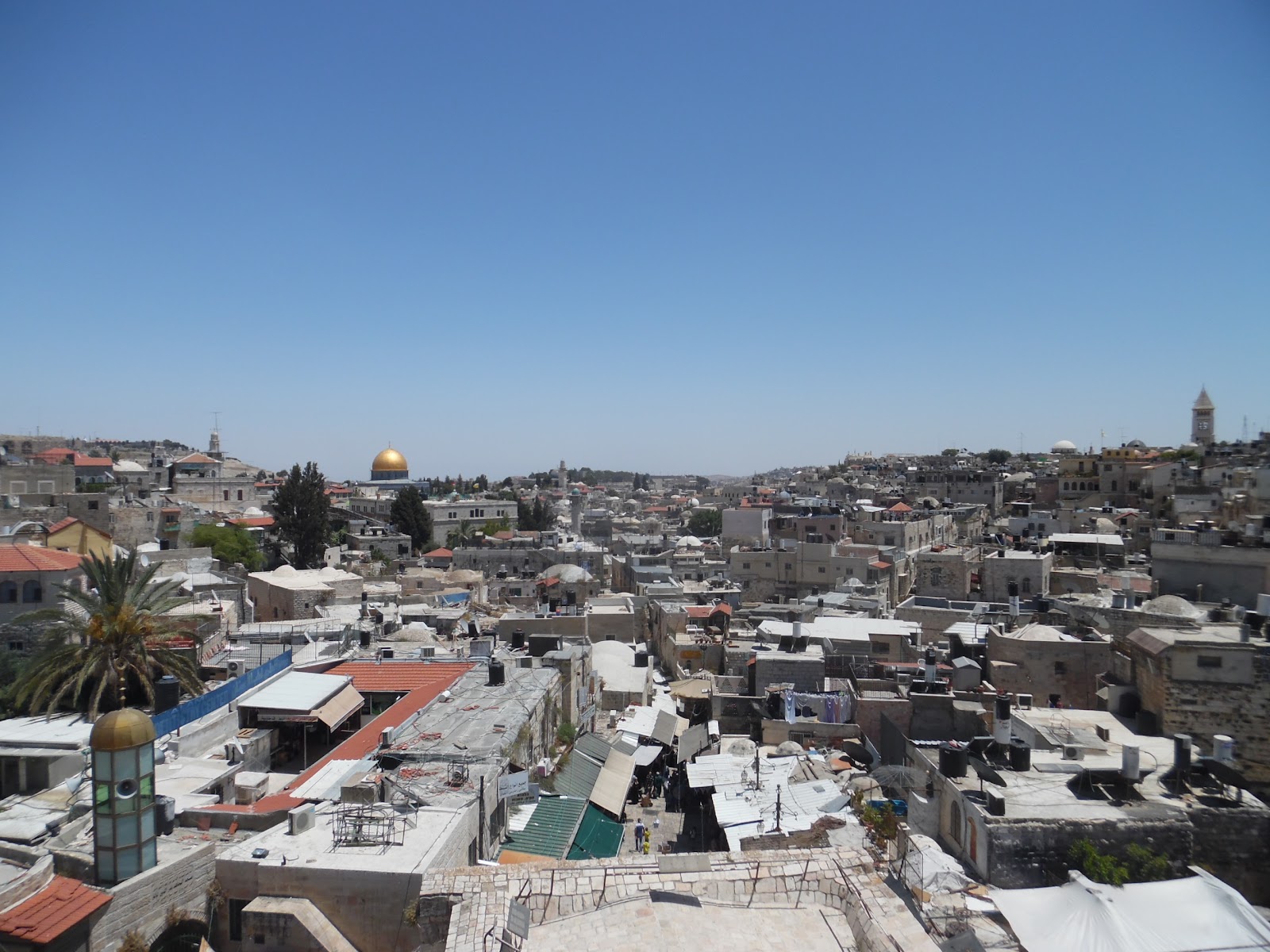
Jerusalem from the Ramparts Walk
The Ark of the Covenant with the Mercy Seat upon it was the place where the High Priest was to place the blood from Israel’s atonement offering each Yom Kippur. But in the days of Zechariah it was missing, and every priest was aware of this fact. One priest wrote: “After the Ark was taken away a stone remained there from the time of the early Prophets,” and it was called ‘Shetiyah’. It was higher than the ground by three fingerbreadths.”
Temple Mount from Ramparts Walk
Another priest said: “Once when a priest was occupied he saw a block of pavement that was different from the rest. He went and told it to his fellow, but before he could make an end of the matter his life departed. So they knew assuredly that there the Ark lay hidden.”
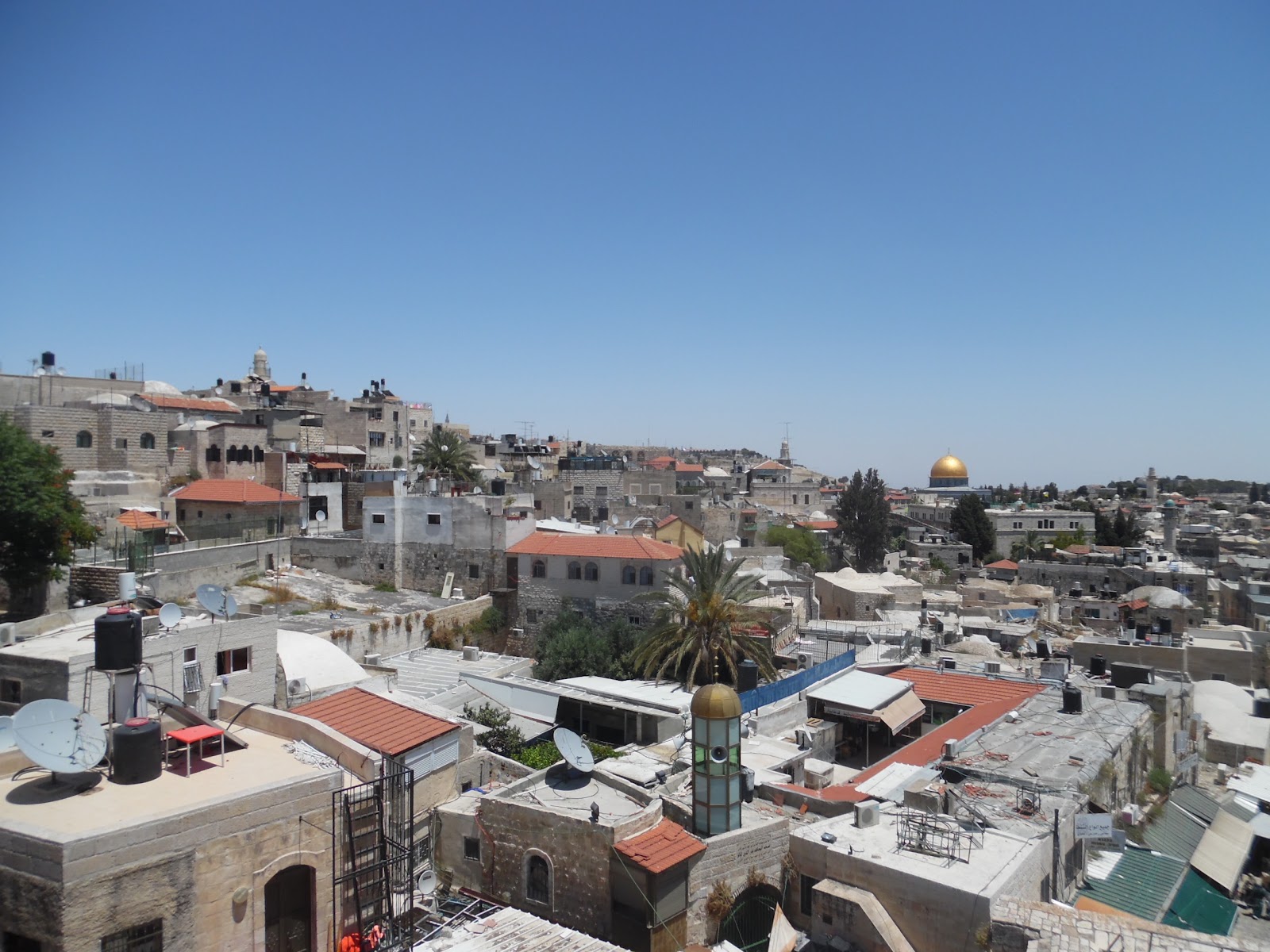
Jerusalem from Tabtznik Park
The Holy of Holies remained important even without the Ark of the Covenant. The High Priest continued to go in every year on the Day of Atonement. He would sprinkle the blood on the place where the Ark of the Covenant had been placed before. To a priest of a lower level, like Zechariah, the Altar of Incense was the closest he could come to the Holy of Holies. It was at this place that the Angel met him and announced that he and Elizabeth would have a son.


Tuesday, November 29, 2016

Temple Days of Service

Zechariah the Priest looked forward to serving the Lord at the Temple each time the opportunity afforded itself, which was about five weeks per year. The journals in the book Advent Journeys attempts to share Zechariah’s passion and dedication for the Lord’s work.
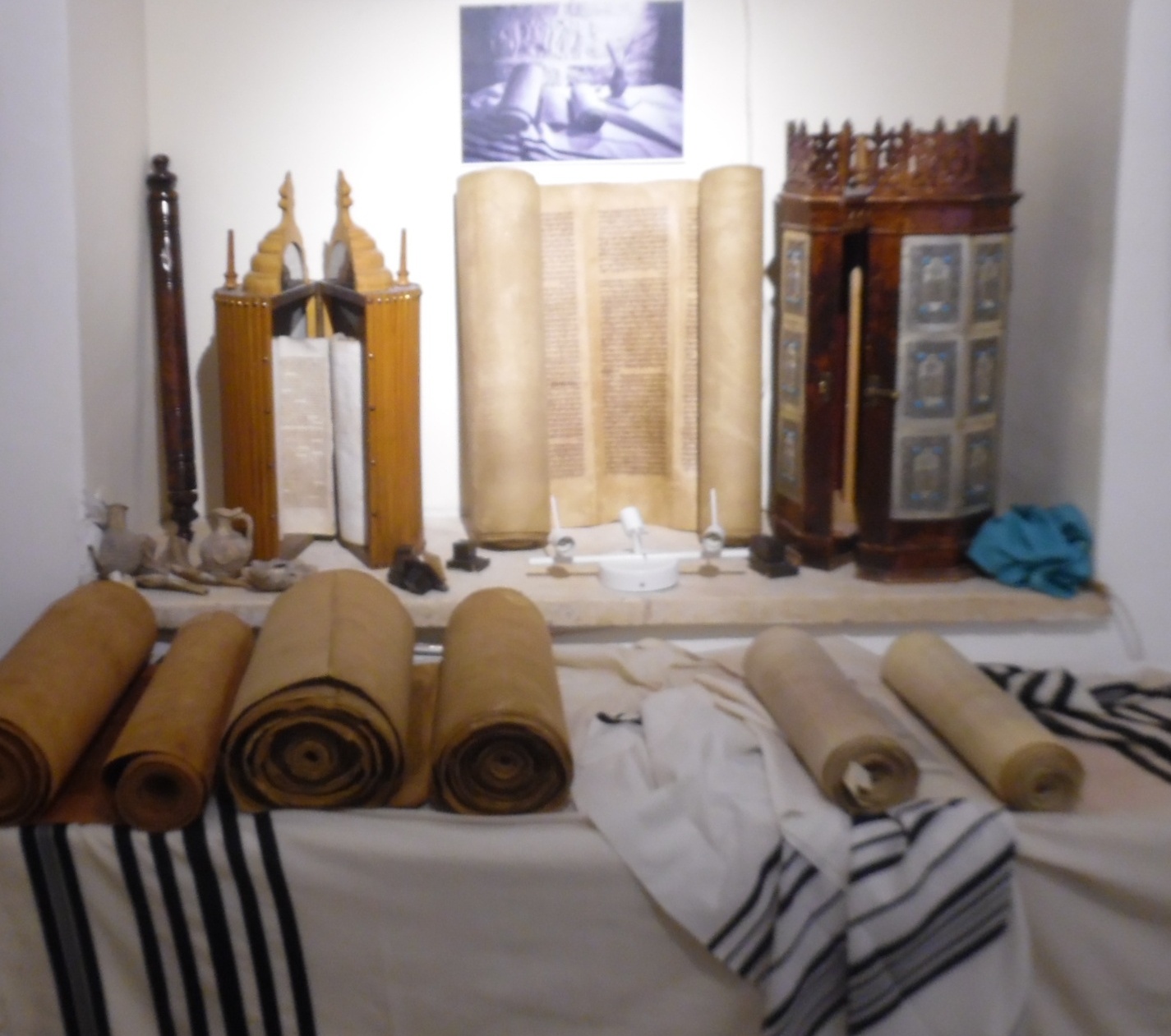
Scrolls inscribed by a Sofer
The scripture relates to us as background the manner in which Israel’s priesthood is organized. At first, in the days of Moses, there were four divisions created in order to setup, tear down and carry the Tabernacle as it traveled across the wilderness. Once the Tabernacle became a permanent fixture in Shiloh, the priests were not needed for transportation. We can almost sense in 1 Samuel that common priests ceased to serve in the Tabernacle under Eli and his sons.
Temple Mount with Mount of Olives behind
In the establishment of the Temple in Jerusalem by King David, the orders of Priesthood were reestablished, and increased to twenty-four orders. The names of each of these orders can be seen in 1 Chronicles 24-26.
Home of one of the High Priests
King David assigned some priests as gate-keepers: some to give the offering, some to cook meals and some for administration. David also organized Temple musicians, who shared their gift of music for generations.
Home of one of the High Priests
As the population of Israel grew, so did the priesthood. With the establishment of a permanent structure, all priests were not needed every week, so a system of rotation called Mishmarot and Ma’amadot was set up. All priests would serve during the three harvest festivals, and then in rotation once every twenty-four weeks. The scripture tells us Zechariah was a Priest of the order of Abijah.


Saturday, November 26, 2016

Elizabeth at Home

In writing the words of Advent Journeys I came to thoroughly enjoy taking walks with the Biblical characters themselves. One of the couples I enjoyed visiting with the most was Elizabeth and Zechariah, the parents of John the Baptist. By tradition this couple lives in Beth Hakkerem (then Jer. 6:1; Neh. 3:14), or Ein Karem (today).
Over this wall we see the valley through which Joseph traveled
I first met this couple on Joseph’s trip (which occurs in the book on Week 2, but I wrote it first) as Mary came to visit her cousin when she finds out she is pregnant. As Joseph and Mary travel to Bethlehem, they visit Zechariah and Elizabeth along the way. Ein Karem is one of the Levitical cities located about five miles from Jerusalem.
The map of Joseph & Mary's route on right
Ein Karem is on the west side of a mountain which separates it from Jerusalem proper. In order to get there from Jerusalem on our travels in Israel, we took the light rail to the top of Mt. Herzl, and then transferred to a bus which took us down a long descent into the village. From the village we could see the ancient travel paths through a valley from the north and a valley which extended west, then south and finally to the east on the other side of the mountain. The terrain around the village is mountainous.
In front of Church of the Visitation in Ein Karem
The village today is small (considering its location as a suburb of Jerusalem), with a population of about 2,000 people. In the days of Zechariah and Elizabeth, there would have been less than 200 people.
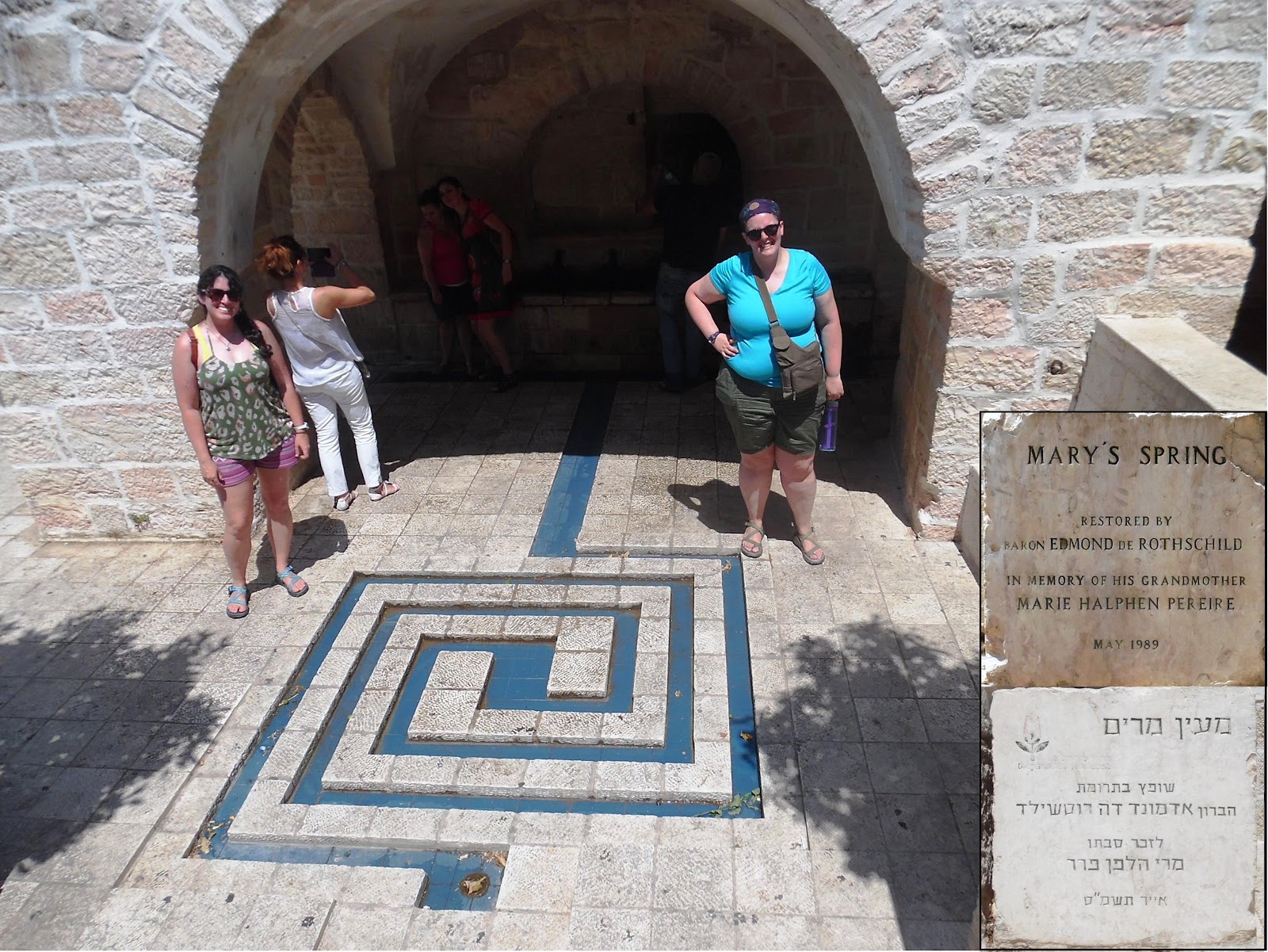
Today it is said Ein Karem hosts about three million visitors per year. They come to see the village where John the Baptist grew up. They visit the spring where Elizabeth came out to greet Mary. They enter the Church of the Visitation, the Church of St. John the Baptist, the monastery of Les Soeurs de Notre-Dam de Sion, and the Moscobia Convent. The churches are very beautiful, and the small village descending from the spring into the valley speaks of the rural setting of John the Baptist’s nativity.
Mary's Well in Ein Karem
After ascending to the Church of the Visitation we stopped in a grocery to buy soft drinks and watch the pilgrims parading through the streets from one church to another. But through the crowds we could enjoy the quietness of what this village was in the days of Zechariah and Elizabeth, Mary and Joseph, and the two boys who every once in a while played on the dirt roads and in the spring.


Friday, June 17, 2016

Israel Adventure - Day 9

We began our morning drinking coffee with Dr. Kalman, the professor from Hebrew Union accompanying the group, on Ben Yehuda Street (a modern pedestrian shopping district in Jerusalem). The time was a casual pre-orientation. During the meeting we were serenaded by a saxophone playing on the mall (including Rebbe Elimelech and Eliyahu HaNavi). Dr Kalman just arrived, and most of the group was getting over jetlag. He gave us some details of what we are doing today and the next few days.
Following coffee he took us to the pedestrian grocery shuk (market), Mechane Yehuda, a few blocks away. We visited a crowded pre-Shabbat market with every kind of food available. We purchased halva and cherries. We also heard a man playing the electric guitar as we waited for the group to finish shopping.
After shopping we parted ways with the group, taking the light rail to Mt. Herzl. There is a cemetery there for Israel’s heroes. Theodor Herzl is buried at the top of the mountain, over which the views are spectacular.
We boarded a bus from there to Ein-Kerem, the home town of Zechariah and Elizabeth. As we rode through the terrain and entered the village I thought about my book Advent Journeys, which in Week 2 looks at the route Zechariah the Priest and Joseph, the father of Jesus, travel to the Temple.  I could clearly pick out the route.
The village is in a valley formed by a spring, called Mary’s Spring, where water is constantly running. Above the spring we walked up the mountain to the Church of Visitation. We saw many other pilgrims also visiting the church. We also visited the church of St. John the Baptist, a Franciscan mission. We took a break at a nearby shop and drank Coke while watching pilgrims making their way to the Catholic sites in the area.
From Ein-Kerem we took the light rail back to the Damascus gate. We entered Jerusalem; it was crowded and noisy. It was Ramadan and also Erev Shabbat (the evening Sabbath begins). Shopkeepers were announcing their wares. Many women in their Burkas were in the streets. We made our way through the Old City to the Jaffa Gate, where we crossed the street and entered a park. In the park there were fountains and children playing. It was a hot day and the Sabbath.
We continued past the Artists’ Colony (closed for Sabbath) to the Windmill and Lion’s fountain. Chelsea and Sarah had fun walking in the water. Then we came home.
After a rest at home we visited Shira Hadasha Synagogue, a Modern Orthodox place of worship about one block away. Most of the worship liturgy was sung. Worship held our attention (even though it was in Hebrew), and was a great way to end the day.

Thursday, December 10, 2015

Levitical Villages

“The Lord spoke to Moses in the plains of Moab by the Jordan across from Jericho, saying: “Command the children of Israel that they give the Levites cities to dwell in from the inheritance of their possession. … Each shall give some of its cities to the Levites.” - Leviticus 35:1-8
Before entering the land of Israel, Moses made sure to give the Levites (ministers) land from each of the other tribes.  Moses was told to make sure no tribal group was left out, and no tribe could begrudgingly not give some land to the Levites, the tribe of Priests.  God did this because He wanted to make sure in a very visual way His presence was spread to each of the tribes of Israel.
Some of the Levitical villages become important within the land of Israel.  The heritage of Abraham was felt in Hebron (Kirjath Arba).  Jacob’s name was honored in Shechem.  Many in the line of the High Priest, including Jeremiah, came from Anathoth.  The ark of the covenant was returned to Beth Shemesh.  By tradition John the Baptist was born in Beth HaKerem.
Six of the Levitical cities Kedesh, Shechem, Hebron, Golan, Ramoth, and Bosor were named as cities of refuge.  The Levites in these cities acted with mercy as protectors, and with skill as lawyers and judges to discern who was truly guilty and who should find freedom, forgiveness or grace.
The Levites, while they lived among the people were not to blend with the people.  They were to maintain and remember their purpose: to serve as priests for God.  These men were to serve in the Temple according to their time.  King David set up courses so each group of priests would know when to go to Jerusalem.  All Priests served during the three harvest festivals of Pesach, Shavuot, and Sukkot.  By rotation they served two additional weeks per year, making five weeks of service total.
The book Advent Journeys takes a look at how Zechariah, the father of John the Baptist serves in the Temple.  Much of the information in this book comes from the Jewish Mishnah, the oral tradition which was written down by the generation impacted by the destruction of the Temple.
As the Levitical cities served a purpose for the people of Israel, we, as people of faith are to serve a purpose in our communities and villages.  Moses said, “if you will indeed obey My voice and keep My covenant, then you shall be My own possession among all the peoples, for all the earth is Mine; and you shall be to Me a kingdom of priests and a holy nation.” (Exodus 19:5-6; see also Deuteronomy 7:6, 26:19).  Peter repeats this for Christians in 1 Peter 2:9-10.

Friday, December 4, 2015

Courses of Priests & Retirement age

I find as I talk to people many do not understand the organization or the purpose of the Temple in Jerusalem.  We want to relate the Temple to something familiar in our world, to the church.  But the Temple was not the church. The Temple was the place of prayer and sacrifice.
In our world there are many churches and many denominations.  In the world of Jesus’ time there was one … and only one Temple.  The Temple was located in Jerusalem on Mount Moriah.  The Temple was the most important institution in Jewish life, instituted by God in the days of Moses, and built first by Solomon, and rebuilt by Zarubabel and then by King Herod.  While there were many synagogues, there was one … and only one Temple.
In our world we go to church on Sunday, or as the Jews refer to Sunday, the first day of the week.  We attend church on Sunday to worship God and to remember that Jesus arose from the grave on the first day of the week.  The Jews go to Synagogue on the seventh day (Sabbath).  They go to the Temple when needed.  The scripture specifically instructs, “Three times a year all your men must appear before the LORD your God at the place he will choose: at the Festival of Unleavened Bread, the Festival of Weeks and the Festival of Tabernacles. No one should appear before the LORD empty-handed:” (Dt 16:16)  The Jews also go to the Temple to make a desired or required sacrifice (See Leviticus 1-7).  Some would go regularly for prayer.
In our world we sing hymns and worship, and the same could be done in the Temple.  There was not a real song leader or time of singing, however, some of the priests who were musicians would stand between the Court of Israel and the Court of the Women to sins Psalms to the people.  There were prescribed Psalms people sang as they ascended to the Temple, prescribed daily psalms sung by the priests, and other psalms people would sing in worship.
In our world we hear a pastor or a priest give a sermon.  In the Temple there was no sermon, that is not what the Temple was about.  The Temple was a place of sacrifice.  People would come, and give their offerings to the priest.  They could not enter the Holy Place, only the priests could enter.  The people stayed outside.  The people prayed.  They heard music if the priests were singing.  Occasionally there were men, such as Peter, who came to the Temple courtyard and preached.  But it was a sideline activity.  The main purpose of the Temple was to give offerings to God and to pray.
In our world the pastor is called by the church or sent through the denomination.  In the days of Jesus there were no denominations.  We read of the Saducees, they served the Temple.  We read of the Pharisees, they were lawyers, and worshipped in the Synagogues.  The Essenes were a monastic group who lived in their own communities.  And there were the Jewish people who connected with the Temple (because the law of Moses ordered this), and the Synagogue, which was a community of faith near their home.
In our world pastors can and do move.  In the times of Jesus the Priesthood was by birth.  Men were not called to go to a church, they were born into their place of service.  Father passed on to son the traditions of the faith and the practice of the priesthood.  Men served between the ages of 25 and 50.  After 50, men retired and would mentor younger priests.
Through Advent Journeys you will visit a world which is very different that our world.  The world of Jesus is worth reading about and studying, for in so doing you understand Jesus, the people around him and the New Testament in a much fuller way.

Thursday, December 3, 2015

The Place of Elijah in Jewish Tradition

Elijah is a favorite Bible character for every Jewish child and most adults.  He is often remembered most quickly as the person of the fifth Passover cup, for near the end of the Passover observance children get up from the dinner table, open the door of their home for the prophet to enter and when they return to the Seder table they find Elijah has come and drank a once full cup which was especially prepared for him.
In the process of this observance the Passover leader explains that Elijah is a Bible hero who never died, and he was one of only two people ever taken alive to heaven.  He rode to heaven, according to 2 Kings 2:11, with a chariot of fire and a whirlwind.  Because Elijah is alive, and never died, he can come back to earth.  And Elijah returns in order to alleviate poverty, save people from troubles, and to answer difficult questions for the Rabbis.
The Talmudic tractate Kiddushin [40a] that tells about the virtue and the poverty of a certain Rabbi Kahana. He told a powerful woman who had made advances toward him that he had to get himself ready for their tryst; instead he went up to the roof and hurled himself off to avoid sinning. Enter Elijah, who caught him and then reproached him: "You have troubled me to come a long distance to save you." When the rabbi replied, "I was forced to do it due to my poverty," Elijah gave him a basketful of dinars.
Elijah was a prophet who was not afraid to speak for God.  He spoke openly to King Ahab and Queen Jezebel about their sins.  As a result of their sins Elijah told them (and it was fulfilled) it would not rain in Israel for three and a half years.  He also challenged the prophets of Baal to call down fire from heaven.  Elijah won the challenge.  Elijah cared for the poor, feeding a poor widow.  He also raised the dead.  He was a great prophet.
At the end of the Old Testament in the book of Malachi there is a prophecy about Elijah which says, “But I will send you Elijah the prophet before that great and terrifying day of the Lord’s judging. Elijah will help parents love their children and children love their parents. Otherwise, I will come and put a curse on the land.”
It is through these traditions that the Jews and many Christians believe Elijah will return.  He will return to announce the Messiah, and it is believed he will return at the end of time.  As Moses is a representative of the law, Elijah is the representative of the prophets.
The tradition of Elijah was recognized in the New Testament, for Matthew 17 says,  “Jesus took Peter, James, and John, the brother of James, up on a high mountain by themselves. While they watched, Jesus’ appearance was changed; his face became bright like the sun, and his clothes became white as light. Then Moses and Elijah appeared to them, talking with Jesus.
Zechariah the priest of whom we are reading today in Advent Journeys was told by the Angel Gabriel that his wife would give birth to a son, and Zechariah was to name him John.  The angel further told Zechariah, “ He will help many people of Israel return to the Lord their God. He will go before the Lord in spirit and power like Elijah. He will make peace between parents and their children and will bring those who are not obeying God back to the right way of thinking, to make a people ready for the coming of the Lord.
Jesus says of John the Baptist: “Truly I say to you, among those born of women there has not arisen anyone greater than John the Baptist!  … And if you are willing to accept it, John himself is Elijah who was to come. He who has ears to hear, let him hear.” (Matthew 11)

Wednesday, December 2, 2015

The joy of a child: Sarah, Hannah & Elizabeth

It can well be said that the birth of a child changes a person’s life.  The birth of my daughters Chelsea and Sarah has added an irreplaceable dimension to my life.  This dimension is more than the miracle of the little face with it’s eyes looking up at me (and me into those little eyes with wonder), or the ten little fingers which eventually grasped my index finger as they reached out in trust, or even the body which was born as a human wiggling as it showed of the life within.
The change in my life is more than the routine which was abruptly changed by those cries in the night to be fed or changed.  It was more than the new room we prepared in our home; but rather the change came through the new room which was formed in my heart for these little lives which God entrusted to Denise and I.
These lives were but a beginning, yet unshaped and unlearned, waiting to be taught and shown what life is all about.  In the early days my daughters trusted. ANd I gave all that I could so they would learn the things they needed in order to survive and to thrive in the world.
Then as life went on they taught me.  Even from the young age of three or four, they were teaching … for they kept asking, “Why?”  and I was forced to think to see if I could answer.  And as I sought the answers, I learned and I grew.  And as I loved and gave more and more of myself to keep up with their growth, God used this sacrifice to teach and shape me more into the image of who He desired me to become.
My daughters grew, and were shaped even more: not only by my teachings, or those of my wife, but through teachers at school and at church, by family, friends and neighbors, and by life itself.  And most of all (because we prayed) by God.  And my daughters grew to love God and seek His ways for their lives.  And we all learned.
In these more recent days, we have worked together.  We have written books.  First our Passover books: Spring and our Hagaddah.  And more recently Advent Journeys, a book about Christmas.
My daughters are the future, for they will live beyond my life.  They have brought the same joy as experienced by Adam and Eve as their children were born, or by Abraham and Sarah when Isaac was born, or by Isaac and Rebecca as Jacob and Esau came into this world.  They brought as much joy to Denise and I as Isaac, Samuel and John the Baptist brought when born in old age (although Denise and I were not that old).  The miracle of birth is an occurrence which will change your life.
And the more you let it change your life, the greater the reward.

Tuesday, December 1, 2015

Chosen by Lot: Isaiah 6

The Bible, New Testament and Old Testament, contains a wonderful mosaic of wonderful interconnected passages.  Many people miss these connections due to lack of familiarity with the wide scope of scripture passages, through skim over and get through reading style, or because of cultural or doctrinal limitations.  But God wants us to see where dots connect and stories correspond.  The interrelationship between Old and New Testament is a source of seeing the truth and authority of a book given by God.
The first chapter of Luke is a great example of an interconnected passage which is an easy skim over to an untrained eye; but a passage of great depth both culturally and spiritually to anyone who desires to dig deeper.
The passage begins with what appears to be a simple priest … but even with the first glance, the reader understands there could be more!  “There was a priest named Zechariah.” Yes, that name is familiar, for Zechariah is one of the final prophetic books of the Old Testament.  Zechariah the prophet tells of the future which includes the coming of the anointed one, the messiah.  Zechariah the priest forms the connection, for the name Zechariah means “God has remembered.”
Zechariah is of the order of Abijah, one of twenty-four courses into which the priesthood is organized.  Week one of the book Advent Journeys gives a bit more information on this organization and what it means for the New Testament story.  Abijah means “God is my Father.”
In the course of his work Zechariah is chosen by lot to tend the altar of incense.  What the reader does not understand is the uniqueness of the selection process.  Indeed there are at least six positions chosen daily by lot, but to serve the altar of incense is a special drawing for a task which is only allowed once in a lifetime.  (Tamid 5:2 of the Jewish Mishnah).  The posting for this work takes a common priest as close as possible to the Holy of Holies.  A point made (and highlighted between the lines) is how God (“God is my Father”) waited until just this moment to call Zechariah (God has remembered) to this important appointment.
Zechariah approaches the altar of incense, and as Isaiah (“God saves”) sees God “on a very high throne. His long robe filled the Temple.”  He is met by an angel (Gabriel) who announces his wife’s pregnancy.  Zechariah’s lips question God, “How can this be?” [He probably should have said, “Here am I, send me.”]  And Zechariah is struck dumb.
But the message was heard, and Zechariah names his son John (“God shows mercy”).  In a symbol reflecting Isaiah 6:6-7 Zechariah’s lips are healed, and he begins to talk again.

Thus begins the Christmas story in Luke.  The story, and the entire Gospel are a continuation of the Old Testament inspiration which brings Immanuel (God with us) into the picture with spiritual forgiveness and healing.  The story goes on, as can be seen through the prophetic quotes of Zechariah, Mary, Simeon and Anna.

Monday, November 30, 2015

Worship in the Tabernacle

During week one of Advent Journeys we walk with Zechariah as he serves in the Temple.  The Temple and its practices are an image of the Tabernacle Moses built in the wilderness.  The Tabernacle contains an important picture which will help us understand what God desires in our worship.
Approach: The Tabernacle of Moses was surrounded by a white linen fence symbolizing the purity of God’s holiness.  The whiteness of the linen stood out in sharp contrast against the dirty sand of the desert just as God’s righteousness stands out against man’s sins.  The white linen surrounds a compound of holiness.
The Tabernacle represents the place where we go to meet God to worship Him.  The first step in worship is to have a heart which desires to worship God.  While this step might not seem necessary to say, there are many who come out of tradition, because they are forced, or because they are going with someone who wants to worship.  Unless our hearts are desire worship, we will probably not meet God.
In a period of repentance, we are to see ourselves as God sees us. Because “all have sinned,” we should pray for understanding, and see forgiveness from our sin.  We should bring a gift to God because we love Him.  For the Christian, Jesus is our Sin Offering, so as we approach the altar of sacrifice, we should realize the price for sin has already been made.
When we come to the place of worship, our lives should be ready for worship.  This means if we have a problem with another person we will resolve the problem before we come to the Tabernacle.  Jesus said, “if you are presenting your offering at the altar, and there remember that your brother has something against you,24leave your offering there before the altar and go; first be reconciled to your brother, and then come and present your offering.
Entry: There is one door into the Tabernacle (there were more entries to the Temple).  Jesus said, “I am the door, and the person who enters through me will be saved.” (John 10:9).  Jesus explained that any who climb in over the fence are thieves or robbers.  There is but one way into the Tabernacle and into the presence of God.
Step One: As one enters the Tabernacle the first item seen is the Brazen Altar, the place where sacrifices are made.  Leviticus 1-7 describes five sacrifices.  The most important as we enter the place of worship is the sin offering.  We must come understanding we are sinners, confessing our sin, and receiving atonement for our sins.  This occurs on the Brazen Altar … and through the offering of Jesus on the cross.
Step Two: The next item we see in the Tabernacle is the laver, the place where the priests wash their hands and feet.  The lesson here is that as sin offerings are made the hands of the priest become blood covered and greasy, and they need to be cleaned.  The offering has been made, but there is a residual on the priest’s hands.  The connection to life is that often, even though people are forgiven of sin by God, they do not forgive themselves.  The laver is the place to remind us if God forgives us, we are truly clean.
The Holy Place: Once sin has been forgiven by God and we have forgiven ourselves, we can enter into the place of worship.  In the Holy place there are three items of furniture:
  1. The Menorah which symbolizes God is light and in Him is no darkness.  The Menorah of the Tabernacle also teaches us of God’s eternity because the light does not go out day or night.
  2. The Table of Shewbread shows the desire of God to have fellowship with man.  On the table are twelve loaves of bread symbolizing all twelve tribes of Israel.  There is also the cup of the drink offering.  With the bread and wine we enjoy communion with God.
  3. The Altar of Incense stands next to the veil of the Tabernacle.  This place is as close as a common priest can come to the Holy of Holies where symbolically God dwells.  The scent of the incense ascending to God represents the prayers of the saints.
The veil separating the Holy Place from the Holy of Holies was torn in two parts when Jesus died.  This renting of the cloth symbolizes our forgiveness and that fact that common man may now approach God.
Inside the Holy of Holies was the Ark of the Covenant.  This box, built by Moses, contained the Ten Commandments, the rod of Aaron, and a jar of manna God gave to feed Israel in the wilderness.  God gave each of these items to teach Israel His intentions.

On top of the Ark of the Covenant is the Mercy Seat, symbolically the throne of God.  On either side of the Mercy Seat stands an angel to accomplish God’s bidding.  Angels are God’s messengers.   More tomorrow.

Saturday, November 28, 2015

Psalms of Ascent, Going to Jerusalem

During the first week, in our new book Advent Journeys, we walk with Zechariah the priest.  Zechariah was the husband of Elizabeth and the father of John the Baptist as recorded in Luke 1 of the New Testament.  In the introduction we learn Zechariah was a priest of the order of Abijah and he and his wife were without children.
As I wrote the chapter on Zechariah, the first thing I noted was that he was of the order of Abijah.  Abijah is one of twenty-four orders of the Levitical priesthood of Israel.  These divisions of priests first organized by King David are called Mishmarot & Ma'amadot.  In the times of Jesus each division of priests would serve five weeks per year (three weeks of harvest festivals where all Priests were to serve and two other weeks served in a rotation of divisions). {more on this tomorrow}
We are told that Zechariah and Elizabeth are advanced in age and can not have children.  This bears similarity to the stories of Abraham and Sarah, Isaac and Rebecca, Jacob and Rachel, and Elkanah and Hannah.  According to the Torah Zechariah was advanced in age, but he was still serving in the Temple.  This means he must have been about fifty years of age (Numbers 8:25).  And as all of the other aged parents, Zechariah was a man who was faithful to God.
Because Zechariah was faithful to God, it can be read between the lines that he enjoyed his week of service in the Temple.  I tried to capture this joy as I wrote the first week of journals for Zechariah in the book Advent Journeys.  On his way to the Temple for his work duty Zechariah would have recited (or sung) the Psalms of Ascent: Psalms 120-134.  These Psalms, as I read them, captured a sense of things which impacted the life of Zechariah.  I placed one or two Psalms of Ascent as a scripture reading each day during the first week of Advent. The journal of Zechariah will often reflect something in these Psalms.
In our twenty-first century world I hope we, as believers, can reflect the joy Zechariah felt as he approached the Temple.  I hope this joy is evident as we attend worship service each week, and also in our daily lives as a reflection of our love for the Lord.