Showing posts with label Elijah. Show all posts

Sunday, April 5, 2020

Creatively Socially Distancing

Passover Seders are supposed to be relational and fun! We raise our glasses for prayers, then clink and say L’Chaim together. During the Seder a child is instructed to ask four questions (then to sit back on a cushioned chair … but not fall asleep). We watch for reactions to the maror, and laugh and sing a song about a little goat. Without planning our self quarantined Seders will be somber and lonely.

With creativity and forethought we can create interaction throughout the evening. One suggestion already given is to use a computer (with good Bluetooth speakers) for the main Seder. We can also text and hold side conversations on the cell phone during the evening. Pictures can also be made and sent back and forth.

But there are other things we can do. These are from a list of questions that appear in my April 1 blog:
     9. On all other Passovers after the Matzoh is broken, a piece goes missing and must be found by the children … Why must the children search in multiple houses on this night?

My challenge for Passover is to think out of the box, literally. Normally, during the Passover Seder the Afikoman is snatched and hidden. But what if the grandkids are not in your house - How can they search for the hidden Matzoh? It could be that the leader of the Seder would respond to the children’s instructions of “turn right” or “go straight” along with the “Hot” or “Cold” remarks, but why not think out of the house? This year, the Afikomen could be snatched virtually. This takes coordination. What is important for proof that the Matzoh is actually the same is the wrapping … it must be in the same covering.

Here is what you must do: The leader and one of the attendees will coordinate the hiding of the Matzoh. When the Matzoh is “snatched,” it disappears out of the house. The search can begin within the house, but when all leads are exhausted, the leader should hint at, “Did someone reach in through the computer and move the Afikomen to their house?” A series of questions, and a continued search can ensue … with denials, and cell phone texts and calls as grandchildren look in their own homes for the Afikomen. Make it challenging and fun!

This is a chance to show off things within each person’s homes, that might not be noticed in a normal visit. Allow the search time to be completed.

10. On all other Passovers we open one door to welcome Elijah … why on this night do we open many doors for the great prophet?

Normally at our Seder, all the children open the door together in order to greet Elijah. But this year is different! There will be children at every house served by our virtual Seder. What can you do? Send them each to their own doors, along with the computer or cell phone video. But can we do more?

Think about how you would greet a special visitor at your home. With song, with signs, confetti, in your pajamas, in a tuxedo? You get the idea. We are to think outside the box, and make a show virtually. Let the door openers use props, songs, or drama at the door. Plan a virtual award for the most creative welcome for Elijah. This should make the Passover Seder lots of fun!

Thinking outside of what we normally do, that is what my newest book, Psalmatic Seder is about. Many of my readings said, “the Passover Seder is not really that old … it came into the form we use in the Middle Ages.” As I thought about these articles I was reading, I thought about the Book of Psalms, possibly dating to the time of the first Temple, definitely written before 200 BC. Psalm 78 and 105 are actually Passover Haggadahs. THese formed the basis for this Haggadah. The Seder follows the normal 15 steps (and unsurprisingly, so does the Book of Psalms) so I followed this format, but used some different verses. This presentation will produce a familiar, but refreshing Passover Celebration. Please look up the Psalmatic Seder on Amazon.com


Pesach from Psalms, a new idea!

Friday, May 25, 2018

A Day at the Beach

One of our favorite places to visit in Israel is the seashore. The Mediterranean laps the western side of Israel along the western boundary of the country, from the Negev to the border with Lebanon.
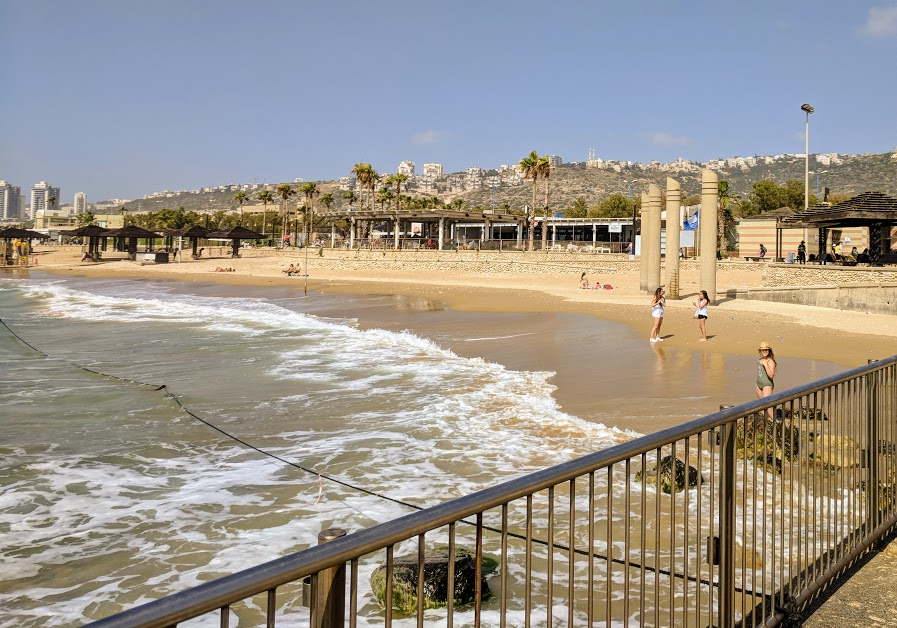
The Boardwalk in Haifa, Israel
The seacoast is enjoyed by many people because the climate of Israel is warm most of the year to encourage people to come out and enjoy the beach.
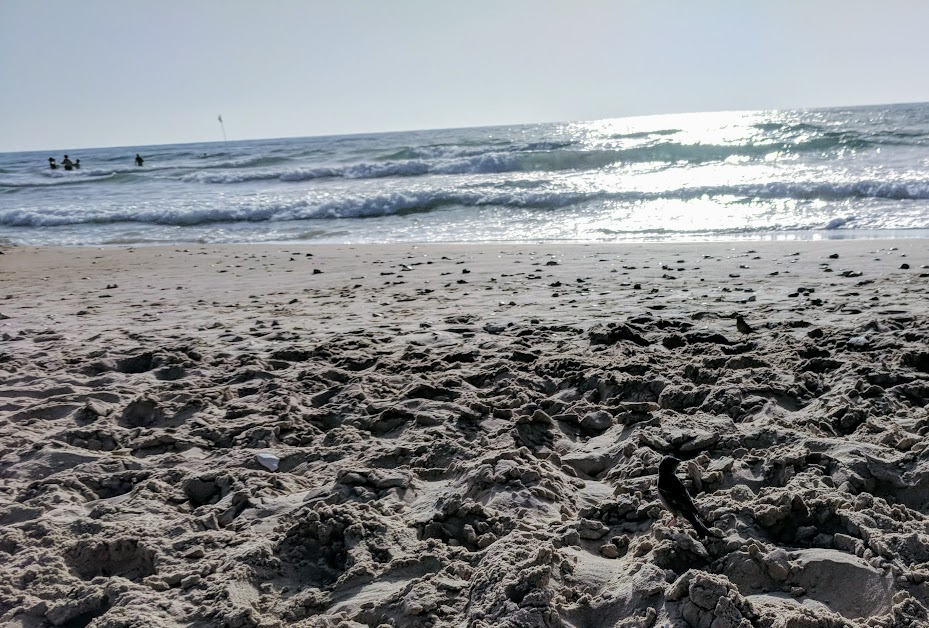
A Sparrow on the Beach
The beaches in Israel are of a light sand the length of the Mediterranean coast. Many shells can be found on the beaches, especially in the south. The northern beaches contain more smooth rocks. In the area around Caesarea it can be seen how some of the sand is brought from the trade winds over the Sahara Desert to build the beaches.
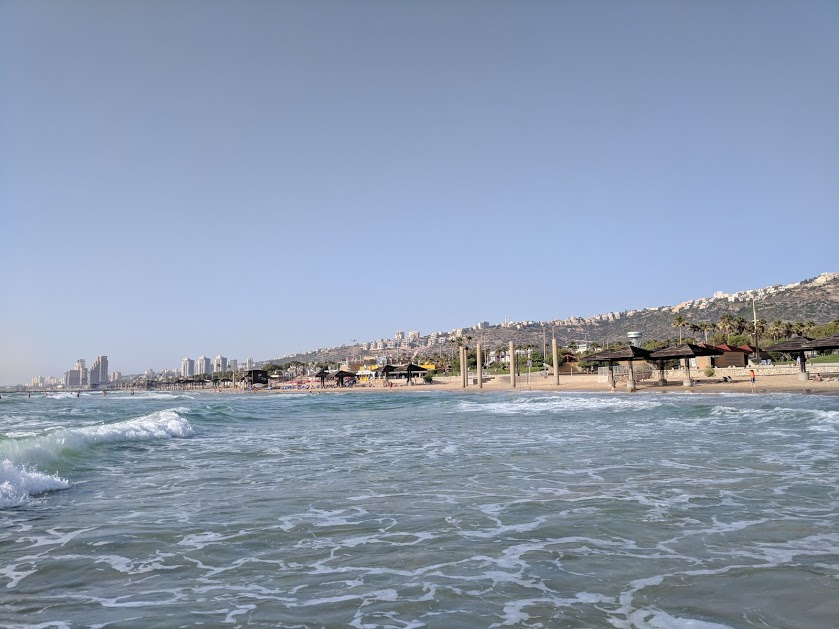
Mount Carmel rises above Dado Beach
The beach around Haifa rests beneath the heights of Mount Carmel. In all probability the Prophet Elijah not only came west on Mount Carmel to look for clouds, but he also dipped his feet into the Mediterranean. There is a cave in Haifa near the shore that is called Elijah’s Cave.
Information Sign at the Haifa Beach
Israel has several protective sea ports. The first and oldest of the parts is at Yafo (Joppa) where Jonah took a ship and went west to escape God. The port was created by a small indention in the coast, and a roc barrier to the south. The view across this inlet from Yafo to Tel Aviv is quite beautiful.
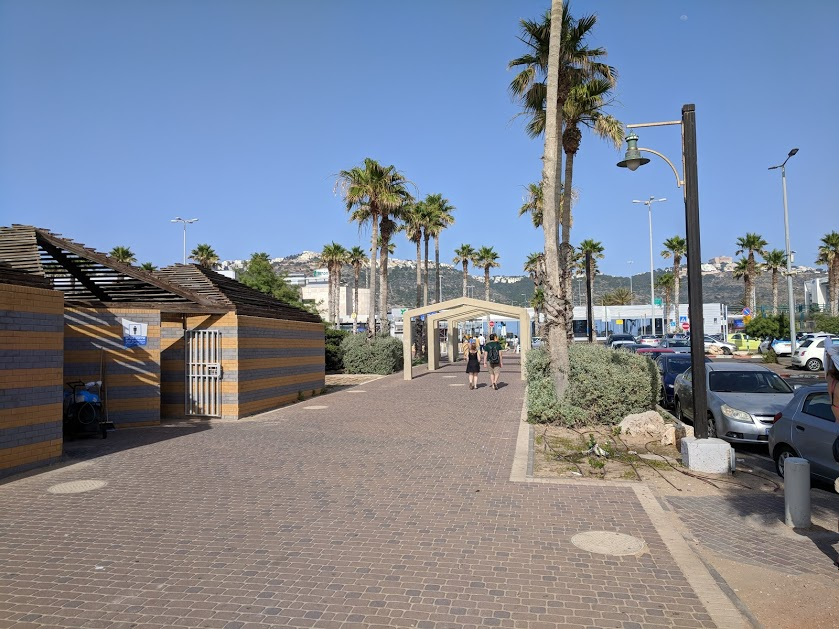
Entrance to the Carmel Beach in Haifa
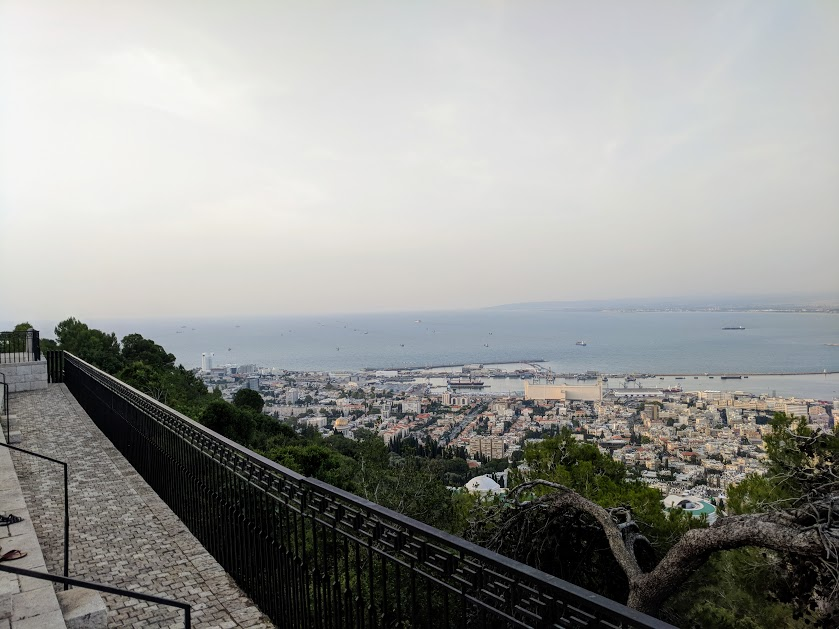
A sign at the top of Mt. Carmel says that the only place in Israel you can look north across the Mediterranean Sea is in Haifa. The seacoast in this part of Haifa is a huge seaport. From the top of the mountain cargo ships from around the world can be seen attempting to get in and to deliver their cargo.
Looking North from the top of Mount Carmel
The northern seacoast of Israel can be easily observed from the top of Mount Carmel from Haifa to Akhziv National Park, which borders Lebanon. This is a beautiful area which contains some rock crevices and underwater caves produced by the waves striking the limestone cliffs. The area is called Rosh Hanikra.
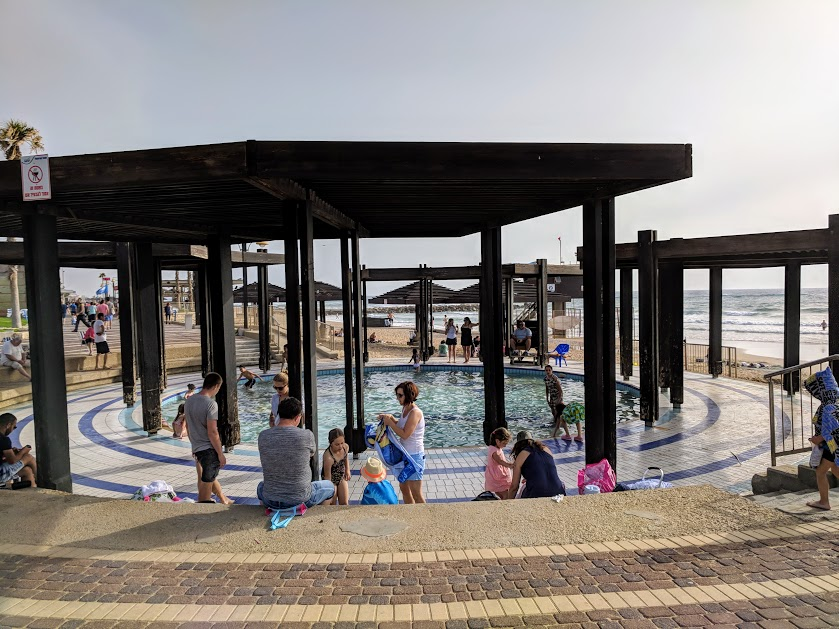
Shelters along the beach in Haifa
The main beaches in Israel like many other peaches around the world. There are wide boardwalks which divide the beaches from the shops. Along the beaches there are shelters, monuments, and plenty of space to spread a towel. There are many restaurants and other shops along the boardwalk, and also bathrooms where people can get changed.
A Fresh water Swimming place
Israel’s beaches are filled with people of all ages from children to senior adults all playing in the waves strolling the beaches picking up seashells, surfing, and swimming.

Saturday, May 19, 2018

Haifa's Panarama

Today is Shabbat, a special day in Israel, a definite necessity after our overseas flight, time in Yafo and two weeks of traveling. Today is a gift, a day to slow down and enjoy the gift of life and God’s creation.
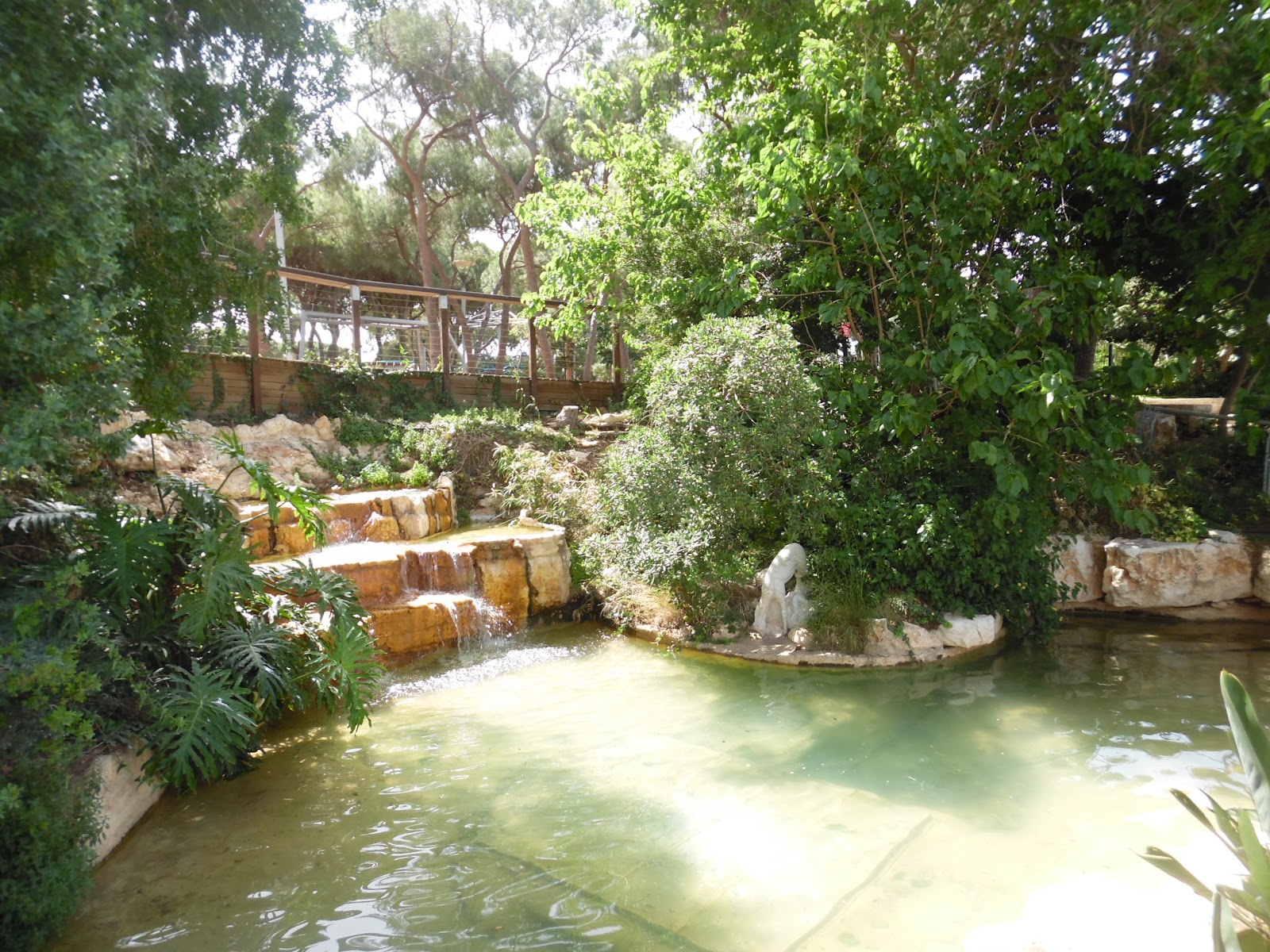
A pool along the Dan Panorama, Haifa
We began the day with a great supper at Burgus Burger Bar, a short walk through a garden and past a fountain, about two blocks from where we are staying. We had a leisurely dinner with our new friends from the afternoon’s hike. I should note that the Jewish day starts at Sunset, “And there was evening, and there was morning…”
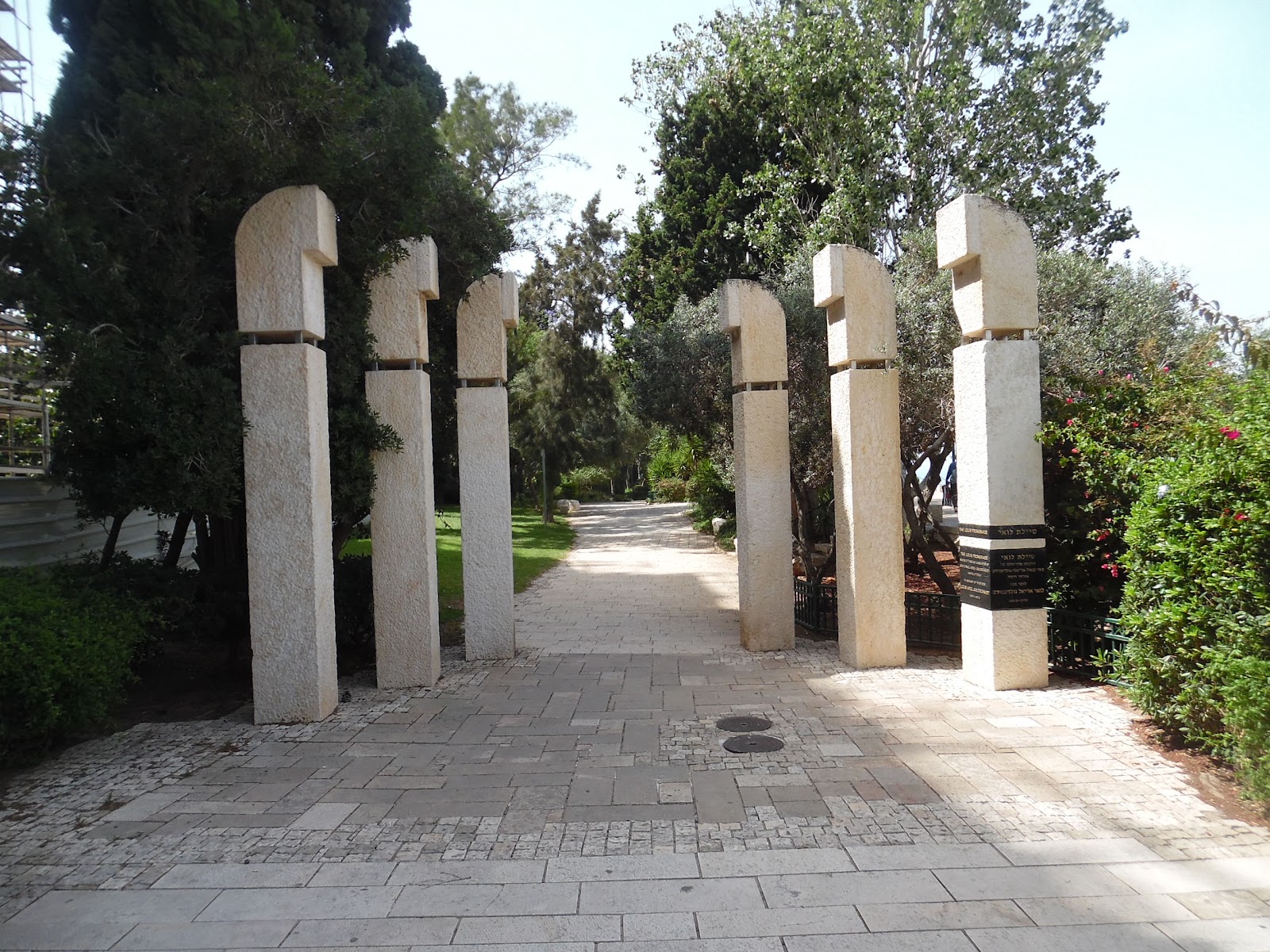
Dan Panorama Promenade in Haifa, Israel
After a fitful rest, we awake to a bright new day. Some of the family slept in, because it was the Sabbath. There is no rush, and the day was created to enjoy. We walked through the garden again to Landwer for an Israeli breakfast: a farmer’s omelette (with mushroom, spinach, leek and goat cheese), scrambled eggs, shakshouka, Israeli salad, tuna salad, cream cheese, feta, olives mix, labnah and chickpeas, eggplant cream, tomato salsa with tahini, guacamole, sweet yogurt with granola and honey, halva spread, fruit jam, whole-grain wheat bread. and coffee. We took our time.
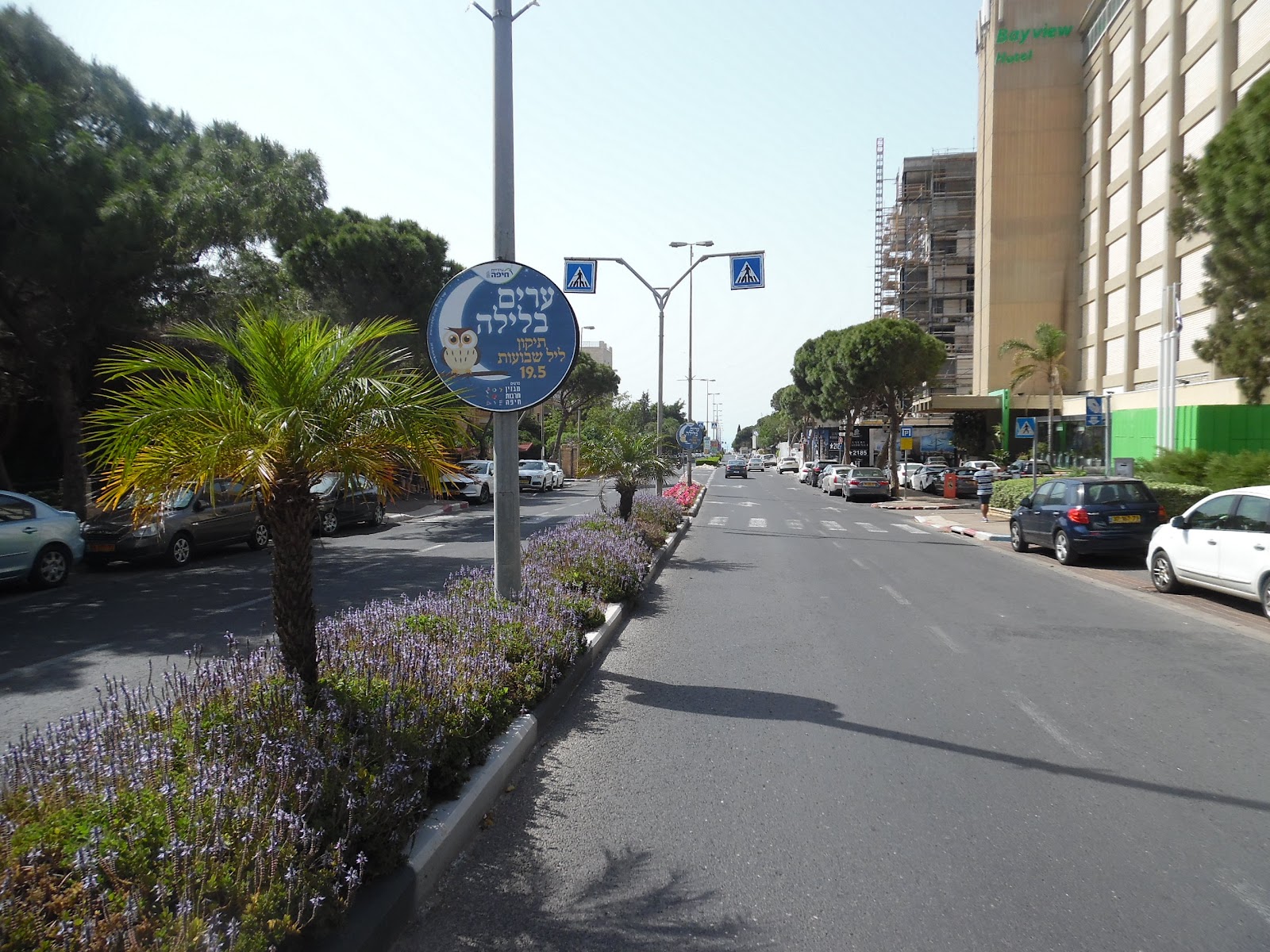
No traffic on the normally crowded main street!
The city of Haifa is at rest on Saturday. Offices are closed, public transportation comes to a stop, and the hustle bustle of daily live comes to a halt. We took a walk in the afternoon along the Dan Promenade.
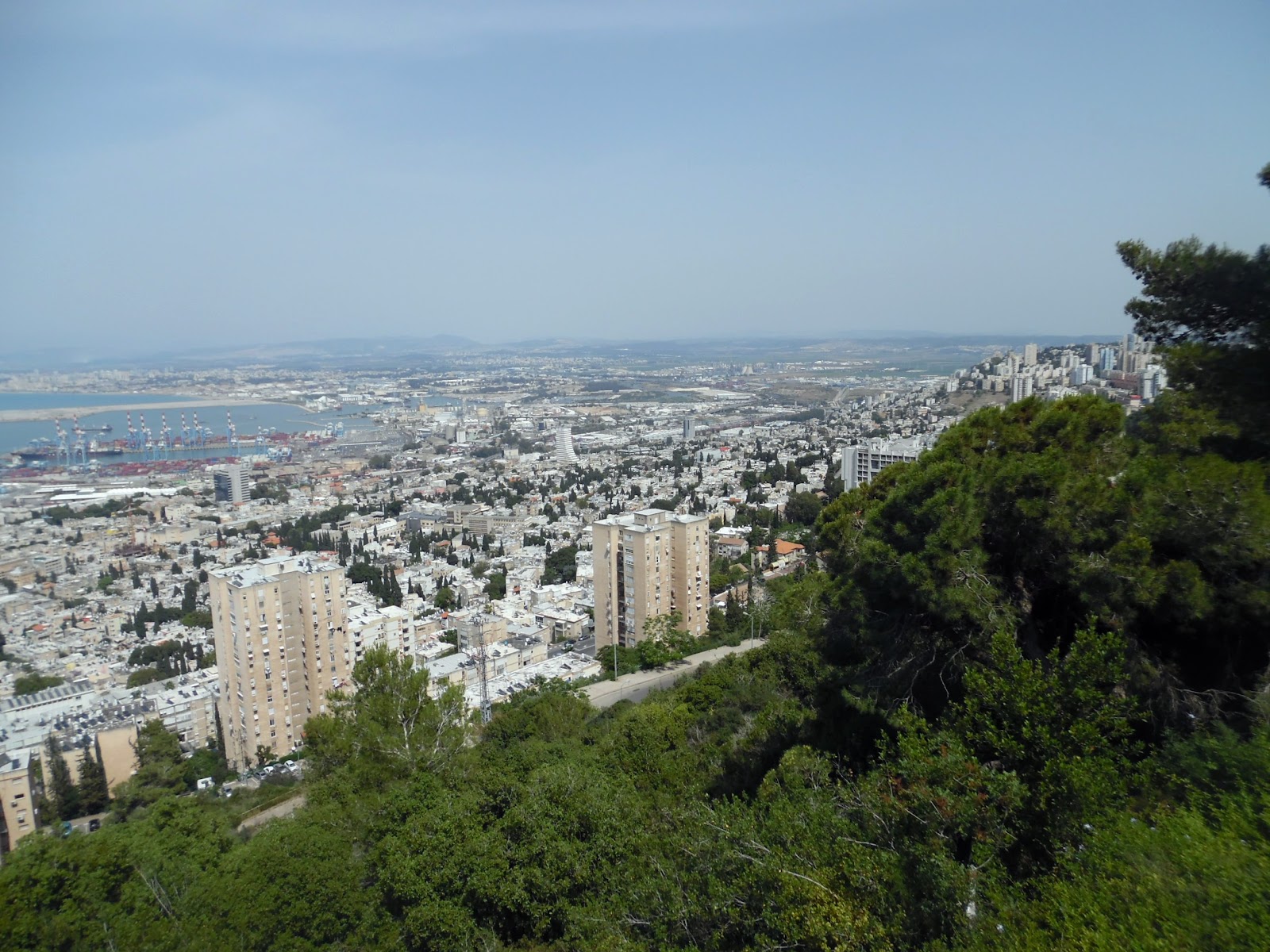
Downtown Haifa at the bottom of Mount Carmel.
We took a hike along the top of Mount Carmel, overlooking the Mediterranean Sea. We could see downtown Haifa and ships entering the port.
Ships entering Haifa Harbor. Also Bahai Gardens

Bahai Gardens spread out below, and the Jezreel Valley opened to the east. Akko could be seen to the north, and I was told that on a clear, dry day, it is possible to make out Cyprus. Our day is ending with strawberry mint tea and awaiting Shavuot to arrive this evening.

** Today's post is from Haifa looking north; Yesterday I wrote about a trail going west. Both overlook the Mediterranean where Mount Carmel projects into the sea. This is probably the place Elijah came to find the drought breaking rain in 1 Kings 18.

A Pool and a Monastery in Haifa

If a person gets off the beaten path in Israel and takes trails, the Eretz Yisrael is full of surprises.
Our trail of descent from Mount Carmel, Haifa
Yesterday we took a side trail off of Mount Carmel towards Carmel Beach. The path was steep at first, and full of dead branches as we deciphered the way to get to the marked trail.
An oak grove near where we joined the trail
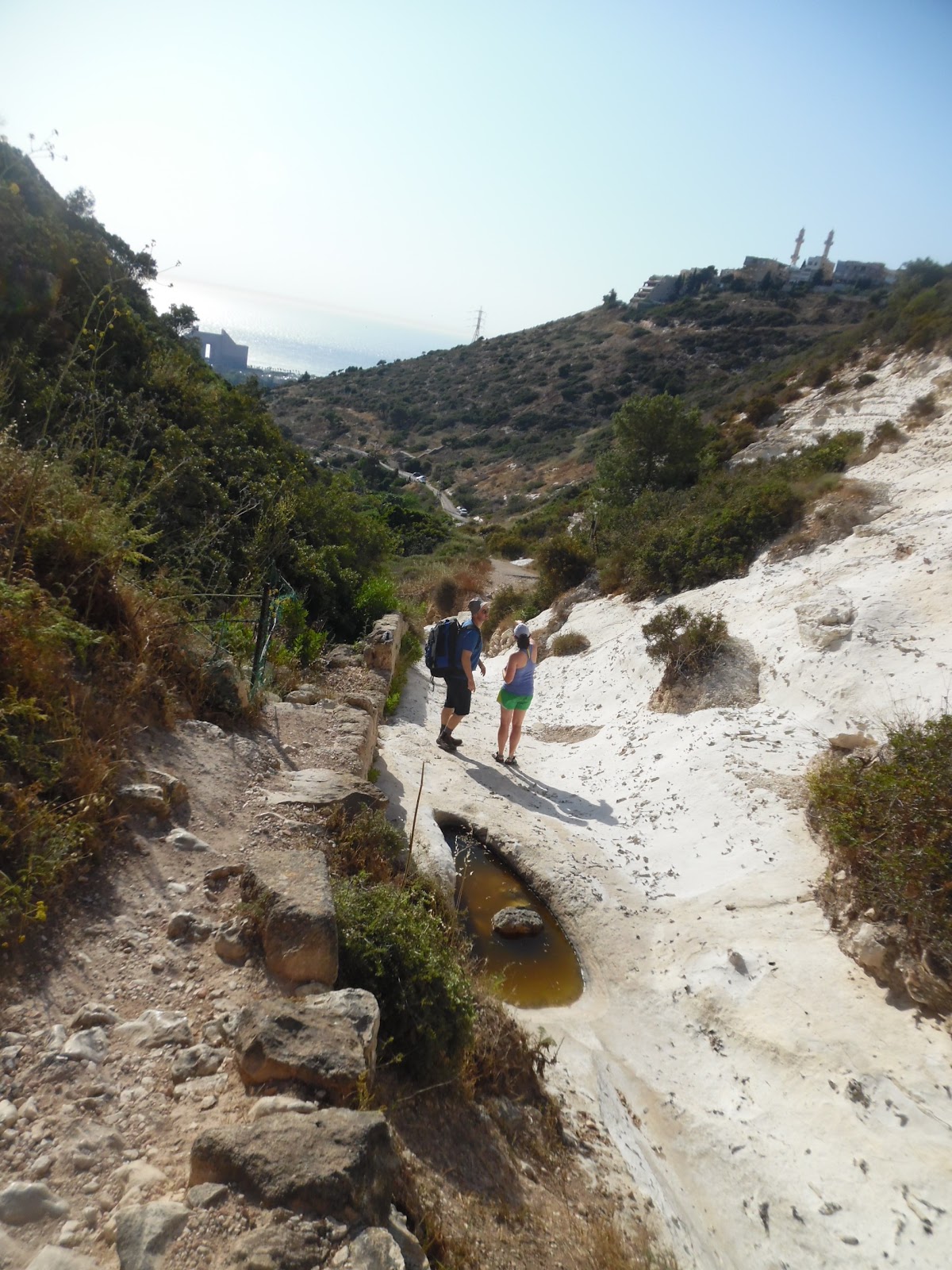
The marked trail took the course of a wadi, a dry riverbed that can quickly carry run-off during times of rain (not the place to be in wet weather). The stone gave us an easy descent.
The wadi we traveled along the first part of our trail
Along the way there were groves of oak trees and other plant life.
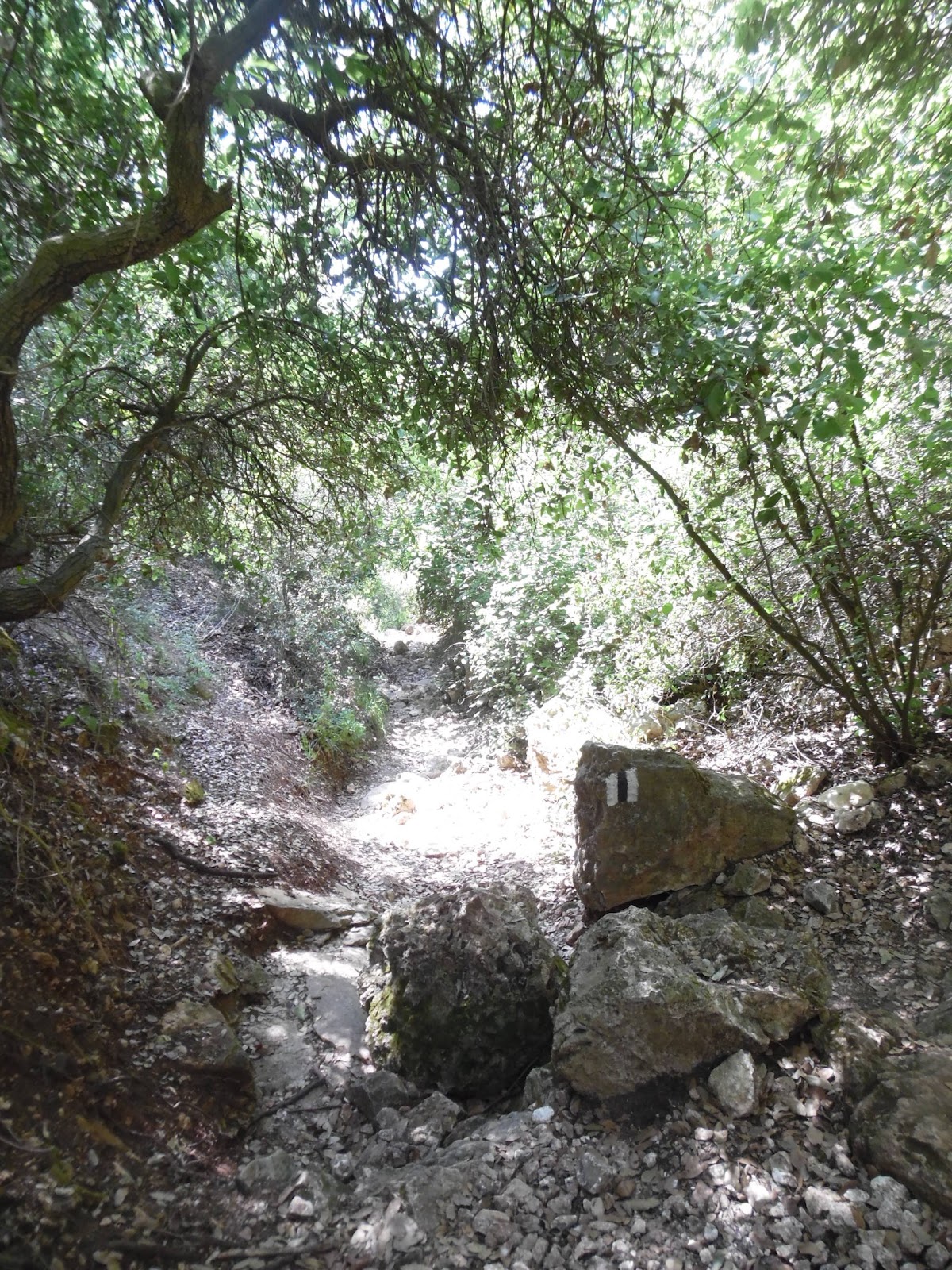
The trail marking under the oak trees
Eventually we found ourselves on an old developed roadbed. This made the traveling easier, as the route had been graded for easy and smooth descent.
Our trail follows an old road
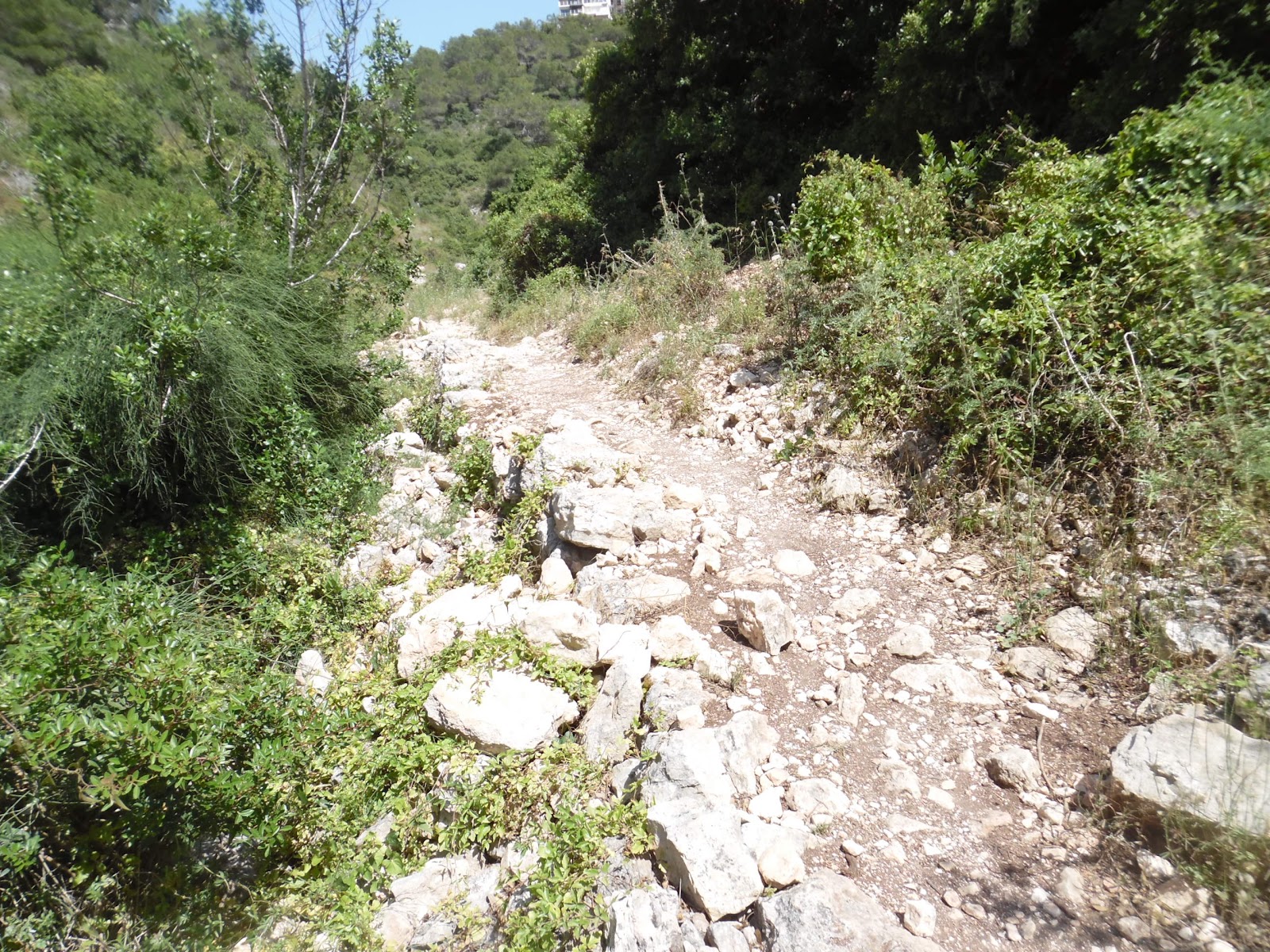
The roadbed was old, and not maintained. What had once been a road had become a trail.
The road is old, and all smoothness is gone
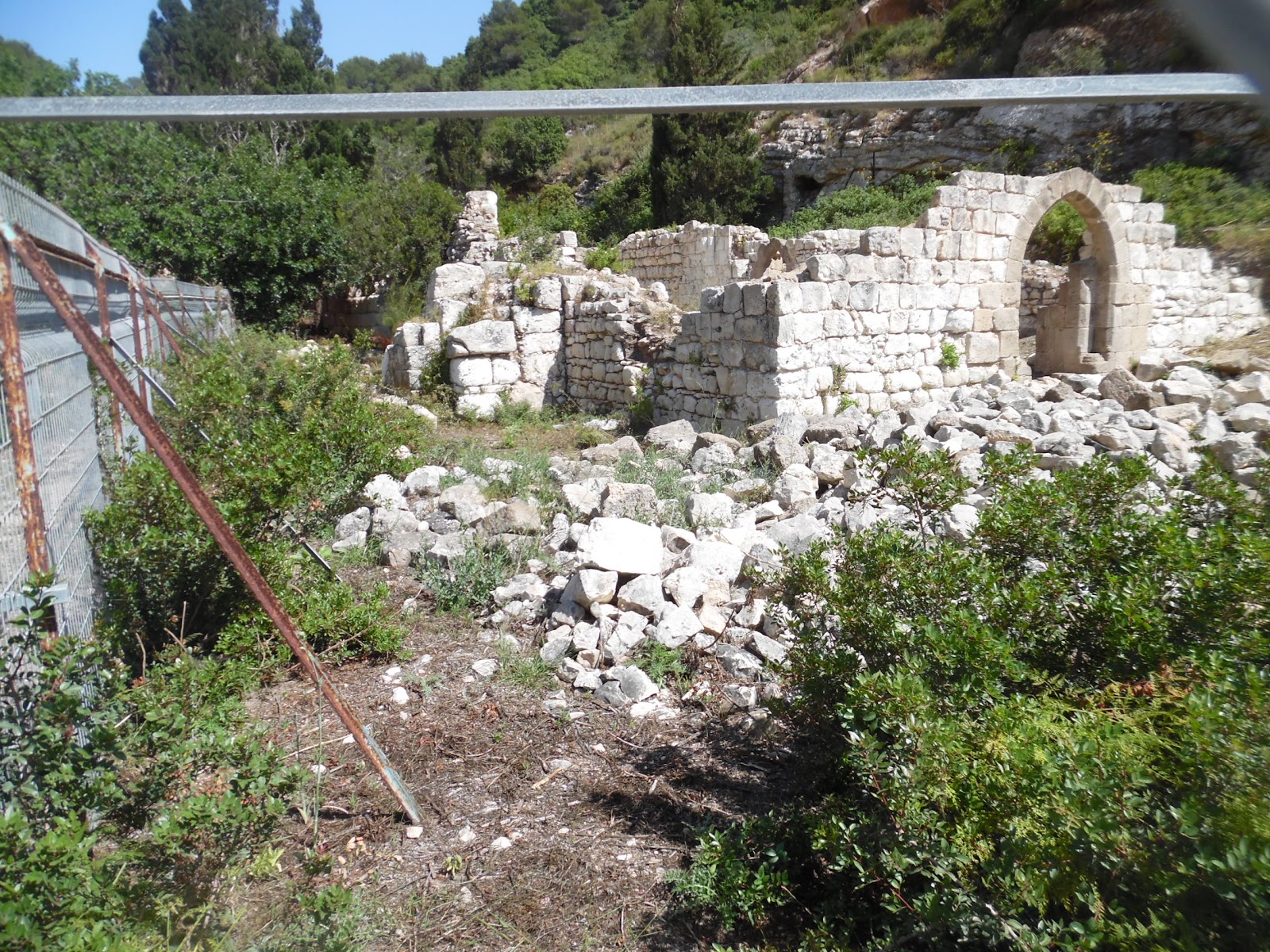
Along the way we ran into an antiquity. There are actually ancient ruins (and some newer ruins) all over Israel. This ruin was the remains of a center for Carmelite monks. The Carmelite Order is dedicated to contemplation and prayer. They find inspiration for their practice of faith from the prophet Elijah and Mary, the mother of Jesus. Both were people of prayer.
Antiquities marker for the Carmelite Church
There is an old monastery on the trail.
An old entrance to an old church
The monks needed a source of water, so they built a pool at a spring where water comes out of the mountain.
A cool place for a refreshing rest
This spring was actually our destination, and we spent time in the cool refreshing waters. Then we drank coffee, and talked to others who were hiking the trail. One of the men we talked to helped open facebook in Israel. We talked about many things, including politics. The Israelis are fascinated by our politics, especially as it influences Israel. We also talked about education, youth groups and the natural beauty of the land.
The path below the monistary
Beyond the monastery, an aqueduct took water downhill. There were many ponds along the way with other people bathing. We finally reached a road at the bottom and took a taxi to our home on top of the hill.

Tuesday, June 6, 2017

Jericho's Walls and more

How low can you go? Find out during a 14 day trip to the Holy Land in May 2018. While on our journey we will make several stops along the shores of the dead sea. We will visit Jericho, home town of King David’s grandmother, Rahab. We will spend the night at Al Mog, a Jewish Kibbutz on the Dead Sea.
Our trip agenda - www.KosherCopy.com
Tell es-Sultan, or Jericho, is reputed to be the lowest and oldest city on earth. And indeed many archeological digs confirm the antiquity of this site. The earliest remains belong to the Natufian people who established a hunting site near the ever flowing spring which supports settlement. In the Neolithic period round houses constructed of mud brick have been found in a village surrounded by a wall and a round tower. This is the earliest fortification system known on earth.
Walls and ancient housing in Jericho
We will visit the site of the excavation and see the walls surrounding the ancient city. During our tour we will re-tell the story of Joshua and how the walls crumbled on the seventh day when the trumpets sounded for the seventh time. In what amounted a a great victory Israel conquered the most powerful city in Canaan during the days of Joshua.
Ancient building and walls at Jericho
Outside of the Tell es-Sultan we will visit the spring which existed during the time of Elijah and Elisha. The two prophets visited this area as Elijah traveled toward his appointment with God on the far side of the Jordan River.
One of the springs at Jericho. Elijah visited here!
We will go near the area where Elijah was taken to heaven in a chariot of fire. We will celebrate baptism in this area for any who wish to be baptised in the Holy Land. This is the area where Jesus was immersed by John the Baptist.
Mount of Temptation at Jericho
We will see what is traditionally called the Mount of Temptation behind Jericho. A cable car climbs the mountain and a monastery is located in the area to commemorate the fact that Jesus overcame the temptations Satan put forth.
Looking across Jericho toward Jordan
We will also see sycamore trees while we visit in the city of Jericho. The modern city is home to about 18,000 people. We will drive through the city and around a city square. We will talk about Zacchaeus who was the chief tax collector in this region and how he climbed a tree like the trees we will see on our journey.
Jordan City square with Sycamore and Palm trees
We will observe and travel the roads which enter Jericho from every direction. There was a major travel route from Jordan, across the river, through Jericho, and up Wadi Quelt into Jerusalem and beyond to the Great sea. A trade route traveled by Jesus also came into Jericho from the north. Many travelers would use this route to avoid Samaria and travel on to Jerusalem. Others would continue south on the road through Jericho to visit the Dead Sea.
The north and south road near Jericho. Date Palm farm
Jericho is a desirable place to live with hot summers and mild winters. Many types of fruit grow in this area including date palms. Cleopatra fell in love with Jericho. Herod the Great gave her a palace to live in which was also visited by Mark Anthony. THe remains of this palace are visible today.
Looking across the City of Palms toward Moab
Al Mog is a Kibbutz located just north of the Dead Sea with views toward the heights of Moab from which Moses first saw the Promised land and views of the ascent to the Judean highlands. The Kibbutz is located in the oxygen rich Rift Valley and features a swimming pool which will be quite refreshing at the end of a warm day.
Take time to sign up for a unique trip - www.KosherCopy.com

During the time we spend along the Dead Sea and Jericho during our 14 day trip to the Holy Land many Bible stories and more recent history will be shared. Please check the brochure located at www.KosherCopy.com under the tab Israel Tour 2018. Sign up for the tour on the linked registration page. The trip to Israel will be unforgettable.  

Thursday, December 3, 2015

The Place of Elijah in Jewish Tradition

Elijah is a favorite Bible character for every Jewish child and most adults.  He is often remembered most quickly as the person of the fifth Passover cup, for near the end of the Passover observance children get up from the dinner table, open the door of their home for the prophet to enter and when they return to the Seder table they find Elijah has come and drank a once full cup which was especially prepared for him.
In the process of this observance the Passover leader explains that Elijah is a Bible hero who never died, and he was one of only two people ever taken alive to heaven.  He rode to heaven, according to 2 Kings 2:11, with a chariot of fire and a whirlwind.  Because Elijah is alive, and never died, he can come back to earth.  And Elijah returns in order to alleviate poverty, save people from troubles, and to answer difficult questions for the Rabbis.
The Talmudic tractate Kiddushin [40a] that tells about the virtue and the poverty of a certain Rabbi Kahana. He told a powerful woman who had made advances toward him that he had to get himself ready for their tryst; instead he went up to the roof and hurled himself off to avoid sinning. Enter Elijah, who caught him and then reproached him: "You have troubled me to come a long distance to save you." When the rabbi replied, "I was forced to do it due to my poverty," Elijah gave him a basketful of dinars.
Elijah was a prophet who was not afraid to speak for God.  He spoke openly to King Ahab and Queen Jezebel about their sins.  As a result of their sins Elijah told them (and it was fulfilled) it would not rain in Israel for three and a half years.  He also challenged the prophets of Baal to call down fire from heaven.  Elijah won the challenge.  Elijah cared for the poor, feeding a poor widow.  He also raised the dead.  He was a great prophet.
At the end of the Old Testament in the book of Malachi there is a prophecy about Elijah which says, “But I will send you Elijah the prophet before that great and terrifying day of the Lord’s judging. Elijah will help parents love their children and children love their parents. Otherwise, I will come and put a curse on the land.”
It is through these traditions that the Jews and many Christians believe Elijah will return.  He will return to announce the Messiah, and it is believed he will return at the end of time.  As Moses is a representative of the law, Elijah is the representative of the prophets.
The tradition of Elijah was recognized in the New Testament, for Matthew 17 says,  “Jesus took Peter, James, and John, the brother of James, up on a high mountain by themselves. While they watched, Jesus’ appearance was changed; his face became bright like the sun, and his clothes became white as light. Then Moses and Elijah appeared to them, talking with Jesus.
Zechariah the priest of whom we are reading today in Advent Journeys was told by the Angel Gabriel that his wife would give birth to a son, and Zechariah was to name him John.  The angel further told Zechariah, “ He will help many people of Israel return to the Lord their God. He will go before the Lord in spirit and power like Elijah. He will make peace between parents and their children and will bring those who are not obeying God back to the right way of thinking, to make a people ready for the coming of the Lord.
Jesus says of John the Baptist: “Truly I say to you, among those born of women there has not arisen anyone greater than John the Baptist!  … And if you are willing to accept it, John himself is Elijah who was to come. He who has ears to hear, let him hear.” (Matthew 11)