Showing posts with label Israel. Show all posts

Wednesday, October 24, 2018

Two Months in Israel

This year I had the privilege of spending two months in the land of Israel. The time was enjoyable and educational. While in the land I participated in a two week tour, four archaeological digs and also wandered various historic sites, shopping areas, recreational parks and various places to eat.
Some of the places I visited during the two weeks of my tour were places I visited before, but since I helped plan the tour, there were some new places also.
The Archaeological site at Shilo
One of the places I looked forward to seeing was Shilo, the site where Joshua set up the Tabernacle and where young Samuel heard the voice of the Lord. The Tabernacle is long gone, but the hills still stand at this site, the ruins have been made visible and the stories about Israel’s place of worship are still remembered.
A cave sits below the place of the Tabernacle at Shilo
One of the things I personally was interested in was the road that led to Shilo. I wrote about the trip of Joseph and Mary in my book Advent Journeys. I was pleased to see it was like the pictures I researched for the book. The site of Shilo was interesting also.
Baha'i Gardens in Haifa with the port area below
A second new place I visited was Haifa. I visited the Baha'i Gardens, hiked the Haifa Trail, ate great food at the top of the hill, and looked down at the great harbor below. The gardens were beautiful and very well kept. I walked down the 750 steps in the garden, and walked up the alternate trail that led back to the top of the hill. I enjoyed swimming at the beach.
The house in the Church of the Annunciation at Nazareth
I participated in archaeological digs at Tel Gezer, Tel Hadid, Zippori, and at Tel Dan. Zippori was the most interesting dig, and I will write about that in another post. While at Zippori I visited the Church of the Annunciation. The sanctuary is beautiful. The small house in the church as well as Joseph’s carpentry shop in the basement of another church are both interesting.
Kurlander Dairy in Northern Israel

I spent about ten days near Tel Dan and enjoyed the beautiful countryside in Northern Israel. While there I took a long hike a Banias and saw the waterfalls. I also entered Dan at the Canaanite Gate, visited Kerlander Dairy, Hermon Field School and various restaurants and shopping centers in the area.

Friday, June 8, 2018

A Train Ride in Israel

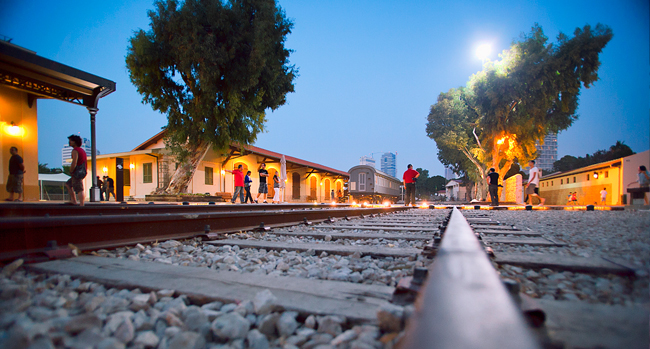
Two of my favorite places in Israel are train stations, the first train stations in Tel-Aviv and Jerusalem.
Old picture of Train Station in Jerusalem
Today train service is no longer available at these stations, and both train stations are shopping centers.
Old Train Station Jaffa
But both train stations, especially the depot in Jerusalem are cultural centers as well as train stations.
First Train Station, Jerusalem
My family and I have attended a film festival, a book fair and and several concerts in the First Train Station.
Beit Shemesh train station looking east
Railroad service was first proposed for the land of Israel by Moses Montefiore in the 1830’s. At that time travel within the land of Israel was by foot or by camels. The trip to Jerusalem was long and hard.
Bet Shemesh Train Station looking North
The route a ride from the port city of Jaffa crossed the Plain of Sharon from the port of Yafo to Lod (or Lydda).
Beit Shemesh city sign
Then the road entered the Sorek Valley, ascending to Beit Shemesh.
Zorah is on this Mountain
This is the land of Samson and Delilah.
Farmland approaching Beit Shemesh
Beit Shemesh is listed as a city both in the territory of Dan and in the Judean Hill country.
Judean Hills - Zorah in background
The train ascends the Judean hills along the sorek river.
Sorek River running through the Judean Hills
The ride is very beautiful. There are some olive groves along the way,
Olive Groves along Railroad Line
But not many houses, for this is rugged country.
Defensive Structure in Judean Hills
I was advised many times not to take the train, because the ride from Jerusalem to Beit Shemesh on the train takes longer than a bus ride. (about an hour) To get from the train station in Beit Shemesh to the airport requires three or four train transfers.
Old Railroad leaving Jerusalem Highlands
We were not taking the ride to meet a time schedule, only to see the beauty.
Beauty from train window
The train was for the most part empty because of people’s attitudes. That was ok for us, as we could take pictures from both sides of the train through the windows.
Train from Jerusalem to Beit Shemesh
Near the top of the hill the train stops at a terminal across the street from the Biblical Zoo.
Looking across tracks from Biblical Zoo in Jerusalem
The final stop is near German Colony.
Looking at park behind Jerusalem Train Station
We enjoyed the smooth and beautiful ride very much.
Map of Israel Train zones

In the near future there will be a high speed train from Jerusalem to the airport. Don’t know, but possibly train service on the old line will come to an end at that time.

Wednesday, June 6, 2018

A visit to the top of Mount Scopus

Today we went to the top of Mount Scopus and visited Hebrew University.
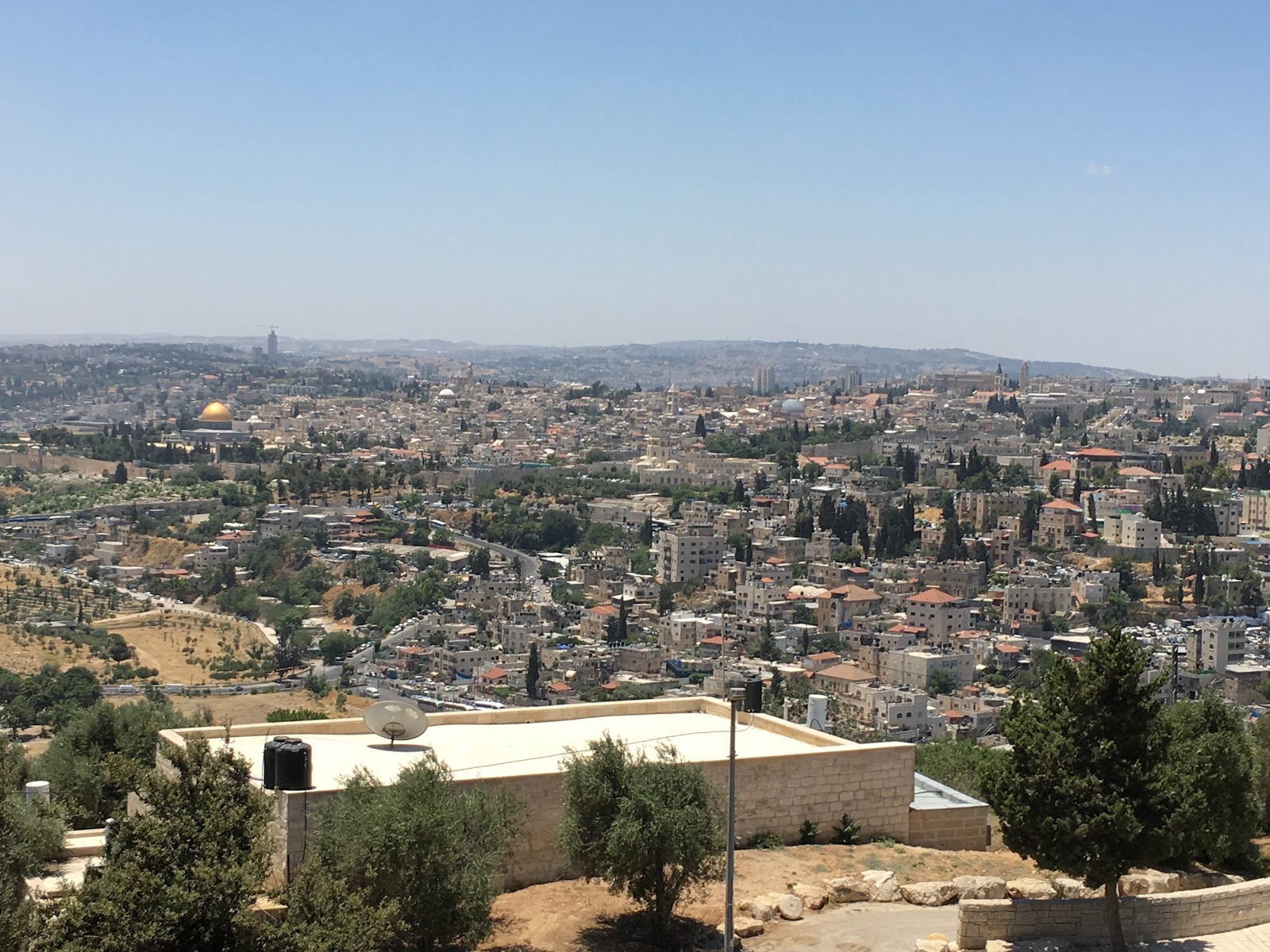
Jerusalem from the top of Mount Scopus
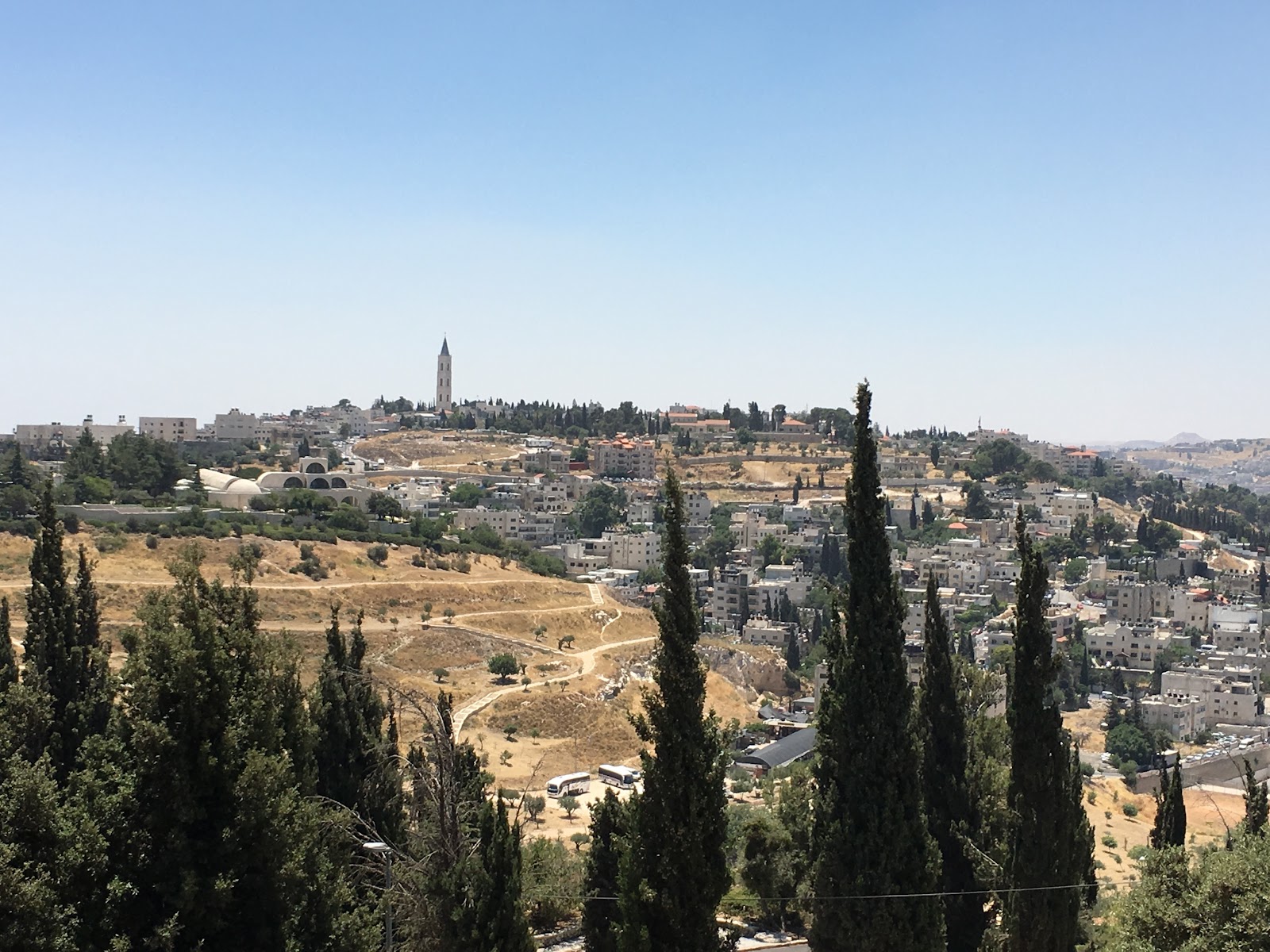
At 2710 feet above sea level, Mount Scopus is the highest mountain near Jerusalem and it therefore offers a great view of the city.
The view of Mount Scopus from the Mount of Olives
Mount Scopus is the highest peak along the ridge that is also known as the Mount of Olives.
Looking at Jerusalem
The name of the peak means “watcher.” Since antiquity people have climbed the mountain to scope out what is occurring in Jerusalem.
Looking at Jerusalem from Hebrew University
In 1918, Zionist leaders laid a cornerstone as a promise to build a place of higher learning on top of Mount Scopus. The school opened in 1925.
Looking down from Hebrew University
After Israel was created in 1948, the mountain became part of a United Nations zone of protection within Jordanian territory. At times Mount Scopus, with it’s school, was totally cut off from the outside. Men and women dedicated to the institution of higher learning on it’s peak protected the school by offering their continual presence.
A Plaza at Hebrew University
We took the bus up Mount Scopus for our visit to the University.
Looking up to Mount Scopus from the wall around Jerusalem
When we arrived on campus, we stepped out to one of the overlook plazas on the campus. The campus is large and an easy place to get lost. Various buildings are attached and dedicated to various disciplines. Other buildings are across open plazas, or on the eastern descent of the mountain.
Map of Hebrew University
After taking pictures we walked to the east side of the mountain and visited The National Botanic Garden of Israel.
The Garden at Hebrew University
This garden was started by one of the professors of Biology with the goal of planting and maintaining every plant native to the land of the Bible.
How the Garden Started
The gardens are diverse, containing everything from water plants
Water Plants at Hebrew University
(look closely, can you count the frogs??)
Frogs on the Lily Pad
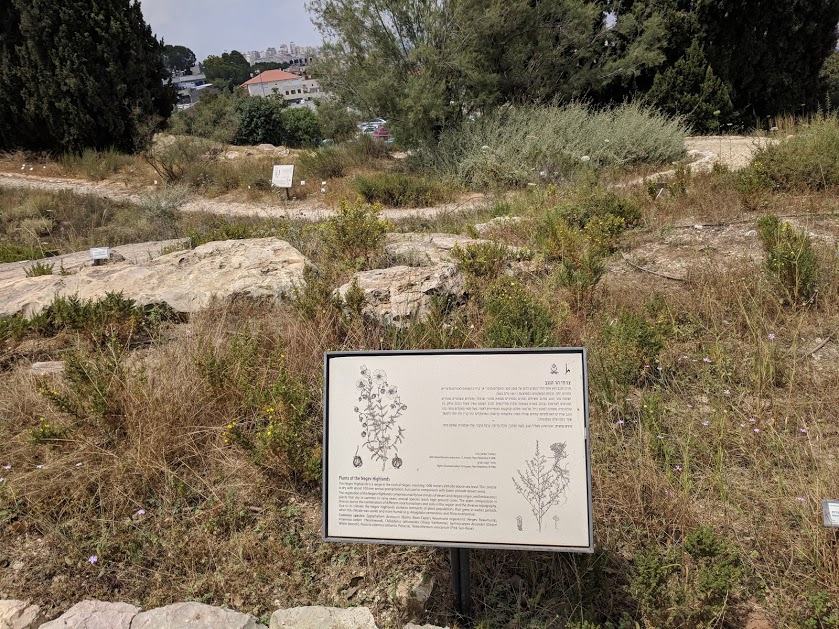
To plants of the Negev.
Plants of the Negev
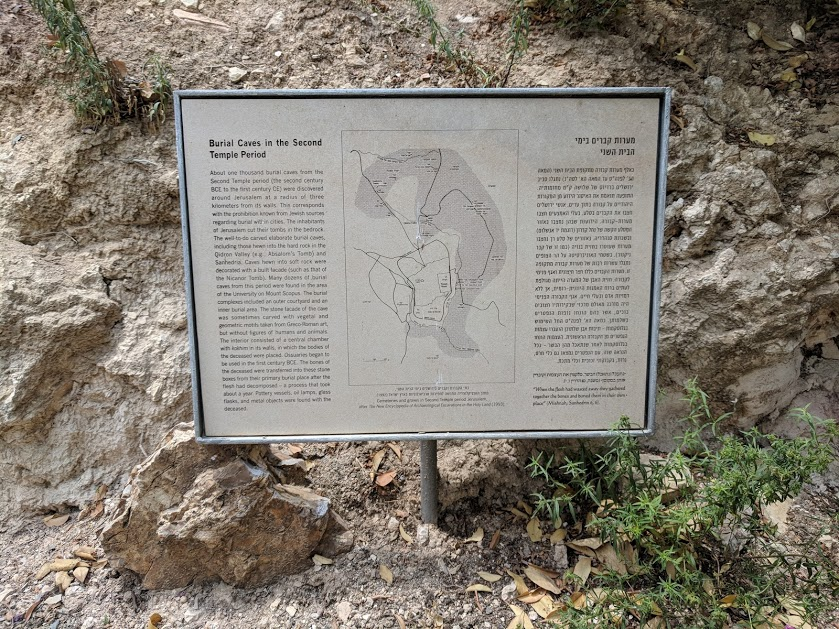
The garden also contains tombs dating back to the times of the New Testament and before.
First Century Tombs around Jerusalem
A Jewish man named Nicanor of Alexandria, who donated the beautiful (Acts 3) bronze Eastern Gate of Herod’s Temple is buried in this graveyard.
First Century Tombs and Osuary
The gardens extend throughout the University,
Plants on Mount Scopus
With Tabachnik Garden, a National Park, located below the University on the southern slopes of Mount Scopus.
School of International Studies
We walked the campus, and saw the International School, in the Frank Sinatra building.

Wednesday, May 30, 2018

Digging in Zippori

Yesterday, today and tomorrow’s activity involved investigating a first century water system. We are concluding a dig on a cistern in order to determine the flow of water.
Cistern Archaeology Project at Beginning
The town of Tsippori originated in the fourth century BC (or maybe before) on a high hilltop which offered both protection and a great view. The name Tsippori means “Bird,” perhaps, as the Talmud suggests, because it was "perched on the top of a mountain, like a bird.” (Megillah, 6, 81)
Looking across Galilee, as a Bird
The city was very strong, and for this reason it became a regional capital. According to Josephus, Tsippori was called the "glory of the entire Galilee."
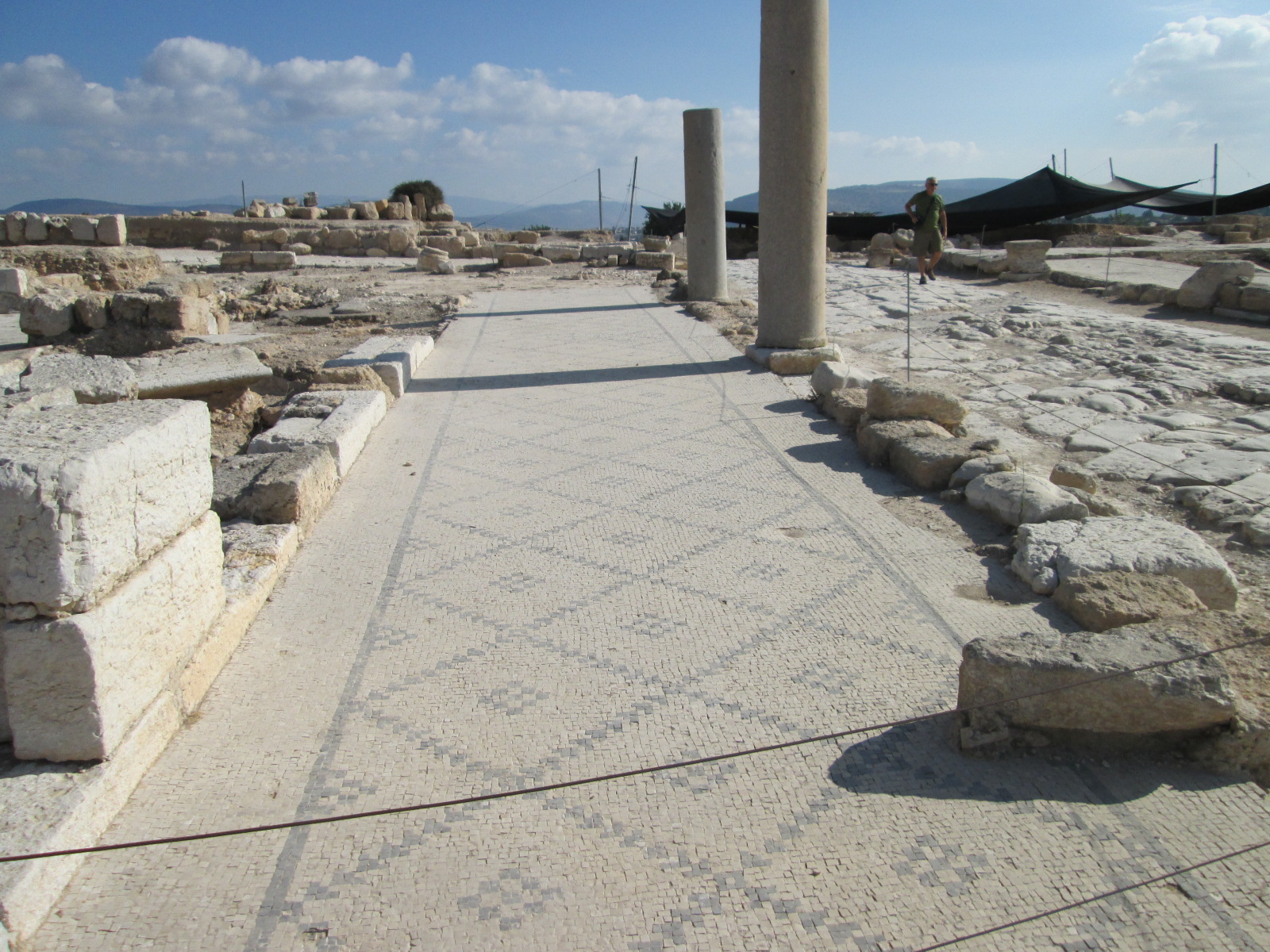
Mosaic walkways in the market in Zippori
When Herod's son, Herod Antipas was made tetrarch, he made Sippori the capital of all of Galilee, and began a huge building project.
Mosaic floors from homes in Sepphoris
It might have been at this time the cistern where we are working was created as a resigour along the aqueduct from water sources around the Nazareth Mountains.
Information sign for the Cistern
The population was mixed, but mostly gentiles.
Mosaics from homes in Tsippori
The city is laid out in a typical Roman pattern with wide north-south and east-west cardios. There is a large shopping complex where the main roads cross.
Walking on the old Roman Cardio
The homes in Sepphoris were quite ornate and featured mosaic floors.
Mosaic Mona Lisa of the Galilee
A small Jewish area is located near the top of the hill,
Jewish Neighborhood in Zippori
It features mikvah pools, which tell of its Jewish character.
Looking at a Mikvah Pool
The Sanhedrin met here for a time after the destruction of the Temple.
Bird's Eye View of Jewish Neighborhood, Mount Carmel in background
Rabbi Yehuda Hanassi transferred the seat of the Sanhedrin from Bet She'arim to Tsippori, and around 220 CE he completed the Mishna in the city.
Synagogue Mosaic
The Synagogue of the city saw several renovations over the years. The mosaic floor of the fifth century Synagogue is enclosed with a multimedia presentation. It contains scenes from Bible stories, priestly offerings and a zodiac diagram.
Cistern Project this evening, compare for progress
Our work on the water cistern has made huge strides in the past few days.
Tour Group from Georgia that helped us dig
We have found pottery, old nails, roof tiles, some Roman glass, and old coins.
One of the coins found at Tsippori

The archaeological dig was productive and enjoyable.