Showing posts with label Sanhedrin. Show all posts

Wednesday, May 30, 2018

Digging in Zippori

Yesterday, today and tomorrow’s activity involved investigating a first century water system. We are concluding a dig on a cistern in order to determine the flow of water.
Cistern Archaeology Project at Beginning
The town of Tsippori originated in the fourth century BC (or maybe before) on a high hilltop which offered both protection and a great view. The name Tsippori means “Bird,” perhaps, as the Talmud suggests, because it was "perched on the top of a mountain, like a bird.” (Megillah, 6, 81)
Looking across Galilee, as a Bird
The city was very strong, and for this reason it became a regional capital. According to Josephus, Tsippori was called the "glory of the entire Galilee."
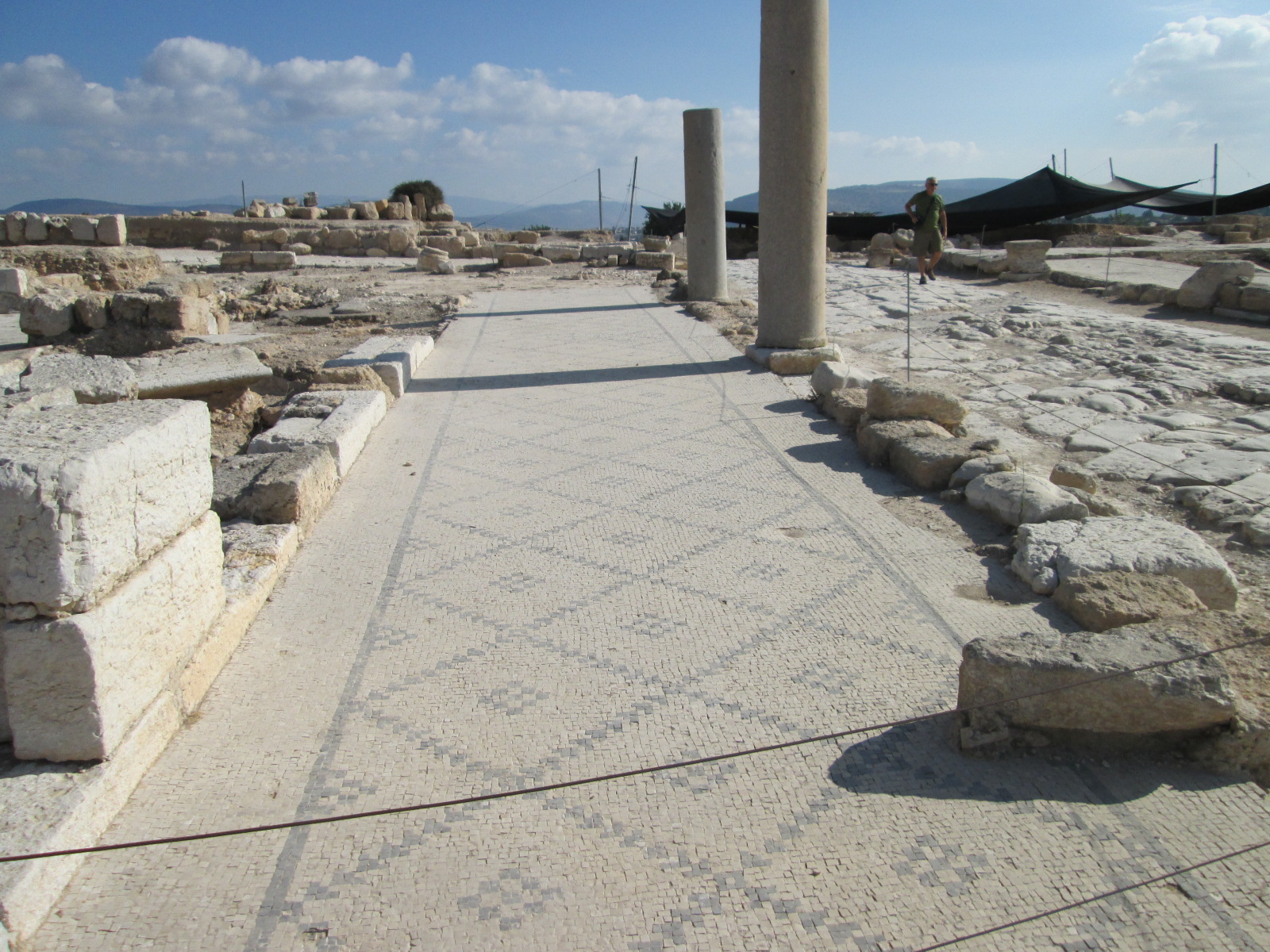
Mosaic walkways in the market in Zippori
When Herod's son, Herod Antipas was made tetrarch, he made Sippori the capital of all of Galilee, and began a huge building project.
Mosaic floors from homes in Sepphoris
It might have been at this time the cistern where we are working was created as a resigour along the aqueduct from water sources around the Nazareth Mountains.
Information sign for the Cistern
The population was mixed, but mostly gentiles.
Mosaics from homes in Tsippori
The city is laid out in a typical Roman pattern with wide north-south and east-west cardios. There is a large shopping complex where the main roads cross.
Walking on the old Roman Cardio
The homes in Sepphoris were quite ornate and featured mosaic floors.
Mosaic Mona Lisa of the Galilee
A small Jewish area is located near the top of the hill,
Jewish Neighborhood in Zippori
It features mikvah pools, which tell of its Jewish character.
Looking at a Mikvah Pool
The Sanhedrin met here for a time after the destruction of the Temple.
Bird's Eye View of Jewish Neighborhood, Mount Carmel in background
Rabbi Yehuda Hanassi transferred the seat of the Sanhedrin from Bet She'arim to Tsippori, and around 220 CE he completed the Mishna in the city.
Synagogue Mosaic
The Synagogue of the city saw several renovations over the years. The mosaic floor of the fifth century Synagogue is enclosed with a multimedia presentation. It contains scenes from Bible stories, priestly offerings and a zodiac diagram.
Cistern Project this evening, compare for progress
Our work on the water cistern has made huge strides in the past few days.
Tour Group from Georgia that helped us dig
We have found pottery, old nails, roof tiles, some Roman glass, and old coins.
One of the coins found at Tsippori

The archaeological dig was productive and enjoyable.

Thursday, May 24, 2018

Among the Tombs

Today we went to Bet She’arim and climbed around the tombs of the deceased. Bet She’arim is an archeological site located just north of the slopes of Mount Carmel and south of the mountains of Galilee.
Tomb complex at Beit She'arim
Bernice, the daughter of King Agrippa I found the area so beautiful that she built an estate at Bet She’arim (called Besara in the life of Josephus) for her personal use. The land was filled with grain fields and also some orchards.
Pomegranates, Olives and fields of Grain
The wealth and beauty of the area drew the Sanhedrin move to this location for a period of time after the Temple in Jerusalem was destroyed (The court of 70 moved from Yavneh to Usha, Shefar’am, Bet She’arim, Sipporis, and finally to Tiberias).
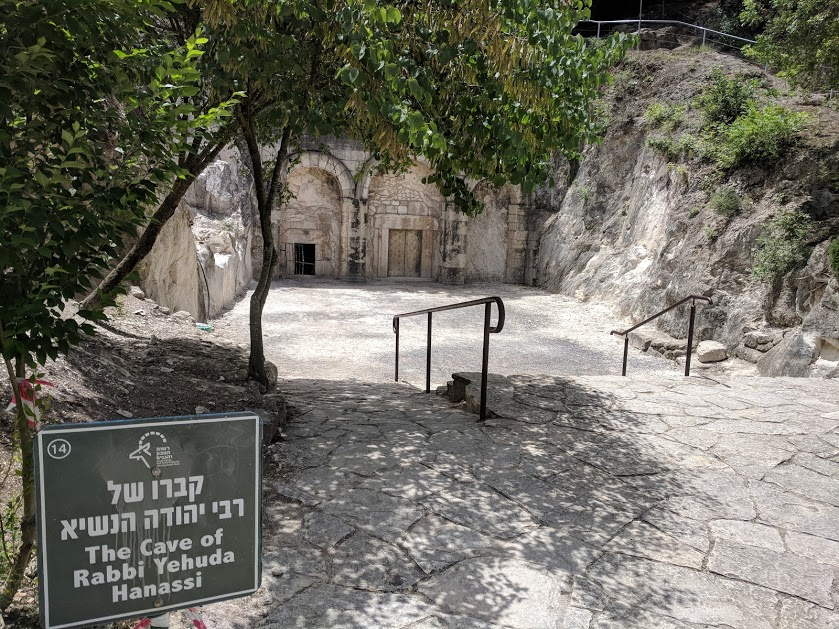
The tomb of Rabbi Hanassi
Rabbi Yehuda Hanasi established a school in Bet She’arim. Although this great rabbi and the compiler of the mishnah moved to Tiberias after seventeen years,.he chose to be buried in a cave at Beit She'arim.
A Decorative Menorah in the Tombs
Many people from around the world greatly respected Rabbi Yehuda Hanasi for his teachings, and desired to be buried close to his tomb.
One of the Tomb Complexes
The Talmud says, “Whoever is buried in the Land of Israel is deemed to be buried under the altar.” Some believed people buried elsewhere would need to roll underground all the way to Israel at the time of the great resurrection.
Cave of the Torah Ark
The tombs at Beit She'arim contain important people from Israel and beyond. People from Antioch, Palmyra, Byblos, Beirut, Sidon, Tyre, Yahmur, Phaena, Arabia, Caesarea, Himyar, and Etsion Gaber were buried at this site.
Grave of Rabbi Gamliel
Large complexes of caves were built under the hills at Beit She'arim during the first three centuries of the Common Era. Some people were buried in wooden coffins, some in stone containers, some laid on limestone and placed into ossuaries. There are many inscriptions over niches in the caves written in Hebrew, Aramaic and Greek.
Photographer of the Tombs

One inscription reads: “I, Justus, son of Leontius and Sappho, lie here dead / And after I had plucked the fruit of all wisdom / I left the light, the miserable parents, who mourn ceaselessly / and my brothers. Woe to me in Besara. / After descending to Hades, I Justus, lie here / with many of my people, for so willed stern fate. / Be comforted, Justus, no man is immortal.

Monday, June 13, 2016

Israel Adventure - Day 5

Today started with a walk to the Caffe Yaffo. Akiva served us mini-lox sandwiches with cappuccino. The food and atmosphere were great.
After breakfast we walked through the Jaffa Flea Market. The shops were interesting. All types of merchandise filled the stores from furniture to appliances. There were tourist items, clothing, artwork, and restaurants. Some were packed and others were well organized. The picture below shows a shop owned by a hoarder - Who knows what is there!?! We only stayed long enough to snap a picture, because that was our purpose there! Probably the owner knew where the good stuff was, but we did not … and tourists are impulse shoppers, so we moved on to the next area.
We found some interesting things in some of the other shops. I found a few items we will bring home, for which we bargained Israeli-style. Looking through the shops was an adventure. In the middle of the flea market are tents, and a huge “Yard Sale.” My mother-in-law would like that. As for us, it was cheap stuff that can be found in American thrift stores.
After the flea market we took the car to Machon Ayalon, an underground bullet factory operated by the Haganah. This is an interesting place and a crucial part of the War for Independence. Up above the underground factory it looked like a regular Kibbutz (collective organization for farming). The buildings were there, some of the industries were there … so the Haganah could escape British scrutiny during this intense time period.
BUT, inside the laundry the Haganah had a secret - and many members of the Kibbutz had no idea what was going on right under their feet! Under the very noisy (to cover up sounds) washing machine (which moved from its “permanent place”) there was a trap door with a ladder that went down into the factory under the hill.
They kept the normal laundry crew in the dark by sending them out to hang clothing every time the door opened to let the 45 secret employees come up for lunch. At the end of the day they made sure the laundry workers had gone home. The mission was top secret.
The factory was a place dug out inside the hill; inside were bullet making machines. Four and a half million bullets were produced in four years of production by 45 volunteer workers from a group of just-graduated high schoolers who, upon completion of Kibbutz training, had been recruited sans details by the Haganah for this secret mission. Two ventilation shafts gave air: The first was in the laundry, and the other shaft was at the bakery, which hid smells of manufacture with the smells of baked goods. This was a very well kept secret, which helped win the Jewish war of independence.
After seeing the underground bullet factory, located on Kibbutz Hill in Rehovot, we went to Yavne. This is the place the Sanhedrin of Israel moved after the Temple was destroyed in 70 AD. The Sanhedrin held the Council of Yavne where they discussed “what now.” They had a lot of issues to solve, such as how to compensate for the lack of a Temple or proper place to make sacrifices. What was to be done about the Atonement Offering? The decisions made at Yavne set the tone for the observance of Yom Kippur today. Many other decisions were made there as well.
There is a tel under which the ancient ruins lie. An Ottoman tower exists on top of the tel, as does Rabban Gamaliel’s tomb (accompanied by Ali Abu Hurairah). Nothing else can be seen on the top of the hill. There is a Temple on the edge of the tel, pictured above. There is also an amphitheater on the other side of the tel, pictured below. The tower at Yavneh can be seen near the trees on the right in the background.
After looking at the Tel we went out to eat in Yavne. Chelsea’s Hebrew skills came in handy since the server didn’t know much English, and we survived and had a great meal, a donair with chicken and various salads.
I talked to a young man there who was interested and excited that someone would come to Yavne because of the council and because Gamaliel lived there.
After returning to our Apartment we walked up the street to the main plaza at Jaffa. Sarah took pictures at the Zodiac Fountain. We plan to go back there tomorrow or Wednesday to see the things on the Plaza.
I lost my passport, a book, my kindle, and a camera in the square at Jaffa two years ago. It was either taken when I walked across the plaza to join our tour group or I hid it very well just before trying to surprise them. I asked the girls to look for the white Lechi bag, and they laughed. Chelsea said, “Why don’t you check with the Police, we filed a report.” So I went to the Police station, where I had a great visit with the officer. He said if found, it would be turned over to the US Consulate. Then we talked about Tel Gezer (he lives near there), and how we have enjoyed our visit.
The police asked if I was Jewish, I answered “Yes, but I became a Christian.”
He asked, “Why?” I told him that someone shared Psalm 22 with me. He asked if that was in the New Testament. I told him, “No, it is in the Tanakh.” I jotted the scripture down for him to look at when he got home.
We then went down to the beach and walked along the water. We walked to Tel Aviv proper, crossed the main road, and went to an old train station (the Tachanah). We looked in some of the shops and then ate ice cream, Halva Gelato … it was good!