I recently looked up the definition of the word ‘church.”
Dictionary.com, Macmillian and Merriam Webster said, “a building used for public Christian worship.” The Cambridge Dictionary added, “a Christian religious organization.” The Free Dictionary added, “Ecclesiastical power as distinguished from the secular”. The Urban Dictionary said, “expression to show approval of a situation.” Vocabulary.com said, “A church is where you go for a public religious service. On Easter, some people go to church to pray.”
The New Testament translates the Greek word “ἐκκλησία” (ekklesia) as ‘Church.’ This word, derived from the compound “ἐκ” (A primary preposition denoting origin (the point whence action or motion proceeds), from, out (of place, time, or cause; literal or figurative) and “καλέω” (to call or be called by name) means “an assembly of the people convened at the public place.” Similarly, the Greek word for Synagogue, derived from the compounding of σύν (a primary preposition denoting union) and ἄγω (to lead by laying hold of, and this way to bring to the point of destination) means “to gather together, assemble, collect, gather, or meet.”
The “church” is not a building at all. It is people who gather together in a public place for a specific purpose.
The apostle Peter wrote the church is “a chosen people, a royal priesthood, a holy nation, God's special possession, that you may declare the praises of him who called you out of darkness into his wonderful light.” (1 Peter 2:9). He is quoting from Exodus 19:6, where God calls Israel, “a kingdom of priests and a holy nation.” Moses also wrote, “you are a people holy to the LORD your God. The LORD your God has chosen you out of all the peoples on the face of the earth to be his people, his treasured possession.” (Deut 7:6)
During the months of August & September 2019, I will write several short blogs about the church. I will look at what it is, what it is not, and hopefully raise awareness so people of the church, or synagogue, or mosque or temple can understand there is a perception problem and better explain who they are and what they do within their local communities.
Showing posts with label Synagogue. Show all posts
Showing posts with label Synagogue. Show all posts
Thursday, August 22, 2019

Tuesday, August 20, 2019
What is a Church?
Perhaps you think “everybody knows that!” or would tell me that the answer to this question is common knowledge in the United States … but you are wrong! In recent years there are many (and that number is growing) people who have no idea what a church is or what a church stands for.
A recent survey (2018) asked the question, “Aside from weddings and funerals, how often do you attend religious services?” 46% (almost half) answered seldom or never. About ten years a group went door to door in a small southern town and asked the question, “do you belong to a church or religious organization in this community?” An amazing 80% answered “no.” Christians who encourage each other by saying, ‘people will come to church if we just invite them,’ fool themselves. Most people who do not regularly attend religious services have no idea what happens in a church, synagogue, mosque or temple.
And how would people know what goes on in a place they seldom attend? Think about it … do you know what goes on inside the building of another religion? Do you know what their services are like? What holy book they use? What they teach, or how they interact with the community? Do you know what they think about your religion? Do you even know how to approach them?
During the months of August & September 2019, I will write several short blogs about the church. I will look at what it is, what it is not, and hopefully raise awareness so people of the church, or synagogue, or mosque or temple can understand there is a perception problem and better explain who they are and what they do within their local communities.
A recent survey (2018) asked the question, “Aside from weddings and funerals, how often do you attend religious services?” 46% (almost half) answered seldom or never. About ten years a group went door to door in a small southern town and asked the question, “do you belong to a church or religious organization in this community?” An amazing 80% answered “no.” Christians who encourage each other by saying, ‘people will come to church if we just invite them,’ fool themselves. Most people who do not regularly attend religious services have no idea what happens in a church, synagogue, mosque or temple.
And how would people know what goes on in a place they seldom attend? Think about it … do you know what goes on inside the building of another religion? Do you know what their services are like? What holy book they use? What they teach, or how they interact with the community? Do you know what they think about your religion? Do you even know how to approach them?
During the months of August & September 2019, I will write several short blogs about the church. I will look at what it is, what it is not, and hopefully raise awareness so people of the church, or synagogue, or mosque or temple can understand there is a perception problem and better explain who they are and what they do within their local communities.
Friday, August 18, 2017
Capernaum
In May 2018 I will be taking a group on a 14 day trip to the Holy Land. During this trip we will visit the Galilee region and Capernaum, a city where Jesus lived for several years. This city on the shores of the Sea of Galilee is an interesting place to visit. The site is maintained by the Franciscans, who have added walkways and benches and maintained the landscape so the story of Jesus’ residence can be told without too many modern intrusions.
 |
| Gate at the Franciscan Monastery of Capernaum |
During our visit to Capernaum, we will enter the archaeological site through gates situated by a Catholic church. Once on the property we will be seated on shaded benches where our tour leaders will explain what can be seen at the site and share associated Bible stories so we can take away a memorable experience.
 |
| Shade trees which protect seating area of Capernaum |
From the benches we will be directed into a fourth century synagogue constructed from imported limestone. Limestone was chosen for the exterior of the Synagogue to give a white (pure) appearance in a village constructed mostly out of the black basalt rock, which was easily available in the region. The fourth century building is well-maintained and enables the visitor to walk within and understand construction and practices in ancient places of worship. Tall pillars and an intact anterior provide photo opportunities and an ambiance to the visit.
 |
| Anterior of the Capernaum Synagogue |
On the south side of the Synagogue, a portion of the earlier basalt synagogue has been uncovered where visitors are able to see a portion of the building in which Jesus and the disciples worshipped.
 |
| Remains of a first century synagogue at Capernaum |
Outside the Synagogue, we will walk through a large area of foundational ruins. Many of the foundations are several feet in height and display steps and other features which will help us visualize the city Jesus called home (Matthew 9:1)
 |
| Ruins of Capernaum from the Synagogue |
Over one area of ruins we will be able to enter a twentieth century church which sits above a residence believed to be the home of Peter’s mother-in-law. The modern church has a glass floor which allows visitors to see foundations of a first century home and a fifth century church. Diagrams give explanation of the existing foundations.
 |
| Looking across ruins of Capernaum to the new octagonal church |
Beyond the ruins we will be able to walk down to the Sea of Galilee. We will visualize the beaches from which Peter, Andrew, James, and John departed on their fishing excursions. These shores are also the place recorded in Matthew 4 where Jesus meets Peter and says, “Come, follow Me, and I will make you fishers of men.”
 |
| Looking from Capernaum across the Sea of Galilee |
On our trip within Galilee we will see Capernaum from several different vantage points. We will see the village from our boat ride on the Sea of Galilee, from the top of Mount Arbel, and if we strain our eyes from Kibbutz Ma’agan, where we will spend three nights. Once we walk through the village of Capernaum in Galilee, each sighting will give us a new perspective as we discover the shores along which Jesus often walked.
 |
| A view of Capernaum from the top of Mt. Arbel |
If you would like to join us on our 14 day trip to the Holy Land click this link. To sign up for the trip click here. I hope you will travel with us during our 14 day trip to the Holy Land in May 2018.
Tuesday, July 11, 2017
Visiting a Biblical Period Home
On a 14 day trip to the Holy Land in May 2018 we will visit the Talmudic village of Katzrin. Within this village we will find well preserved homes and streets reminiscent of what villages looked like during the time of Christ. While in Katzrin we will be able to see and enter homes, study the layout of the village and worship in the Synagogue.

We will enter the national park at Katzrin through a gate. Upon entry our attention will be drawn to Menorah emblazoned on the wall as a mosaic. The picture is colorful and symbolic. The town of Katzrin was known for its faith and the words of at least one Rabbi are immortalized in the Mishnah.

Through the gates we will enter the village of Katzrin along a street containing several standing homes dating to the sixth century AD. The homes are made of basalt rock, which is native to the region of Galilee and the entire Golan Heights. Residents of Israel built homes of rock because it was much more available than wood. Because of climate and geography homes and buildings of historic Israel are much different than homes our twentieth century architecture which relies on the rich woodlands of the eastern United States.
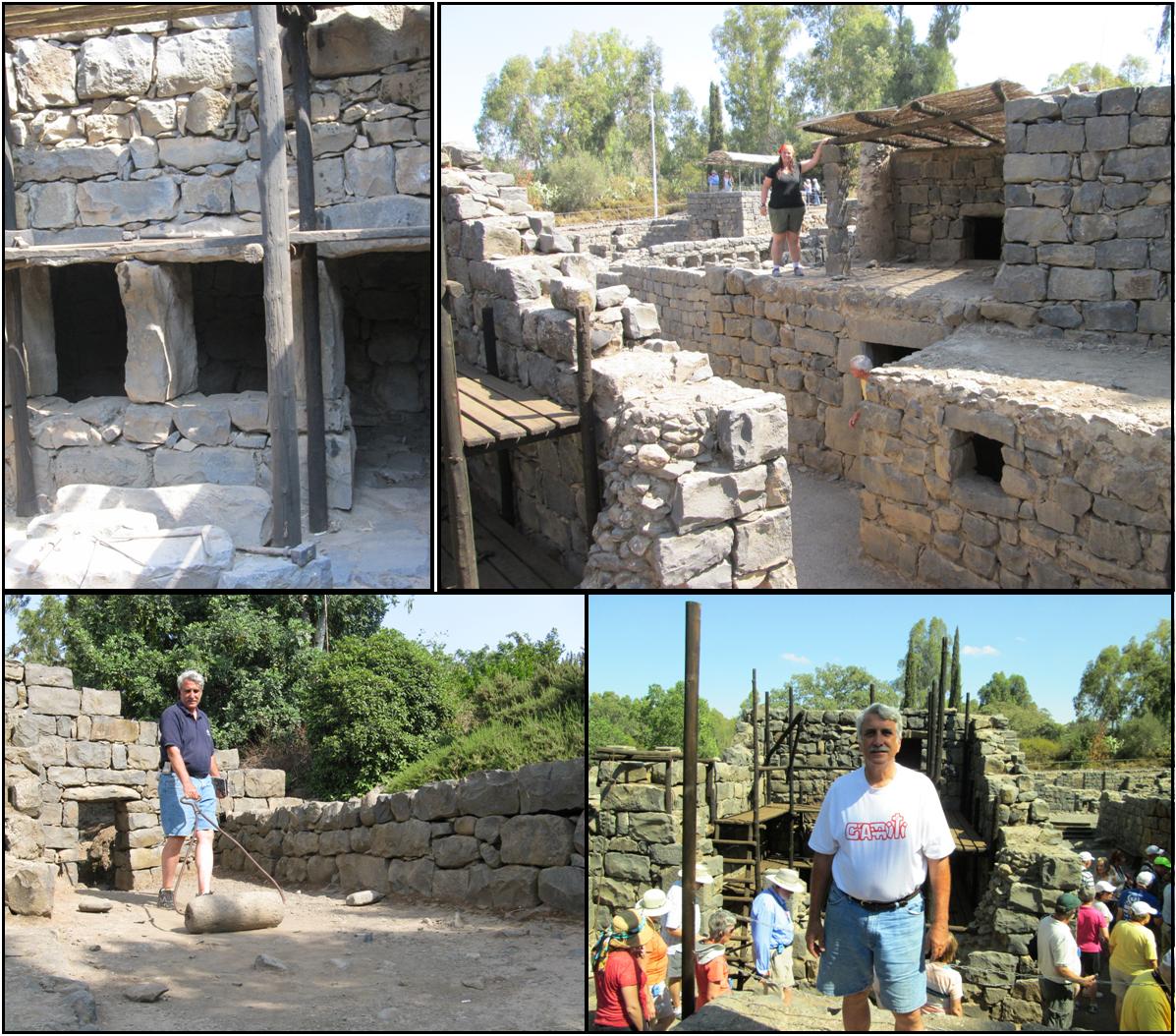
We will make our first stop along the road at a place where we can observe construction practices of ancient Galilee. A set of building scaffolding has been reconstructed so we can visualize early building practices. Nearby we will discover how roofs were built and see the tool used to compact the dirt and thatch so it holds together.

Next to the construction site we will enter a typical house of the New Testament era. We will see and be able to show respect for the Mezuzah on the doorway. This wooden box contains scripture passages from Deuteronomy 6:4-9 and 11:13-21 and remind all who enter a building that it is our faith in God which sets us apart as a people and brings blessings to our nation.
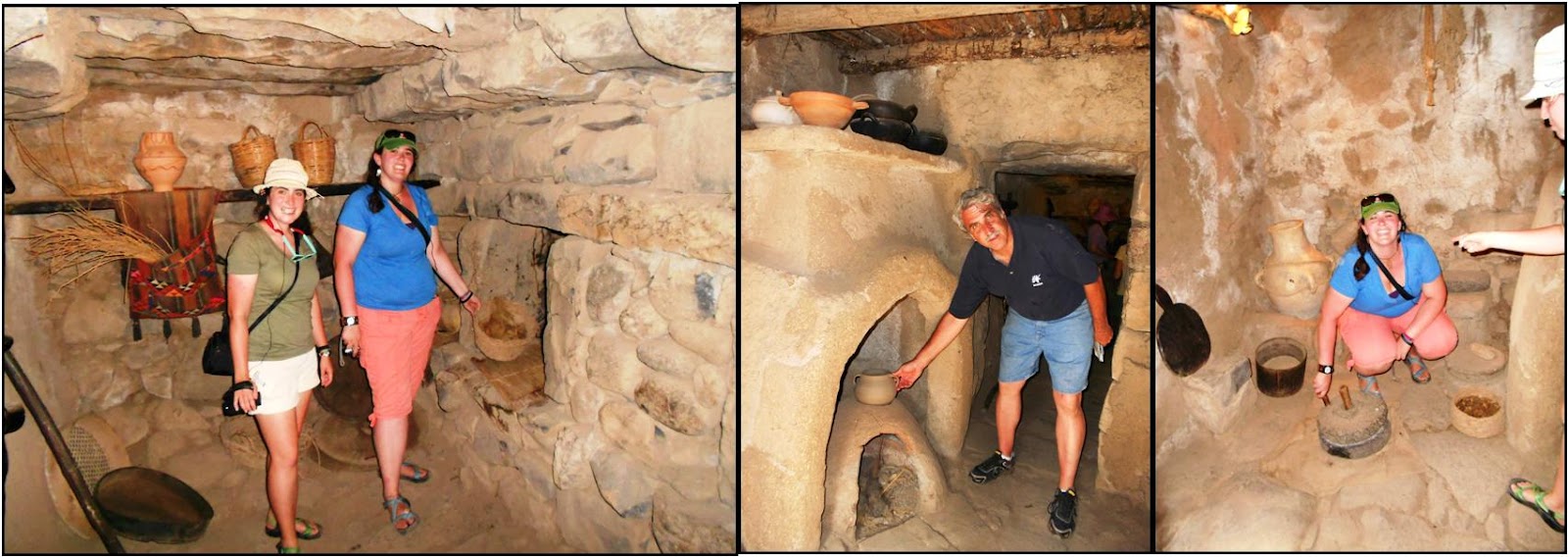
We will enter the house through the kitchen, the workspace of the home where meals are food is prepared and meals are cooked. We will see the oven and the dishes. We will be able to sweep the floor and step back into the days of our Bible, understanding what home life was like for the early disciples.

Beyond the kitchen is a dining area and the living room. It is in this space the family lived. We will observe the dining table, a couch/bed and the ladder which leads to the second level of the home.

On the wall of the home hangs an oil lamp, typical of lighting fixtures in Biblical times.
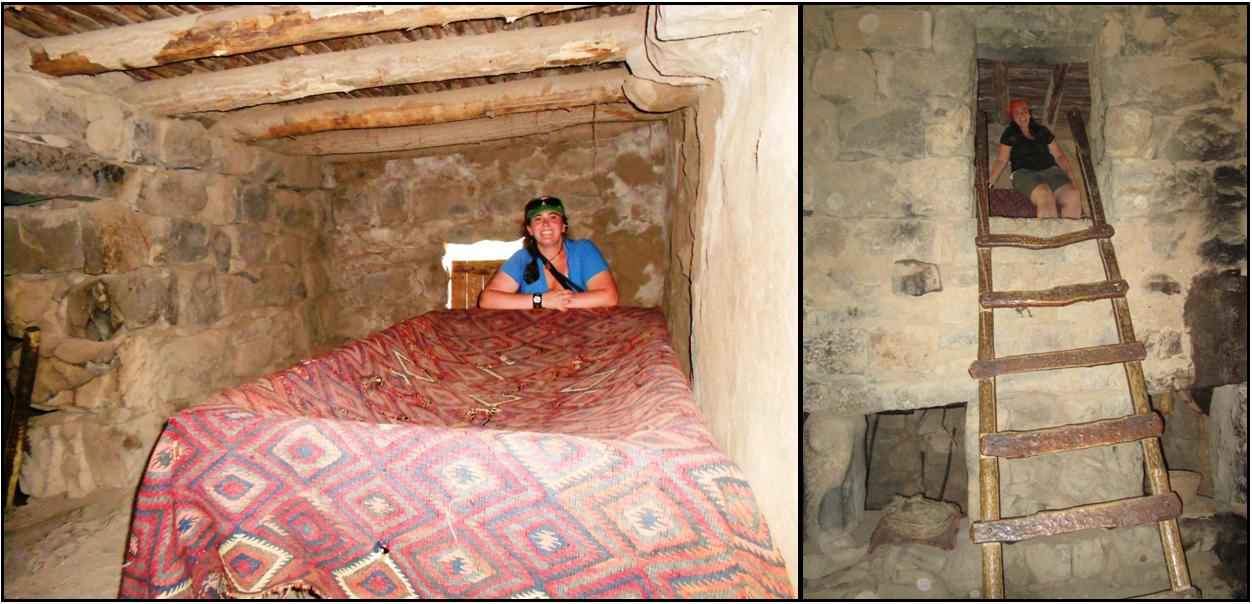
The family slept on the upper level of the home. We will see the large room where the family might have slept together. We will also be able to step out on the roof where the family slept when the weather was hot.
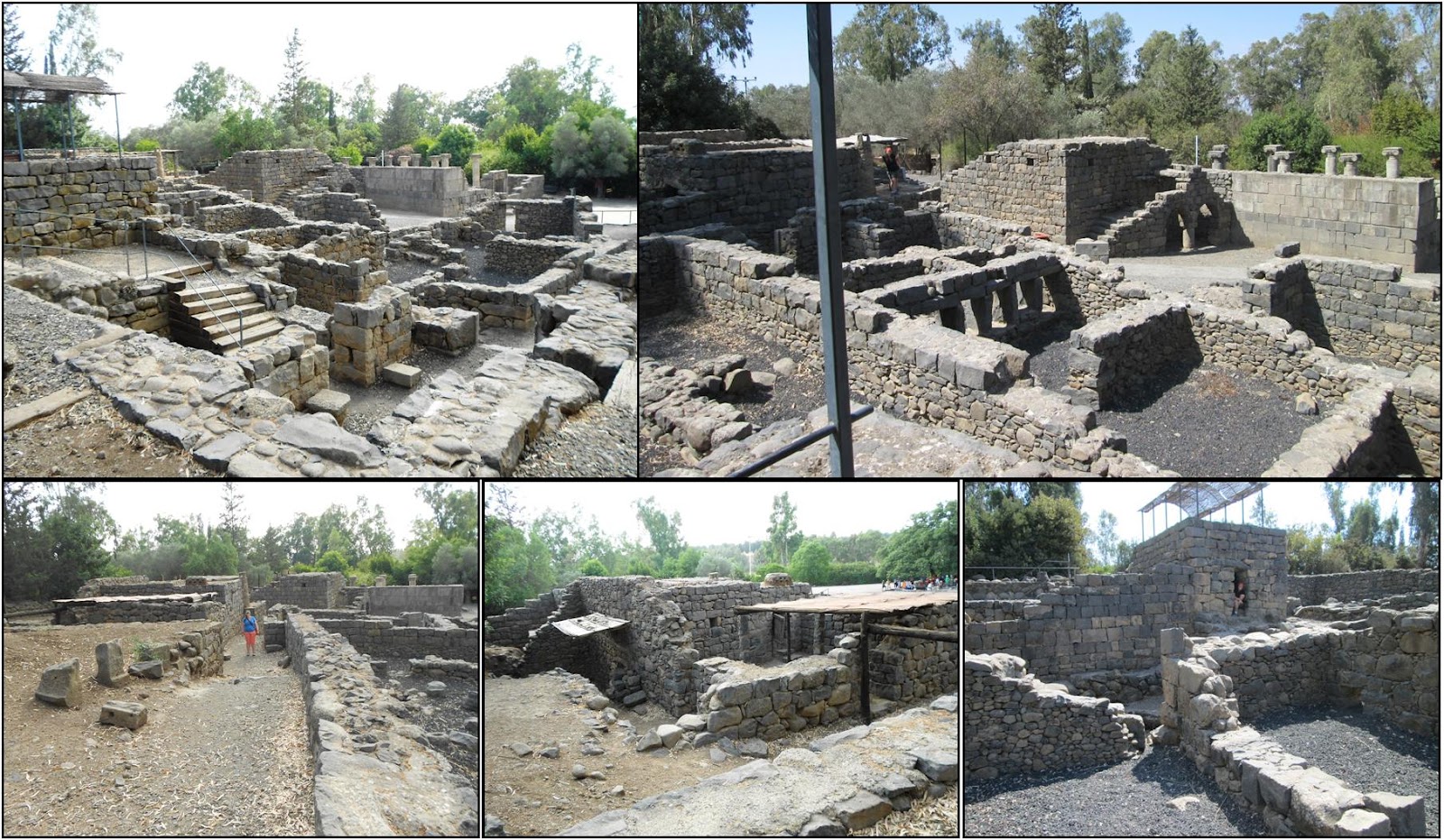
Beyond the house we will move into the rest of the town. We will see the remains of homes and businesses which were destroyed by an earthquake in 749 AD. The layout of the town is still detailed enough for us to understand the consistent architecture of every building. There is an overlook where we can see the layout of the town from a higher location.
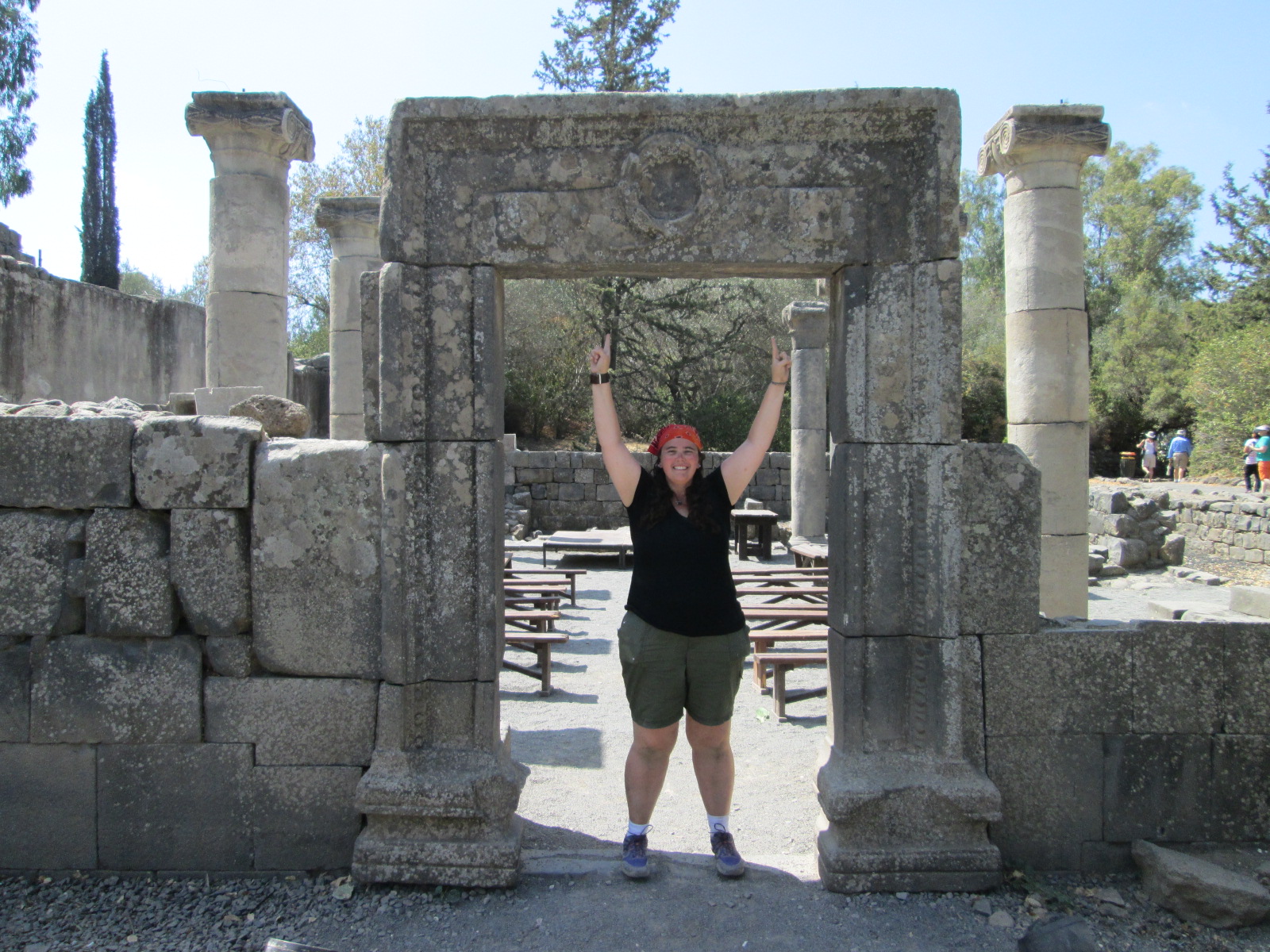
We will visit the synagogue near the exit of the city. We will step through the large doorway of the building and see the carved lintels and stonework. One of the lintels recovered in the area says, "This is the beit midrash (house of study) of Rabbi Eleazar ha Kappar." Rabbi Eleazar is recorded in the Mishnah as saying, “Envy, lust, and ambition shorten man's life." (Ab. 4.21)

We will see, experience and learn many things about the land of Israel and how people of the Bible lived during our 14 day trip to the Holy Land in May 2018. This trip can greatly expand your understanding of the Scripture and help you to visualize Bible stories you hear every week. To sign up, use the link to find more information at www.KosherCopy.com. You will also find links to the trip itinerary and for trip registration.
Friday, June 17, 2016
Israel Adventure - Day 9
We began our morning drinking coffee with Dr. Kalman, the professor from Hebrew Union accompanying the group, on Ben Yehuda Street (a modern pedestrian shopping district in Jerusalem). The time was a casual pre-orientation. During the meeting we were serenaded by a saxophone playing on the mall (including Rebbe Elimelech and Eliyahu HaNavi). Dr Kalman just arrived, and most of the group was getting over jetlag. He gave us some details of what we are doing today and the next few days.

Following coffee he took us to the pedestrian grocery shuk (market), Mechane Yehuda, a few blocks away. We visited a crowded pre-Shabbat market with every kind of food available. We purchased halva and cherries. We also heard a man playing the electric guitar as we waited for the group to finish shopping.

After shopping we parted ways with the group, taking the light rail to Mt. Herzl. There is a cemetery there for Israel’s heroes. Theodor Herzl is buried at the top of the mountain, over which the views are spectacular.

We boarded a bus from there to Ein-Kerem, the home town of Zechariah and Elizabeth. As we rode through the terrain and entered the village I thought about my book Advent Journeys, which in Week 2 looks at the route Zechariah the Priest and Joseph, the father of Jesus, travel to the Temple. I could clearly pick out the route.

The village is in a valley formed by a spring, called Mary’s Spring, where water is constantly running. Above the spring we walked up the mountain to the Church of Visitation. We saw many other pilgrims also visiting the church. We also visited the church of St. John the Baptist, a Franciscan mission. We took a break at a nearby shop and drank Coke while watching pilgrims making their way to the Catholic sites in the area.

From Ein-Kerem we took the light rail back to the Damascus gate. We entered Jerusalem; it was crowded and noisy. It was Ramadan and also Erev Shabbat (the evening Sabbath begins). Shopkeepers were announcing their wares. Many women in their Burkas were in the streets. We made our way through the Old City to the Jaffa Gate, where we crossed the street and entered a park. In the park there were fountains and children playing. It was a hot day and the Sabbath.

We continued past the Artists’ Colony (closed for Sabbath) to the Windmill and Lion’s fountain. Chelsea and Sarah had fun walking in the water. Then we came home.

After a rest at home we visited Shira Hadasha Synagogue, a Modern Orthodox place of worship about one block away. Most of the worship liturgy was sung. Worship held our attention (even though it was in Hebrew), and was a great way to end the day.

Friday, December 4, 2015
Courses of Priests & Retirement age
I find as I talk to people many do not understand the organization or the purpose of the Temple in Jerusalem. We want to relate the Temple to something familiar in our world, to the church. But the Temple was not the church. The Temple was the place of prayer and sacrifice.
In our world there are many churches and many denominations. In the world of Jesus’ time there was one … and only one Temple. The Temple was located in Jerusalem on Mount Moriah. The Temple was the most important institution in Jewish life, instituted by God in the days of Moses, and built first by Solomon, and rebuilt by Zarubabel and then by King Herod. While there were many synagogues, there was one … and only one Temple.
In our world we go to church on Sunday, or as the Jews refer to Sunday, the first day of the week. We attend church on Sunday to worship God and to remember that Jesus arose from the grave on the first day of the week. The Jews go to Synagogue on the seventh day (Sabbath). They go to the Temple when needed. The scripture specifically instructs, “Three times a year all your men must appear before the LORD your God at the place he will choose: at the Festival of Unleavened Bread, the Festival of Weeks and the Festival of Tabernacles. No one should appear before the LORD empty-handed:” (Dt 16:16) The Jews also go to the Temple to make a desired or required sacrifice (See Leviticus 1-7). Some would go regularly for prayer.
In our world we sing hymns and worship, and the same could be done in the Temple. There was not a real song leader or time of singing, however, some of the priests who were musicians would stand between the Court of Israel and the Court of the Women to sins Psalms to the people. There were prescribed Psalms people sang as they ascended to the Temple, prescribed daily psalms sung by the priests, and other psalms people would sing in worship.
In our world we hear a pastor or a priest give a sermon. In the Temple there was no sermon, that is not what the Temple was about. The Temple was a place of sacrifice. People would come, and give their offerings to the priest. They could not enter the Holy Place, only the priests could enter. The people stayed outside. The people prayed. They heard music if the priests were singing. Occasionally there were men, such as Peter, who came to the Temple courtyard and preached. But it was a sideline activity. The main purpose of the Temple was to give offerings to God and to pray.
In our world the pastor is called by the church or sent through the denomination. In the days of Jesus there were no denominations. We read of the Saducees, they served the Temple. We read of the Pharisees, they were lawyers, and worshipped in the Synagogues. The Essenes were a monastic group who lived in their own communities. And there were the Jewish people who connected with the Temple (because the law of Moses ordered this), and the Synagogue, which was a community of faith near their home.
In our world pastors can and do move. In the times of Jesus the Priesthood was by birth. Men were not called to go to a church, they were born into their place of service. Father passed on to son the traditions of the faith and the practice of the priesthood. Men served between the ages of 25 and 50. After 50, men retired and would mentor younger priests.
Through Advent Journeys you will visit a world which is very different that our world. The world of Jesus is worth reading about and studying, for in so doing you understand Jesus, the people around him and the New Testament in a much fuller way.
Subscribe to:
Posts (Atom)


