Showing posts with label Joseph and Mary. Show all posts

Friday, November 18, 2022

The Christmas Hikes

   Have you ever thought deeply about what life must have been like for the people we read about in the Bible? I mean, what was it really: like when Joseph found out Mary was pregnant ... and then when he was told he must pay his taxes in Bethlehem. Have you ever thought about how difficult the trip must have been as Joseph traveled with Mary, who was nearing her time of delivery? How did they traverse the mountains, what did they eat, and where did they sleep? These real people, who were forced into a difficult situation. Would you travel with them if you could? 
   You can! Through a guide entitled Advent Journeys, available on Amazon.com. 
   You can also meet and travel with the Magi, on their way from Parthia to Bethlehem. (And you will be in the room when they meet King Herod!)
Sheep eating leaves of an Olive Tree in Israel

   This guide will allow you to listen in on the voices of the Shepherds as they watched their sheep in the fields near Bethlehem.

   The book  Advent Journeys is designed to lead you into Christmas through short daily readings, beginning the Sunday after Thanksgiving. Please order the book today, so you can read it this season and begin to experience the journeys described in the Bible.


Tuesday, May 29, 2018

The Place of the Angelic Announcement

Today we changed jobs and moved to a new location in Israel. Part of our dig team is now working at a first century water project in Sippori (more about this tomorrow). We are staying in Nazareth.
A view of the altar and old house at the Church of the Annunciation
Sipori and Nazareth are three to four miles apart. It is thought that Joseph walked from his home in Nazareth to work on a government building project in Sippori. Mark 6:3 and Matthew 13:55 list Joseph as a carpenter (τέκτων, a craftsman, or workman).
The Church of the Annunciation in Nazaretth
All four gospels list Nazareth as the place where Jesus grew up. This is the city where Joseph and Mary lived at the time they were engaged to be married. They lived in this city until the time Jesus became active in ministry and moved to Capernaum.
Our hotel in Nazareth
Nazareth was the village where Matthew and Luke report an angel came to Mary with the announcement that she would have a child given by God. The angel also came to Joseph and told him not to divorce his espoused wife for the baby was from God.
The second floor of the Church of the Annunciation
The Church of the Annunciation, which was built in Nazareth in the fifth century, celebrates the announcements of the Angel to both Mary and Joseph to tell them of the miraculous birth.
The altar with an old house where Mary lived
The Church of the Annunciation contains what is reputed to be the home of Mary within the building.
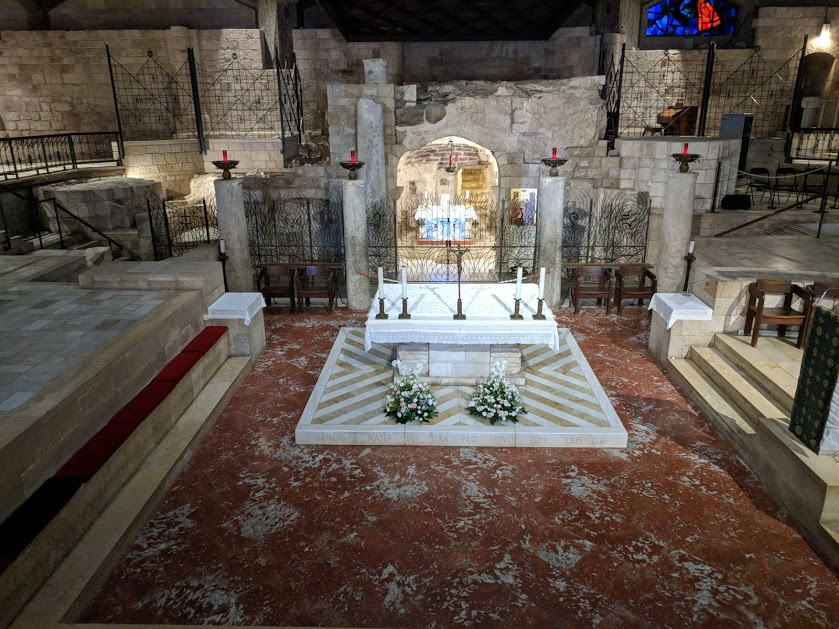
The place of worship at the Church of the Annunciation
The house sits behind the altar on the first floor of the church, The house, built in ancient times, is impressive to see within the modern church building. One room can be visibly seen with a staircase leading up to a second leve. The house can also be viewed from the second floor of the church where there is a circular opening with a railing around it in middle of the chapel. There was a mass on the second floor, and the choir could be heard during my visit to the chapel on the first floor.
The Church of St. Joseph in Nazareth
The Church of St. Joseph sits behind the Church of the Annunciation, and is said to contain ruins of Joseph’s Carpenter shop. Indeed there is a shop with seven steps down, to what is reputed to be a carpenter’s shop.
A picture in the church of St. Joseph
This is the place where Jesus spent his childhood. He was raised as a normal child and probably served in an apprenticeship to his father.
The archeological ruins under the Church of St. Joseph
The first several years of Jesus’ career were spent as a carpenter, possibly in Sippori.
Explaining the Carpenter Shop
There are ruins of what is reported to e the carpentry shop of Joseph in the basement of Joseph’s church. The diagram shows the seven steps down to the shop, the mosaics in the shop and other features. Because of the original rock surface left around the house, one can almost imagine the boy Jesus, playing and working at the site.
Statue of Joseph and Jesus
The churches were not crowded with people when we visited, but the streets were full of people and pigeons.
A plaza in Nazareth with the church in view

The ancient village is now a city which is crowded by people, but within the Church of the Annunciation and the Church of St. Joseph the narrative of this place where Jesus grew from a young boy to a man can still be seen and understood.

Wednesday, March 28, 2018

The Meeting at the Golden Gate

"In the records of the twelve tribes of Israel was Joachim, a man rich exceedingly; and he brought his offerings double, saying: There shall be of my superabundance to all the people, and there shall be the offering for my forgiveness to the Lord for a propitiation for me." (Gospel of James 1)
View of the Golden Gate from the Mount of Olives
According to an ancient legend a beautiful love story takes place between Joachim, a shepherd who tended flocks near Nazareth, and Anne, the daughter of Matthan the priest at the Golden Gate. The tale about the couple relates that they had been married a long time, and loved each other deeply. They were happy and their lives seemed perfect in every way, except that the they were childless. The Joachim and Anne had hoped and prayed for a child, but over the years had become satisfied, because of their love for God and for each other. The accepted as fact that it was not the God’s will for them to have children.
The Vision of Joachim
The Golden Legend, a book of hagiographies by Jacobus de Voragine completed in about 1260 AD, tells the story of Joachim and Ann. It relates how one day when Joachim went to the Temple during the Feast of Tabernacles in order to offer a gift to God, a priest told him his offering was not acceptable because of his wife’s barrenness. The shepherd, who was very dedicated to God was highly distraught, for his relationship with God was pure. He wondered why the Lord would not accept an offering given in love.
The Golden Gate entrance to Temple Mount
Joachim went to pray, and read the stories of Abraham, Elkanah, and Manoah, Each of these men’s wives, although barren for many years, bore sons in old age. Upon understanding the Biblical record of these couples, Joachim realized his offering was acceptable, and immediately returned home. He selected ten of his best lambs and went to make an offering at the Temple.
View of Jerusalem from Mount Scopus
At the same time Joachim’s wife Anne became depressed, went out to the garden and sat down under a laurel tree to pray. While she was in prayer, an angel of the Lord came to her and said, “Anna, Anna, the Lord God has heard your prayer. You will conceive and give birth to a child who will become famous in the world.”
Map of Jerusalem in Temple times
Immediately Anne arose and went to the Temple to pray. As she approached the Golden Gate and was about to enter, she saw Joachim arriving at the same gate with ten lambs from the flock. The two embraced, and Anne asked her husband why he was bringing the offering. He said he had seen an angel who told him, “Joachim, the Lord God has heard your prayer.” The pair entered the Temple in order to give thanks to God.
Joachim meets Anne at the Golden Gate
Nine months later Anne gave birth to a daughter and gave her the name Mary because the years of bitterness and waiting had come to an end. The elderly couple cared for their daughter and brought her up in the Lord. When she became a young woman she was betrothed to a carpenter named Joseph, and from this holy couple was born the Child named Jesus.
Over 250 great stories about Israel

More about this anecdote, and other stories related to the Holy Land can be found in the new book, Israel: Stories for Your Journey, available on Kindle for $1.99.

Wednesday, December 9, 2015

The Central Ridge Highway

The land of Israel is the link which at times connects the fertile crescent, and more often than that this land is the place of separation.  Through the eons different nations and peoples have traipsed upon the Holy Land in order to expand their own wealth and kingdoms.
The land of Israel is incredibly well connected.  Major roads run through the land.  The major road which travels from the north to Egypt along the level plain of Sharon is called the via Maris (by way of the sea).  Beyond the Jordan River the King’s highway runs between Arabia and the Euphrates, where both the Via Maris and King’s Highway connect with the Silk Highway.  These are the roads traveled by nations and their armies.
The common man has sought to escape these major thoroughfares for less traveled local roads.  Thus Abram, when he first traveled from Haran to the south took the Central Ridge Highway.  This is a more local road that travels the spine or watershed of the mountains.  From the lofty heights of this road the traveler can see where he has been and where he is going.  He can also see from east to west: from Mediterranean to the Jordan Valley.
The Central Ridge Highway is the main road of the Biblical narrative.  Abraham, Isaac, Jacob and his children walked this road.  Joshua, Samuel and Saul traveled this way as well.  Elijah, Elisha, and Amos used this road.  And Joseph took Mary along this path which later Jesus would traverse also.  
The road, also called the Way of the Patriarchs runs north and south, and is connected by crossroads from the sea to the Jordan River.  Important intersections can be found at Jerusalem, Bethel, Shechem, and Hazor.  The Philistines attempted to take this road through Aijalon Valley, Sorek Valley, Elah Valley, Guvrin Valley and Lachish Valley.
Through the book Advent Journeys you can join Joseph and Mary as they travel the Central Ridge Road from Nazareth to Bethlehem.

Saturday, December 5, 2015

Roman taxation

There is a tendency to relate the things of our world and our culture to other peoples, times and places.  But the idea does not always work.  The place where I live, the United States is a great nation, the mightiest nation in the world.  This assures me of great safety and immunity from foreign attack.  As a citizen of the United States I am given great privileges.
The same was not true for Joseph and Mary.  Their land was occupied by the Romans, and they were subject to this foreign people.  They were forced to pay their taxes, carry their loads, and remain obedient to these pagan rulers - or die.
And so we begin the Christmas story.  Joseph is ordered to go to the place of his nativity to be counted in a census and taxed.  The Syrian governor desired an accurate count of his citizens.  He needed taxes to maintain his military and his lifestyle (and to give a tribute to Rome).  And in the process of the taxation he wanted to push the people a little in order to show them who was boss.  Joseph and Mary were forced to travel for a reason: to prove they were subjects of an occupied nation.
Through their occupation and forced obedience, Joseph and Mary held fast to a dream, a dream which was shared by many of citizens of Galilee in their day: to be free of the occupation.  Galilee was a hotbed for a group known as the Zealots, who desired to throw off the foreign rule and claim freedom.
While for many people emancipation from the occupiers was only a dream, the Jewish people knew with the right leadership the fight for freedom could be a reality.  While Israel was only a small, impoverished nation, this people who shared both a nationality and a faith knew that small, impoverished people can, if allowed by God, defeat the most mighty empire on the earth.  … And how did they know?  Because it had happened for their great grandparents 160 years before Jesus was born.
Here the story intersects (on purpose) with a festival of the Jews which begins tomorrow.  For as we look at the Hebrew Calendar for 2015 (5776), we find tomorrow, December 6, is the first evening of Chanukah.  If you are Jewish (or as a Christian if you want to) it is time to pull out the Menorah, the dreydles, the Chanukah gelt, and make sure you have ingredients for Latkes.
Joseph, Mary, the Shepherds, and the Jewish people today recall through Chanukah of a time past when the nation was under occupation: not to the Romans, but to Greek rulers called the Seleucids.  These rulers demanded taxes, they pushed their culture and their religion, and they made life miserable for the Jewish people.  Especially Antiochus Epiphanes, who not only suggested - but demanded the Jews bow down to idols.
A Jewish Zealot by the name of Mattathias objected.  And with the help of his sons and the people, they threw off the foreign occupation, and became free - until the Romans came.  And the ember of hope which blazed into freedom under the Maccabees was still glowing: if only there would come a leader.
Joseph and Mary held this hope, for a time, because there were many who believed the purpose of the Messiah was to overthrow the Roman occupiers.  During the life of Jesus his family came to understand he did not com to overthrow the Roman Empire - but the empire of Satan.  It is to Jesus we owe our freedom, for He is light of the world.