Showing posts with label Maccabees. Show all posts

Saturday, December 1, 2018

Hanukkah, Is that in the Bible?

     I hear the title of this blog asked as a question again and again as I take out my dreydel to spin it, or as I say, “Happy Chanukah” as a holiday greeting to people I meet. There are some who do not know what Hanukah is, and I am glad to relate the meaning of the festival. There are some who are uncomfortable with anything that has religious connotation. For these I am sorry, because I am not trying to ‘convert’ them to Judaism, I am just sharing a festival that brings joy to many (a cultural note and a historic event). Then there are yet others who seem a bit perturbed that I would issue that greeting, because they are Christians and the Jewish holiday is not part of their chosen experience. There exists, among some, ‘if it isn’t in the New Testament, it doesn’t matter.’
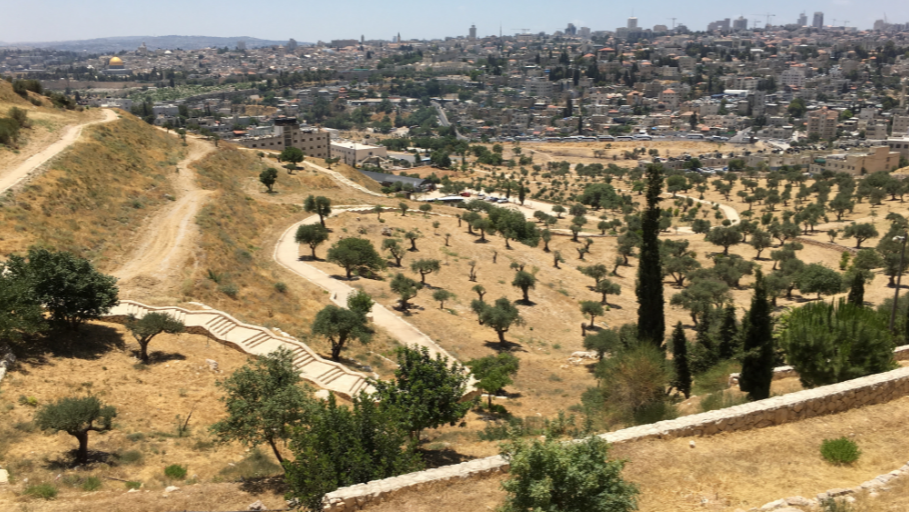
Jerusalem from Mt. Scopus (North)
     And here is where these “New Testament Only” Christians are mistaken. Hanukkah does exist in the New Testament (and even though it is a Jewish holiday, there are no references to this festival in the Old Testament). Here it is, from the Gospel of John 10:22-23, “Then came the Festival of Dedication at Jerusalem. It was winter, and Jesus was in the temple courts walking in Solomon’s Colonnade.” Beyond the Apocrypha, the only Biblical reference to this Jewish festival is in the Gospels.
Jerusalem from Haas Promenade (South)
     John’s Gospel points out that Jesus knew of and celebrated the festival of Hannukah. This festival is the Feast of Dedication, a holiday to remember when the Hebrew army under the command of Judah Maccabee defeated the Hellenistic forces in Jerusalem to recapture the Temple. As a matter of faith, religion and victory, Judah, his brothers, and the people of Israel were very quick (maybe too quick) to pull together the people and items necessary to re-start Temple worship and the practices of their faith. They rededicated the house of God (therefore the New Testament title for the holiday) with praise and palm branches, and with harps and cymbals and stringed instruments, and with hymns and songs.
Jerusalem from Pater Noster (East)
     There can be little doubt that Jesus would have lit a menorah for Chanukah. The Talmud (Shabbat 21b) relates that Hillel and Shammai argued about lighting the candles. Hillel believed that a light should be added for each night so the glow would grow throughout the festivities. Shammai believed eight candles should be lighted the first night, and then one less each night in order to remember the offering of bulls during the Feast of Tabernacles. The menorah was placed by the doorpost (as the Mezuzah was placed on the doorpost) in order to declare faith in the God who redeemed Israel.
Jerusalem from the Tower of David (West)
     The festival of Chanukah contains a story that people of faith can stand behind. It is the recitation of how the household of Mattathias, even when faced with punishment and death, did not neglect the practice of their faith. At the heart of the story is the command by a Hellenistic soldier for Mattathias and his village to bow down to an idol. The village priest and his family refuse to deny their faith.
A book worth reading!
     I have related some stories of the Maccabee rebellion in the book Advent Journeys, available as a book, as a Kindle e-book, and readable through Amazon Prime). If you want to become more personally involved with the Christmas … and the Chanukah story (week 6 of the book), I would encourage taking time to read Advent Journeys, as a book, on Kindle, or through Amazon Prime.

Saturday, June 16, 2018

Tel Hadid

I have just completed a week of an archaeological probe at Tel Hadid, Israel.
A map of Tel Hadid
Tel Hadid is located on a hill on the north side of the entrance to the Ayalon Valley. Tel Gezer is located on the south side of this important transportation zone which leads up the hill to Jerusalem.
Sheep grazing on olive trees at Tel Hadid
The ancient walled city is listed in the Mishnah (Arachin 9:6) as existing in the time of Joshua. Archaeological researchers are interested in the site because several land transfer documents have been found which date back to the times of King Hezekiah, and to the Assyrian and Babylonian conquests of the land of Israel.
Test probes at Tel Hadid
It is thought that after the deportation of the ten northern tribes of Israel that the Assyrians placed a diverse group of people from many nationalities in the land called Samaria. They did this to prevent uprisings in occupied territories. The cultural identity of the people took years to develop into anything more than displaced peoples.
A day's finds from our hole at Tel Hadid
The Maccabees had a presence in this city, which they called Adiada, which is close to Modi’in. Coins and other remains have been found from this period, one of which was a coin found in the probe I was assigned to dig. I asked if the Maccabean coin was from Judah or Simon, and was told I would have to wait until the final reprot.
A Hasmonean Coin from our hole at Tel Hadid
Other coins and metal objects, some extremely rare were also found during our dig.
Highway 6 runs under Tel Hadid

The work at Tel Hadid began as a salvage operation about twenty years ago, as Israel Highway 6 was being planned. Tel Aviv University is mapping and performing test probes in this area, and will begin an actual dig next year. You can go to their website for more information, or if you want to dig at this place. New Orleans Baptist Theological Seminary will be working with Tel Aviv University as they dig.

Sunday, June 10, 2018

A Hasmonean Fortress

Yesterday was Shabbat, a day of rest and enjoyment in Israel. The group I am digging with drove to Masada, Caesarea and Ashkelon. Because I have visited two of these sites, I decided to take another walk, across Highway 1 to Ayalon Canada Park.
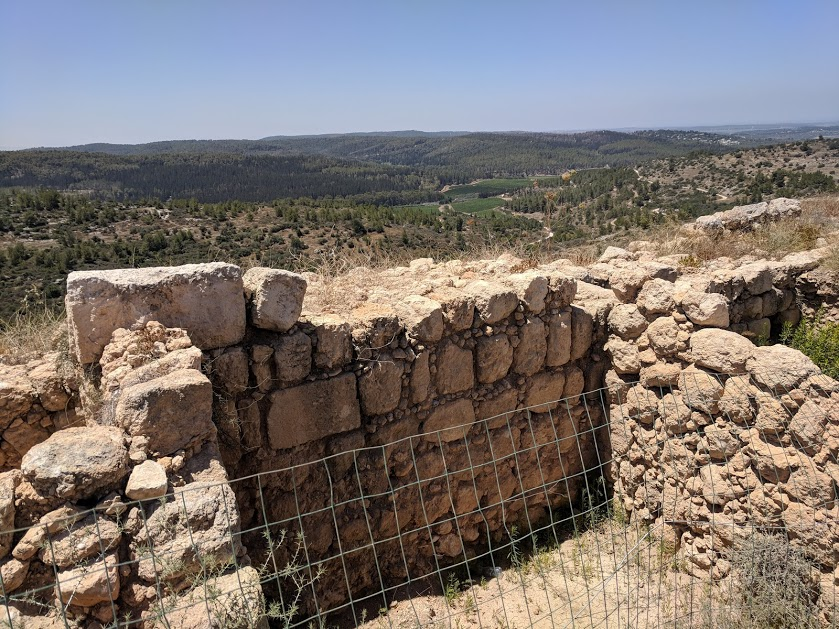
Wall at the Hasmonean Fortress in Ayalon Park
The park contains several ancient and not so ancient places.
Map of Ayalon Canada Park
The park is located on a ridge near the Ayalon Stream. Citizens of Canada planted trees along the ridges of this park through the Jewish National Fund.
Chapel at Emmaus
The park is located near a place called “Emmaus.” Some consider this the place that two disciples visited with Jesus after his Resurrection (Luke 24). Various scholars debate this and list at least two other potential sites for Emmaus. There are remains of an ancient chapel and a modern church next to the park.
Hasmonean Fortress near Emmaus
Emmaus is mentioned in the books of the Maccabees. 1 Maccabees 4 says, “Gorgias (the Seleucid general) took five thousand infantry and one thousand select cavalry, and this division moved out secretly at night. He wanted to come to the Jewish camp and attack without warning. Men from the elevated fortress served as his guides. But Judas heard about it, and he and his warriors moved out to attack the king’s forces in Emmaus…”
Hasmonean remains in Canada Park
I visited the Hasmonean fortress built around 165 BCE which is located on a high hill.
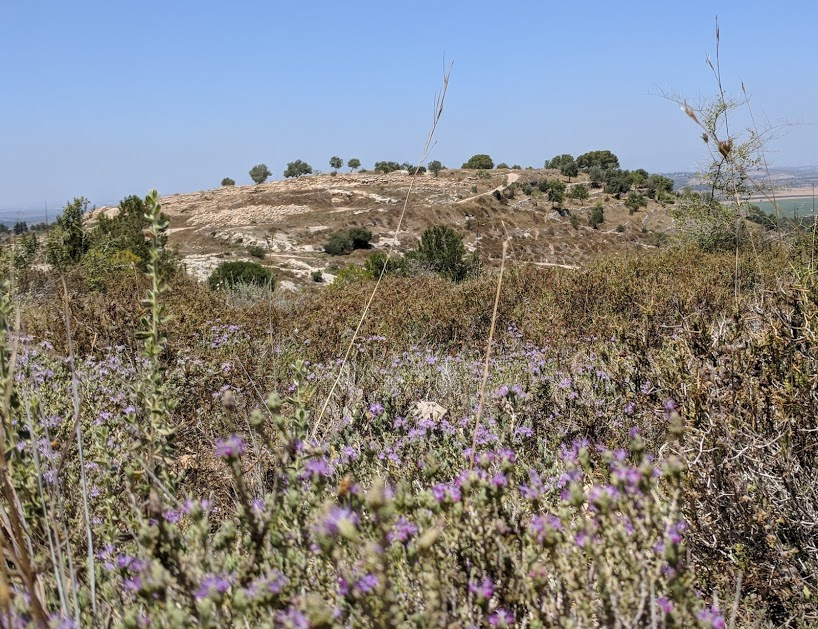
Hilltop with a Hasmonean fortress
Neve Shalom, the hotel of our residence while on our current archaeological dig is clearly visible from this high location.
Hasmonean Building near Emmaus
There are walls,
Hasmonean Fortress
Buildings,
Hasmonean Buildings carved from stone
Caves,
Caves for hiding in the Hasmonean Fortress
And even a Mikvah pool within the Hasmonean Fortress.
Mikvah Pool in the Hasmonean Fortress
The fortress was also used during the Bar Kochba in 135 AD.
Bar Kochba escape hole
Bar Kochba’s soldiers dug escape routes under the ground,
Bar Kochba escape Cave
Which are entered through holes in the ground.
Retaining Ponds in a valley
There are several springs in the park, and an elaborate system of aqueducts
Roman aqueduct in Ayalon Canada Park
Built by the Romans.
Second Century Roman aqueduct
The splendor of the system can be easily seen,
Roman aqueduct in Ayalon Canada Park
(I walked down the hill along the water system),
Roman aqueduct in Ayalon Canada Park
And there is a beautiful pool and plaza at the end.
Pool at the end of the Roman aqueduct

Canada Park is located close to Modi’in, which is the city of Chanukah.

Friday, August 19, 2016

What a Summer!

With the beginning of school in focus, summer travel is officially over. For my family, this summer will long be remembered. Both of my daughters were involved in archeological digs in Eretz Israel with their schools. Sarah went to Tel Gezer in May (see her blog here), and Chelsea dug at Tel Dan in July (see her blog here). Both digs had significant findings.
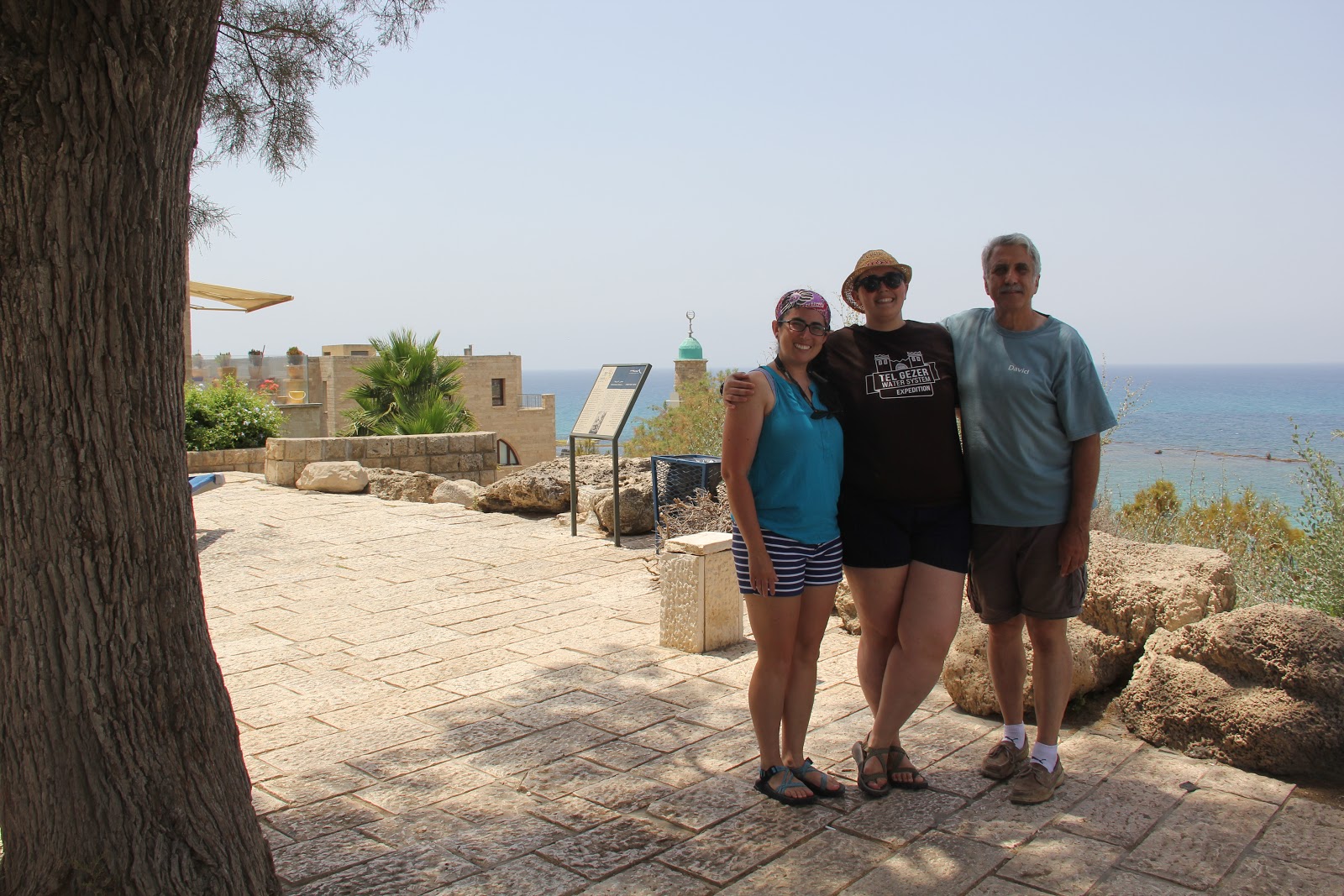
Joppa - Andromeda Rocks behind us
I traveled to Israel with Chelsea to meet Sarah at the end of her dig. We toured Tel-Aviv, Jerusalem and areas in-between for a week and a half before joining Chelsea’s Hebrew Union archeology introduction. Four days into the lessons taught by Dr. David Ilan (which we thoroughly enjoyed), Sarah and I flew back to the United States.
Eiffel Tower in Paris
Along the way, we visited the Eiffel Tower in Paris and Sarah visited with friends in New York City.
Our time together and apart in Israel allowed each of us to experience life and see sights beyond the scope of a normal tour group. The sights, sounds, smells as well as the people we met will long be remembered.
Modi'in from Ayalon Canada Park, Israel
What were my favorite places? I can not relate them all (see my blogs from June and July), but one of my personal favorites was Canada Park.
The park was so named because Jewish communities in Canada planted trees through the area creating an attraction for outdoor enthusiasts. I talked to bikers and hikers who shared their enthusiasm for the area. The weather is often idea for outdoor recreation. The scenery is beautiful and history is to be found throughout the area.
I was drawn to the park because it is close to Modi’in, home of the Maccabees of Chanukah. I had previously looked up an ancient synagogue, which I hoped to find. Before our arrival I had learned the ruins were covered over to protect them, but I could not learn of their location.
I asked one group of bicyclists if they knew of the ruins. They pointed me to Emmaus, which is at the entrance to the park. Emmaus (which means warm spring) was identified by Eusebius as the site where Jesus broke bread with Cleopas. Emmaus is also recorded in 1 Maccabees 3:55-4:22 as the place Judas Maccabeus claimed a victory over the Seleucids. This was not the site of the Synagogue, so we went further.
Another group of bikers pointed us up a ridge to more ruins. The view from the ridge was beautiful, looking down on the modern city of Modi’in. We took several pictures from an overlook, and more bikers too a picture of the three of us together. Then they told us of some more ruins which were on the other side of the ridge.
Hasmonean Fortress Ayalon Canada Park, Israel
We crossed over and hiked higher up the ridge. There appeared before us a long wall of large stone. Inside the wall we found ruins of buildings along with olive presses. From the ruins we could look across Ayalon Valley to Latrun Hill (where Sarah stayed during her dig) and Gezer. [for more photography from this area see background photos on Sarah’s website … excellent job Sarah!!]
Looking across Ayalon Valley toward Gezer
The ruins are called Eked Antiquities, and is a fortress built by the Hasmoneans (Maccabeaus) in about 167 BC. Soldiers of Simon Bar Kochba also used this fortress and dug “get-away” tunnels through the cisterns of the fortress. We later saw more information on these tunnels and a note written by Simon Bar Kochba at the Eretz Israel Museum in Tel Aviv.
Sign in Eretz Israel Museum
Do you like adventure? If so, I want to invite you to go with my family to Israel in June 2018. We will walk and explore the land. (Yes, we will have busses, if you do not want to walk, but something is missed unless we journey at least part of the way on foot, as the people of Jesus’ day walked the land.) I promise that on the trip we will explore new places, learning more about the land and the people of the Bible. If you are interested in this trip, please let me know. The trip is limited to about 50 people, which is one bus load.

No deposit is needed at this time, only a group of people who say, “I’m interested.”

Saturday, March 19, 2016

Stories of Palm leaves & Victory

Today is a day of victory stories and celebrations with Palm leaves.  We all know that Jesus rode into Jerusalem on a donkey amidst great celebration with people laying down palm branches and clothing to build up the road.  Why do we have this tradition?  There are stories, some of which have been forgotten.  
Having grown up in south Florida, palm branches are fun to wave and build outdoor structures (like lean-to's, pirate shacks, tree houses, picnic shelters, and Sukkot tabernacles).  Palm leaves speak of vacations in warm places.  Even in Israel the symbol of Jericho was the Palm Tree.
Palm leaves are symbolic and have been used throughout history as emblems of joy and victory (Ps 92:12).  They were engraved throughout the Temple, beginning on the basins at the entrance of the Temple.  They are used during the Feast of Tabernacles to show God’s bounties. (Leviticus 23:40)
The stories start with the triumphant entry when King David brought the ark of the covenant into Jerusalem.  “David went and brought up the ark of God from the house of Obed-edom to the city of David with rejoicing.... And David danced before the Lord with all his might. And David was wearing a linen ephod. So David and all the house of Israel brought up the ark of the Lord with shouting and with the sound of the horn. (2 Sam 6:12-15)
Likewise, there was great celebration when Jehu was anointed King by the prophet Elisha. When Jehu came out to the servants of his master, they said to him,“Is all well? Why did this mad fellow come to you?” ... He spoke to me, saying, ‘Thus says the Lord, I anoint you king over Israel.’” Then in haste every man of them took his garment and put it under him on the bare steps, and they blew the trumpet and proclaimed, “Jehu is king.” (2 Kings 9:11-13)
The Jews look forward to the time the Messiah will come into Jerusalem in the midst of great celebration.  “Rejoice greatly, O daughter of Zion! Shout aloud, O daughter of Jerusalem! Behold, your king is coming to you; righteous and having salvation is he, humble and mounted on a donkey, on a colt, the foal of a donkey.” (Zech 9:9) “Go through, go through the gates, Clear the way for the people; Build up, build up the highway, Remove the stones, lift up a standard over the peoples. 11 Behold, the LORD has proclaimed to the end of the earth, Say to the daughter of Zion, "Lo, your salvation comes; Behold His reward is with Him, and His recompense before Him." (Isa 62:10-11)
Stories of the Maccabees include palm leaves during two victorious marches into Jerusalem.  The first was when Judas Maccabee celebrated the recapture of Jerusalem with dancing, singing and palm branches. “The Jews celebrated joyfully for eight days as on the Feast of Booths, remembering how, a little while before, they had spent the feast of Booths living like wild animals in the mountains and in caves. Carrying rods entwined with leaves, beautiful branches and palms, they sang hymns of grateful praise to him who had successfully brought about the purification of his own place. By public decree and vote they prescribed that the whole Jewish nation should celebrate these days every year.” (2 Macc 10:6-8)
Twenty years later Jerusalem was under attack again, from Egypt, because of poor defenses.  They appealed to their High Priest and Prince, Simon Maccabee for help.  He rebuilt the defenses and the raids stopped.  “There was a great celebration in the city because this terrible threat to the security of Israel had come to an end. Simon and his men entered the fort singing hymns of praise and thanksgiving, while carrying palm branches and playing harps, cymbals, and lyres. Simon issued a decree that the day should be joyfully celebrated every year.” (1 Macc. 13:51-2)

So it is against the background of many stories about victorious entries and palm leaves that Jesus enters Jerusalem.  John tells us “The large crowd that had come to the feast heard that Jesus was coming to Jerusalem. So they took branches of palm trees and went out to meet him, crying out, ‘Hosanna! Blessed is he who comes in the name of the Lord, even the King of Israel!’” (12:12-13).
Of course there are other stories also, like stories of donkeys ... but more on that later.
Saturday, December 5, 2015

Roman taxation

There is a tendency to relate the things of our world and our culture to other peoples, times and places.  But the idea does not always work.  The place where I live, the United States is a great nation, the mightiest nation in the world.  This assures me of great safety and immunity from foreign attack.  As a citizen of the United States I am given great privileges.
The same was not true for Joseph and Mary.  Their land was occupied by the Romans, and they were subject to this foreign people.  They were forced to pay their taxes, carry their loads, and remain obedient to these pagan rulers - or die.
And so we begin the Christmas story.  Joseph is ordered to go to the place of his nativity to be counted in a census and taxed.  The Syrian governor desired an accurate count of his citizens.  He needed taxes to maintain his military and his lifestyle (and to give a tribute to Rome).  And in the process of the taxation he wanted to push the people a little in order to show them who was boss.  Joseph and Mary were forced to travel for a reason: to prove they were subjects of an occupied nation.
Through their occupation and forced obedience, Joseph and Mary held fast to a dream, a dream which was shared by many of citizens of Galilee in their day: to be free of the occupation.  Galilee was a hotbed for a group known as the Zealots, who desired to throw off the foreign rule and claim freedom.
While for many people emancipation from the occupiers was only a dream, the Jewish people knew with the right leadership the fight for freedom could be a reality.  While Israel was only a small, impoverished nation, this people who shared both a nationality and a faith knew that small, impoverished people can, if allowed by God, defeat the most mighty empire on the earth.  … And how did they know?  Because it had happened for their great grandparents 160 years before Jesus was born.
Here the story intersects (on purpose) with a festival of the Jews which begins tomorrow.  For as we look at the Hebrew Calendar for 2015 (5776), we find tomorrow, December 6, is the first evening of Chanukah.  If you are Jewish (or as a Christian if you want to) it is time to pull out the Menorah, the dreydles, the Chanukah gelt, and make sure you have ingredients for Latkes.
Joseph, Mary, the Shepherds, and the Jewish people today recall through Chanukah of a time past when the nation was under occupation: not to the Romans, but to Greek rulers called the Seleucids.  These rulers demanded taxes, they pushed their culture and their religion, and they made life miserable for the Jewish people.  Especially Antiochus Epiphanes, who not only suggested - but demanded the Jews bow down to idols.
A Jewish Zealot by the name of Mattathias objected.  And with the help of his sons and the people, they threw off the foreign occupation, and became free - until the Romans came.  And the ember of hope which blazed into freedom under the Maccabees was still glowing: if only there would come a leader.
Joseph and Mary held this hope, for a time, because there were many who believed the purpose of the Messiah was to overthrow the Roman occupiers.  During the life of Jesus his family came to understand he did not com to overthrow the Roman Empire - but the empire of Satan.  It is to Jesus we owe our freedom, for He is light of the world.