Showing posts with label Sheep. Show all posts

Saturday, April 1, 2017

Jesse’s Sons: Part 2

Eliab and his father Jesse spent the month descending the steep slopes below Bethlehem and then another month guiding their herd through the rich agricultural lands along the Elah river allowing the sheep to graze on the barley stubble. The valley was greener and the trees were taller than around Bethlehem, which he called home. The people of this region were odd, not like his friends in Bethlehem. They spoke with a different accent, ate unclean foods and paid homage to strange gods.
Early picture of the tel at Gath
As the shepherds and their sheep rounded the bend past Azekah the Valley began to widen and Eliab was amazed at the large city and the fortress which appeared before him. The hill was at least 300 feet tall with a white coloration, and even from what would normally be a two hour walk (if he and his dad were not slowed by the pace of the sheep) he could see high walls along the ridge upon which the city sat. His father told him this was the powerful city of Gath (Tell es-Safi), a stronghold of the Philistines and the sons of Anak. Jesse saw the look of amazement on his son’s face and stopped him to explain.
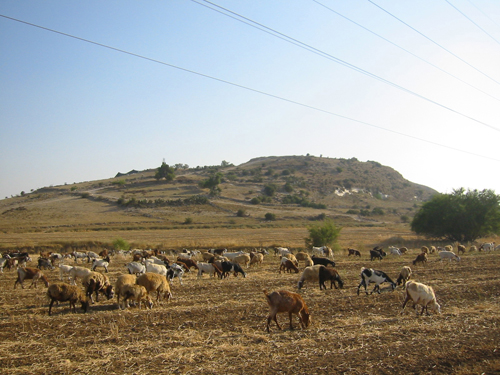
Sheep below Gath - Aren Maeir, Bar-Ilan University
“You will find these people different than our people, and they are unlike the Canaanites we have seen in the valley. These are the Sea Peoples, a strong civilization of warriors who feel that they should own the world. The Philistines rule their territory from five strong cities, Ekron is five miles north. Ashdod, Ashkelon and Gaza are to the south and closer to the coast. Gath ruled by King Achish who is the guardian of the Valley of Elah and the coastal plain below his city. He will allow us to graze our sheep in his territory because the people need meat and wool which comes from our animals. But do not trust anyone, and do not go out of your way to talk with them. Answer when spoken to, but keep your conversations short.”
Gath from the air - from Ferrell Travel Blog
Jesse explained to Eliab, and to his other sons when they first beheld this city, that the people were as strong as their city walls. They had developed a metal called iron, which was far greater in strength than any material which the Hebrews could use. If confronted in a fair face to face, hand to hand, strength to strength battle the Philistines would probably win because their weapons and training were superior to anything Jesse or his people possessed. There were giants in the city, which Jesse had seen. Several were at least eight feet tall, and probably larger. Eliab was to keep his distance from these people, and he was to let his father deal with them as they sold food and cloth.
Jesse had been in the city which was very large, loud and cosmopolitan. The gates of Gath were formidable. The ramparts atop the wall were expansive, and the King’s palace was elaborate. The market was several times larger than any village in the Judean highlands and the dwellings were several stories tall. The city was a busy place in which a person could easily get lost, and if not careful a man could get hurt or killed by these warrior people.
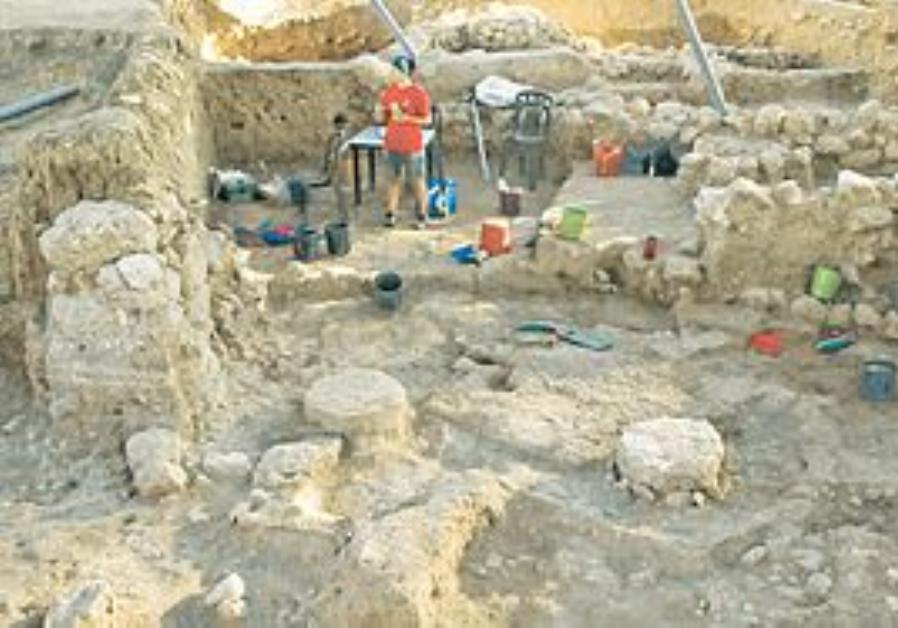
Area F staff and the Early Bronze fortification wall at Tell es-Safi/Gath
The people were especially proud of their great temple to dagon, a god of grain. Jesse told the story of how the Hebrew people battled with them during the settlement of the land and how at one time they captured the Ark of the Covenant. He said, “It was only by the strength of our God that we got it back.”
Jesse told the story of Samuel who was called a judge by the Hebrew people. “In the end,” he said, “Samson was betrayed by Delilah and taken captive by the Philistines who put his eyes out and made him tread grain like an oxen before their god dagon.”
Temple of dagon with its two pillars
Eliab remembered the story and added, “But when the Philistines tried to show the power of their god over our people by chaining Samson to the twin pillars in their temple this strong man was able to shove the supports apart and crush the heathen through the destruction of their temple and their god.

Friday, March 31, 2017

Jesse’s Sons: Part 1

Sons, there were 8 of them and they knew their job. Their job was to shepherd the sheep. Eliab was the oldest, and therefore he was the first of the sons to shepherd the sheep. As the other sons got older they would also take care of the family’s crop of animals. Each son in order would go out with his father, and then his brothers to learn the family craft. They were like Abraham, Isaac, Jacob and his sons. The family was involved and learned the family trade.
A view of the land near Bethlehem in the Judean highlands
In Israel, in the years of the Judges, that meant starting early. When Eliab was but eight years old his father Jesse brought him to the fields of  Bethlehem in order to learn the ways of the sheep and how to care for them. By ten he was ready to leave home for the summer and travel with the herd, for sheep can be hard on the pasture and must be moved from field to field so the land does not wear out. Jesse, as all good shepherds had mapped out a route and taught what he learned about life to his sons.
Caring for sheep on the slopes of Judea
Jessie did not start out as a shepherd.  His father and his grandfather were farmers who raised grain in the Bethlehem highlands. But each winter as a boy he would see sheep which grazed on his father’s land and on other pastures in the area throughout the winter.  He watched the animals and talked to the shepherds. He would hear tales of adventure as the men would journey to the lowlands each year as they cared for their sheep. The son of Obed decided he wanted see to live a life of adventure like the stories he was hearing. He would spend nights with the shepherds to learn about the sheep, and then one day he told his father that this was the life for him. Farmers stay put and shepherds guide sheep.  Jesse wanted to see the world and being a caretaker of sheep would enable him to earn a living and see the world.
A view of the Judean highlands from the Shfela
Each spring Jesse and then his sons led sheep from the high fields of Bethlehem to find better pasture as the earth sprung to life below. He began by descending the steep slopes of the mountains to find what was growing and where the animals could graze. The annual rains would percolate down through the soil until it hit rock, and then it would surface through the multiple springs on the Judean slopes. The sheep would eat fresh food and drink clear water. Jesse, Eliab, and eventually his other sons would sleep in the cool of the caves which dotted the land.
By the full moon of Passover it was Jesse’s goal to be down the mountain and into the low hills called Shfela.  Some of the farmers had raised their first crop, barley, and the chaff and stubble left behind by the harvest made good fodder for sheep. This rich valley was an agricultural dreamland and would bring fatness to the family’s sheep so when the time came for them to be sold each sheep would bring a good price for the family to bring home before the autumn rains.
The green valleys near Azeka in Israel
In time the stubble would give out, and it was time to move on. As the son of a farmer, and now a shepherd, Jesse had learned not to test the patience of farmers. If he was kind to the people who lived on the land and limited damage by his sheep the herd could move without trouble. But if his sheep damaged the earth he would suffer the consequences.
Jesse taught his skills to his sons: To Eliab, to Abinadab, to Shimea, Nethanel, Raddai, Ozem and also to David. They each learned their lessons well as father taught son and son taught brothers and together they worked. The family made friends as they traveled and ate the fruits of the earth and saw the world which lay beyond the small highland community which they called home.
By summer this shepherd family worked their way from the high pastures near Bethlehem, down the steep hills with caves, through the valleys of grain until they reached the plain of Sharon. And it was here they rested. The streams were plentiful and the grass was abundant, and so they slowed their pace to enjoy the place and fatten the sheep.
A view of the coast-land from Tel Gezer
But they did not rest too much, for a shepherd must always move on, and in this coastal plain while the animals grazed the shepherds kept watch, for a strong people in walled cities inhabited this land.  But Jesse and his sons did not fear the people, they only watched. They also sold sheep which they grew to the foreign people who occupied this land, for the people needed food, wool, milk and other products which the herd could provide. Jesse sold some sheep, and he thinned the flock, and by the time of the fruit it was time to move again. This time they would go up the hills and not down.
The day’s work was like this: find a place to graze, guide the sheep, set a boundary and watch. Protect the flock from humans and predators, from eagles, snakes, bears, lions and people. Jesse and his sons worked hard to make sure their sheep grew fat in order to be sold.  Each spring it was down the hill, each fall it was up the hill to return to Bethlehem before the fall rains. And then there was rest.

Monday, March 27, 2017

New things in Ancient Lachish

During our 14 day trip to the Holy Land we will be visiting ancient sites and more modern sites in Israel. Sometimes primitive sites and modern conveniences exist together. The historic Tel Lachish is a historic area which has been modernized.
When I first visited this site in 2014, we could not enter through the city gates because of a major construction project. Ramps were being installed for the disabled so they could easily approach the site without steep inclines or rough terrain.
Our group could not enter through the gate, and we were forced to find another way to the top of the mound. The most obvious approach was to climb the high hill which still covered some of the walls.
The hill was very steep, and we ascended with great difficulty. But we managed and helped one another to the top of the site. From the top we looked down on the entire area which was once the city.
Lachish was a major historic site dating back to the Neolithic period (5500–4500 BC). It is first mentioned in the Amarna letters of Pharaoh Amenhotep III dating to the fourteenth century BC. The city was destroyed several times, but because of its location, it became a major administrative center during the reign of kings Asa and Jehoshaphat with thick walls for protection.
Sennacherib and Nebuchadnezzar were able to overcome the walls and conquer the city, which was abandoned not long after in 587 BC.
The city is inhabited by sheep and shepherds today. The shepherd and sheep pictured in the heading of week three of my book Advent Journeys was taken at Lachish. (I thought about David the shepherd as I took the picture.) Lachish is located (by air) twenty-two miles from Bethlehem.
I hope you can join us on our 14 day trip to the Holy Land.To see the full agenda or to sign up, click the links. You will be rewarded through personal discoveries and experiences by going on this journey.

Wednesday, March 15, 2017

A Boy Named David

Today we’ll take a fresh look at an ageless story which has been told often, but is worth telling again. The story contains elements of self-preservation, protection of a people, and heroism which guides us in faith and also gives an understanding of the land where the epic events and teachings of the Bible took place.
Scrolls at the 5th Quarter in Jerusalem
The story begins in the fields outside a village called Bethlehem, or the House of Bread. Shepherds had passed through this village for more than a thousand years before our story occurred. Abraham, Isaac, and Jacob are known to have passed along the road, Rahab settled here after leaving Jericho, and Boaz lived in the village. Jesse and his eight sons (who are the subject of our story) also lived here.
Elah Valley in Jerusalem where David fought Goliath
The town of Bethlehem sat near an important junction where the Central Ridge Road meets the road which descends through the Elah Valley to the coast.
Road leading down to the Elah Valley from Ramat Rachel
In the days of King Saul, the Philistines (also called the Sea Peoples) were enemies of the new Kingdom of Israel. The Philistines lived along the coast in five major towns and surrounding villages. Throughout their history, they sought to expand their territory. One area of expansion was through the Elah Valley and up the hill to the Central Ridge Road.
Looking into Philistine territory from Gezer, Israel
The Bible tells us of one such war initiative of the Philistines. “Now the Philistines gathered their forces for war and assembled at Sokoh in Judah. They pitched camp at Ephes Dammim, between Sokoh and Azekah.” (1 Sam 17).
Information sign at Tel Azeka, Israel
King Saul responded by enrolling enlistees and sending an army down the road into the Elah Valley, and they camped near Azekah. “A champion named Goliath, who was from Gath, came out of the Philistine camp. His height was six cubits and a span. He had a bronze helmet on his head and wore a coat of scale armor of bronze weighing five thousand shekels; on his legs he wore bronze greaves, and a bronze javelin was slung on his back. His spear shaft was like a weaver’s rod, and its iron point weighed six hundred shekels. His shield bearer went ahead of him.”
Looking into Elah Valley from Azekah
The Hebrews trembled when they saw the nine foot giant. In fear they froze and did not know what to do. For forty days the giant would come down from the Philistine camp and issue the challenge, “Why do you come out and line up for battle? Am I not a Philistine, and are you not the servants of Saul? Choose a man and have him come down to me. If he is able to fight and kill me, we will become your subjects; but if I overcome him and kill him, you will become our subjects and serve us. This day I defy the armies of Israel! Give me a man and let us fight each other.”
Looking into Elah Valley from Tel Azekah
For forty days the giant Goliath descended from his hometown of Gath in order to challenge the Hebrews. The standoff lasted so long that Jesse, who had three sons (Eliab, Abinadab, and Shimma) among the camp of Israel, decided to try to encourage his family. He sent his youngest son, David, to carry food from his home in Bethlehem to his sons who were camped in the Elah Valley.
Looking east from Tel Azekah
While David was delivering food to his brothers, Goliath descended to repeat his challenge before the army of Israel. David told his brothers that he would fight the Giant, and this was told to the King, but Saul thought the boy was too young.
Shepherd near Lachish in Israel
David told the King he was able to defend his sheep against lions and bears. He pushed his desire to fight the Giant against every objection the king could dish out his way. Because no one else was willing step forward, the king allowed a young shepherd to accept the challenge.
Sheep near Lachish in Israel
We all know the outcome - with one stone in a sling, David, the young shepherd, felled the nine foot giant. He also kept the giant’s brothers at bay with other smooth stones collected for ammunition.
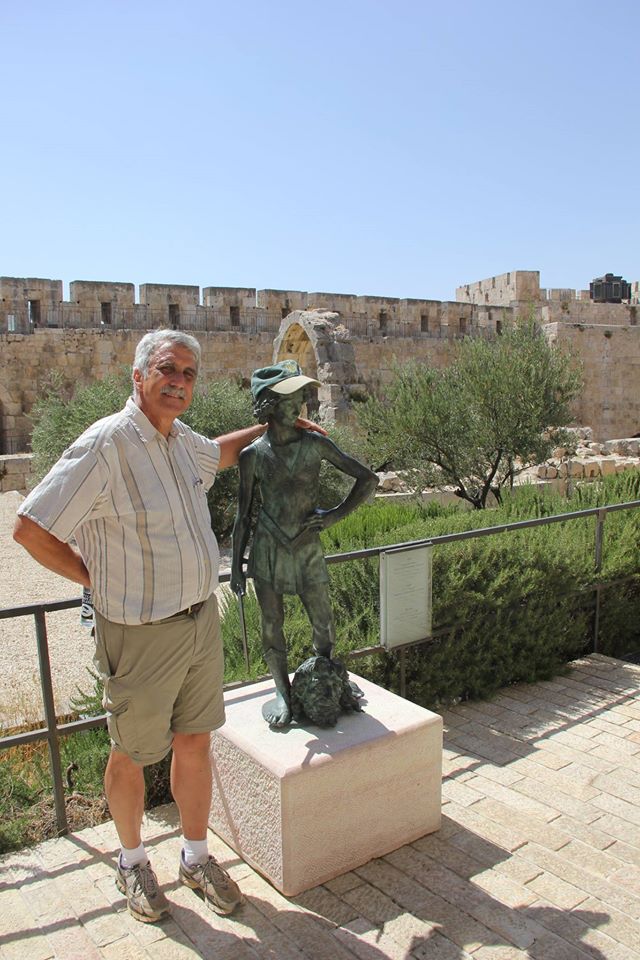
Two Davids at Tower of Israel Museum, Jerusalem

On our tour of Israel May 5-18 we will visit the Valley of Elah, we will see Azekah, and we will ascend Gath. We will retell the stories and relive the events which changed history so long ago. I invite you to join us on this trip in order to experience the stories of the Bible as they come to life.

Tuesday, December 15, 2015

The care which must exist in Churches

Today’s devotion inl Advent Journeys demonstrates how good shepherds care for their sheep.  Each sheep is important to the shepherd: first, because they are counted by the owner, second because the shepherd grows to know their personality through the long hours spent together in the field.  The shepherd wants the best for each sheep.
The church is instructed by the Lord to pay attention to the flock of God even as good shepherds take care of each individual sheep.  Jesus told Peter to “feed my sheep.”  Peter told elders of the early church “Shepherd the flock of God which is among you, serving as overseers, not by compulsion but willingly, not for dishonest gain but eagerly; nor as being lords over those entrusted to you, but being examples to the flock.” (1 Peter 5:2-3)
Some in today’s world have lost the intended concept of caring for the church as shepherds care for their sheep.  Some congregations design an experience called a worship service for clients to attend and enjoy.  Pastors and leaders have been led to think the church is in competition with the entertainment industry, and we must reach the world’s one-upmanship standards of excellence.  Each week we desire people to walk away with a positive experience, and to desire to return (hopefully with a friend) to experience the gospel also.
This thought process misses the point of what both the church and what worship are all about.  The New Testament word for church is ἐκκλησία, which means “an assembly of people.”  As one reads the epistles of Paul we discover this is not just a gathering in an auditorium, but a people who come together to pray, care for others, and receive encouragement to live the Christian life in a pagan world.  Paul spends a great deal of time talking of personal relationships and at the end of each letter he greets people by name.
The church, ἐκκλησία, is to be a place of involvement. We are to be active in our care for one another.  The pastor is to know his sheep by name.  He is also to train under-shepherds; and the flock to share for one another.  This care is a standard of excellence which brings health and vibrancy to the congregation.  If one person is hurting, others help.  If a person is in trouble, friends come together to see how the problem can be solved.  We help the sick get well, bind up the brokenhearted, and help people walk out of darkness into light.
We are also to be active in our worship.  Paul tells us to “be filled with the Spirit, speaking to one another in psalms and hymns and spiritual songs, singing and making melody in your heart to the Lord, giving thanks always for all things to God the Father in the name of our Lord Jesus Christ, submitting to one another in the fear of God.” (Eph 5:18-21)
The shepherd in today’s entry of Advent Journeys says, ”Through observation in the field and processing each animal as an individual we can catch problems in the early stages.”  We must take the same care in our churches.  People are more important than sheep.  We must listen to each other each time we come together in order to hear of any needs.  If an individual is not present, we should call (how often does that happen today!) in order to know if the individual is well.  We must be attentive to God’s flock in order to “catch any problems in the early stages.”
God desires churches which are healthy because they make sure their members enjoy intellectual, physical, social and mental health.  Healthy churches are encouraging churches.  They are places broken people go to become whole.  They become known in the community for the miracles worked in individual lives.  And these miracles become contagious.  These churches take full-time dedicated shepherds, who give beyond the normal because of God's love.