Showing posts with label Bible. Show all posts

Monday, November 14, 2022

The Journey

   "The Lord God formed a man from the dust of the ground and breathed into his nostrils the breath of life, and the man became a living being." (Genesis 2:7) 
   The beginning of life ... and the beginning of the Journey. We don't think much about the journey at the beginning: everything is new! Bright lights, a new room, new faces, and what is that thing that just passed by my face .... there it is again ... oh, its my hand! What else do I have? 
   The journey begins with freshness, exploration and discovery. We meet our family, discover our spaces, and meet new friends. In the first five years, learning increases and our journey is enriched. Then comes school. How good are our teachers ... and our parents: do they encourage learning, or are they stand-offish? 
   At this point, is our life placed into a routine and are our parent's expectations input into us, or are we allowed to explore and discover ourselves and our world. God endows each person with special gifts and abilities. Our young lives and teenage years are to be times of discovery with encouragement to explore ... that is an important part of the journey!
The world has many places to explore
   As we age, there are more and more places to explore. I have watched some families cling so tight to children that they never sightsee, but stay close to home their entire lives. (I know people who have never traveled more than 50 miles from the place where they were born! Sad ... they have missed so much!)
   This world is a beautiful place. Ever year when visiting family, I traveled from the eastern seaboard, to the planes of Kansas, and also to the Rocky Mountains. Each place is so different, and each has unique beauty. God created these places to explore.
Tall Mountains have a unique beauty
   "There is a time for everything, and a season for every activity under the heavens." (Ecclesiastes 3:1) In life there is a time when we are young and full of vitality. Journeys from childhood to youth to young adulthood give us experiences with which to build life. Of course there are work years (There is a time for everything), and vacations. And then retirement. If we have our health (Yes, proper diet and exercise, as well as fresh experiences help), we can extend the journey.
   Personally, I have traveled, and taken on a variety of bucketlist jobs in my early retirement. I have dug at archaelogical sites, served as tour guide, led classes as a specialist, worked as a gardener, helped in disaster relief, explored national parks, written books, participated as an election worker, driven limos as a chaffuer, and even worked the Christmas season at Macys. All are fulfilling in their own way and add variety to life.
   The journey from birth to old age ... there is but one life to live ... and so much to fit in. 

Sunday, March 15, 2020

Is the World Sick?

The world seems to have gone crazy … a new disease is attacking … the CoronaVirus. Is there anything that can be done? Our medical community is working, governments of the world are attempting to solve the problem, but is there anything I can do?

The answer is yes. One answer seems to be to stay in and to self isolate, in order to prevent yourself from getting sick [and if you are sick, to prevent the spread of this illness to others]. Tourist transportation is shutting down, schools are closing, and most religious organizations have shuttered their doors this weekend. Are you stir crazy yet?

As the world has shut down, many of us have slowed down … for a week or two … we are preventing illness from spreading. But maybe we are looking at this in the negative. Is there a positive?

Yes, there is a positive. We are able to chip away at all the things we have put off at home. The lists we have made, and put off until tomorrow can now be worked on. Our yards can be cleaned up. We can stream the movies we have wanted to see, and also we now have time to pick up a good book.

While the world is on lock-down and self-isolation, the opportunity has arisen not to prevent CoronaVirus, but to seek health! While all else is on hold, we now have the chance to help ourselves physically (exercise), mentally (a good book) and spiritually. The world has seen problems before. Often people turn to things that make them devolve (James 1:6-9). The Bible would instruct us to look towards God so we can improve (James 1:2-5). “ Blessed is the one who perseveres under trial because, having stood the test, that person will receive the crown of life” and not a corona (crown) virus.

Our world has faced many problems before. The book, Spring: Connecting with God can help in today’s situation, by giving perspective. The book takes a look at past crises, and how the decisions of people and leaders resulted in either status-quo … or something better, as the crisis abated.

What will it be for you? Will this lock-down improve you? Or when we are past the calamity will you just return to normal?

Monday, September 16, 2019

The Church is People

   Churches are made of individuals, lots of individuals. While your local church might be small, you and your church are still part of something big. Professing Christians make up 31% of the population of the earth. Online estimates say there are 2.19 billion Christians in the world. Each and every Christian is important, and the individual gifts of each person are of equal importance to God. (See the previous blog … if you are not sharing your Spiritual Gift, the church is weakened).
   One of the things scripture teaches is that each individual matters and is important. The Bible contains the names of many individuals. We know details about some of the people listed in the Bible. Other people we only know because their name is written in God’s book. Each and every person is important … consider this, people have been reading their names for over 2,000 years … even if it is only a name, it is an identifier of someone who is important to God.
   The Scripture contains many details about some people, such as the Apostles. Bible studies have been developed around their personalities, their good points, and their bad points. We can learn because this grouping of people lived and became examples for us.
   On the opposite end of the spectrum, there are listings of people of whom we know nothing but their names. Consider the following passage: 
   “Greet Mary, who worked very hard for you. Greet Andronicus and Junia, my fellow Jews who have been in prison with me. They are outstanding among[d] the apostles, and they were in Christ before I was. Greet Ampliatus, my dear friend in the Lord. Greet Urbanus, our co-worker in Christ, and my dear friend Stachys. Greet Apelles, whose fidelity to Christ has stood the test. Greet those who belong to the household of Aristobulus. Greet Herodion, my fellow Jew. Greet those in the household of Narcissus who are in the Lord. Greet Tryphena and Tryphosa, those women who work hard in the Lord. Greet my dear friend Persis, another woman who has worked very hard in the Lord. Greet Rufus, chosen in the Lord, and his mother, who has been a mother to me, too. Greet Asyncritus, Phlegon, Hermes, Patrobas, Hermas and the other brothers and sisters with them. Greet Philologus, Julia, Nereus and his sister, and Olympas and all the Lord’s people who are with them.” (Romans 16) 
   The things we know about each person are that they were believers, they were important to their community ( ἐκκλησία), they were known to the Apostle Paul (who wrote the letter), and they mattered to God (who made sure their names were included in His book).
   Sometimes, unless it is pointed out to us, we miss some information about people who are included in the Scripture. Take the formerly blind man named Bartimaeus (Mark 10:46-52), or Simon of Cyrene (and his sons, Alexander and Rufus - Mark 15:21), these, and a host of other named individuals became Christians, and known members of the church (ἐκκλησία). If these individuals did not join the body of the early church, there would have only been the mention of a nameless blind man who was healed or the foreigner who was forced to carry the cross of Jesus. The Bible is able to name these people and tell what they did because God used their lives to advance His kingdom.
   There are, of course, too many Christians to name in the Bible. Acts 2:41 mentions 3,000 individuals (a reflection of Exodus 32:28 or Joshua 7:3?). Acts 4:4 tells about 5,000 who believed. The Word of God would become too long if each and every individual was called by name. But the early Christians each served God according through the unique Spiritual Gifts God gave them. Some lived life peacefully. Others went to prison like John the Apostle (Rev. 1:9). Some died as martyrs (Hebrews 11-12; Rev. 6:9-11) at the point of the sword, because they were mauled by wild animals, or by burning at the stake or as a lantern along the road to the Coliseum.
   Each and every Christian who lived out God’s calling has a story of valor and accomplishment. No one who obeyed God is insignificant, only those who faded and did not follow God’s calling. Now, the question is, will you live a life of significance, or will you hide in the shadows, finding redemption only because God is merciful. (Luke 19:12-26)

Friday, January 26, 2018

Jaffa and History


Joppa, Jaffa, Yafo, Yaffe, however you spell the name, is a city with a history. Last week in my class we looked at the events which occurred in or around this city, which was built on a hill overlooking the Mediterranean Sea.
The view from Joppa

Some of the most popular stories claim that Jaffa was founded by Japheth, the son of Noah. Although there is no proof of this matter, we do know that people (probably Canaanites) lived upon the hill of Jaffe by 2018 BC (not AD!) these people sought the hillside location for safety, and eventually built a wall around their community in order to defend themselves from attacks. By day they would grow crops, hunt, or go out fishing, and by night they would sleep safely inside the closed city gates.
A historic picture of Joppa

But history was not kind to Jaffa, because neither their hill nor their walls were high enough to keep intruders away. Pharaoh Thutmose III captured the city in about 1600 BC. It is said that he orchestrated an “inside attack” by offering the citizens 100 baskets of Egyptian “treasure,” carried in by 200 Egyptian “porters.” Both the “treasure” and the porters” were really Egyptian soldiers, and once inside the city gates, the city was an easy capture. Ramesses II was there in 1258 BC, as evidenced by a lion scarab and other archaeological finds. Both before, after and in between these two Pharaohs, other Egyptian rulers also called this city a possession and collected tribute from the people in Joppa.
Pharaohs visited Joppa
Along history’s path, the Bible tells of others who visited Joppa over the course of the centuries. It is recorded that Joshua and the army of Israel marched toward the sea along the Aylon River in Israel. This river used to empty into the Mediterranean near Joppa (it has been rerouted). From this march, Joshua turned south and captured other Canaanite villages, including Gezer and Lachish. King Solomon, likewise visited Jaffa in order to retrieve Cedar for the Temple which entered Israel at the port of Joppa.
The Harbor at Joppa

Joppa saw action as Assyrian kings Shalmaneser III, Tiglath Pileser III, Shalmaneser V, and Sargon II conquered Israel and fought against Egypt along the coastal highway. The prophet Jonah sought to escape a preaching assignment to Assyria during this period by taking the first ship out of Joppa to Tarshish. The prophet’s escape did not last long, because God brought up a storm which forced Jonah to be thrown from the boat, where he was saved by a fish who safely returned him to the beach near Yafo.
The story of Andromeda
In 412 BC, another story is told of a young woman who was saved from the sea. As the story goes, King Cepheus and his wife Cassiopeia, who ruled the city of Joppa, used to brag to everyone about the beauty of their daughter, Andromeda. They once said she was even more beautiful than the daughters of Poseidon. This angered the sea king, who demanded that Andromeda be chained to a rock in the harbor in order to save King Cepheus’s city from destruction. Andromeda would have been eaten alive by a giant sea creature, had not Greek god Perseus saved her.
A New Book on Israel

Over the years, Joppa has never been out of the limelight, and many other stories could be told. I have written a few more in my book, Israel: Stories for Your Journey. I will tell and learn others on a future trip to Israel. For more information, check out my webpage at www.KosherCopy.com.

Sunday, April 2, 2017

Jesse’s Sons: Part 3

Eliab was back in the valley he had grown to love, but this time it was not to herd sheep, it was for war. And the conflict was not going well, for an evil spirit tormented King Saul and apparently his people had fallen out of favor with God. The Philistines were successfully expanding their kingdom into Benjamin and were on their way to raid and loot the Judean highlands. King Saul and his generals decided to stand against them in the Elah Valley. This is a place where they had been successful before. In the days of Joshua God helped His people to win a decisive victory over the Amorites by sending a hail storm (Joshua 10:10-11). Samson, the Judge of Israel had killed Philistines in the area with the jawbone of an ass.
When King Saul called out his army Eliab with two of his brothers, Abinadab and Shammah responded. They were camped below the town of Azekah, an ancient village set at a strategic vantage point where the Elah Valley wraps around a hill.  From the top of the hill the entire valley could be observed from end to end. The high position also enabled communication with fire signals which could be seen in the south at Lachish to the east in Judah and to the north in Benjamin. The Assyrians at a later date said the the place was like the nest of an eagle located on a mountain ridge. Simon bar Kocba set a fort in this area in the early second century and his trademark tunnels still run just below the surface. This defendable position was easily accessible for King Saul from his capital at Gibeah through Beit Shemesh.
Satellite View of Azekah
The army of the Philistines was camped on the south side of the valley near the village of Socoh. The Elah River stood between the two armies and was nicknamed in anticipation of the battle to come “Ephes Dammim” or the boundary of blood.
Socoh Hill
But the battle did not come as anticipated, for the Philistines from Gath had a powerful diversion with them, and after a time of acting out and noise making by both armies in order to bring fear to the opposition the Philistines revealed a secret weapon. His name was Goliath, which means splendor. And he was magnificent. He stood nine feet tall and carried a spear like a weaver's beam. He issued a challenge which according to the rules of war in that day must be accepted, “Choose one man and let him fight me. If he is able to kill me, then the Philistines will become your servants: but if I prevail against him, and kill him, then you shall be our servants.”
View from the top of Azekah
The army of Israel trembled, for no one was willing to fight Goliath. He was tall, he sounded mean, he wore a coat of iron and carried a large spear with a sharp tip. By arm length alone a Hebrew was bound to lose, and Israel did not yet possess either iron armor or iron tipped spears.
King Saul called for volunteers, but no one stepped forward. He promised riches to the man who won, but no one was willing. The King even said he would give his daughter as a wife to the successful soldier, but they would not be enticed. The challenge was made each morning and evening for forty days with taunting and ridicule, and every man of the Hebrew army feared for his life.
View from the top of Azekah
Eliab’s elderly father Jesse grew concerned, for he was in Bethlehem and had not seen or heard from his oldest three sons for more than a month. He decided to send provisions by way of his youngest son David because he served the king and knew where the army was camped. David found a substitute to take his place with the sheep, and rushed to the camp of the Hebrews.
As David arrived the Hebrews were gathering to hear Goliath make one of his evening rants. The Lord filled David with grief because no one trusted God enough to step forward. David told his brothers that he would go to the king and volunteer for the battle. Anger flashed in Eliab’s heart, and he told David he was as spoiled as Jacob’s son Joseph who pulled stunts like this to embarrass his brothers.
But discouragement from his brothers did not stop David from going to King Saul. He said, “Let no one lose heart on account of this Philistine; your servant will go and fight him.”
David fighting Goliath
Saul was concerned because of David’s small size and his lack of experience, but David said to the King, “Your servant has been keeping his father’s sheep. When a lion or a bear came and carried off a sheep from the flock, I went after it, struck it and rescued the sheep from its mouth. When it turned on me, I seized it by its hair, struck it and killed it. Your servant has killed both the lion and the bear; this uncircumcised Philistine will be like one of them, because he has defied the armies of the living God. The Lord who rescued me from the paw of the lion and the paw of the bear will rescue me from the hand of this Philistine.”
Saul knew there were no other options, and that time was short before the Philistine’s patience would run out. He agreed that the young shepherd could accept the challenge. The rest is history. Antigonus of Socoh, a voice from the Mishnah who lived 700 years after this event said, perhaps remembering this story, "Be not like servants who serve the master on condition that they receive a reward. Rather be like servants who serve the master irrespective of any reward.  And let the fear of heaven be upon you."
Sign at the entrance to Azekah site
The Elah Valley is quiet now. Azekah and Socoh are now part of British Park, a Jewish National Fund nature sanctuary. Blue Turmus (Lupin) flowers sprout around Socoh rather than Philistines.  Farmers raise crops in the valleys and tourists visit historic sites without fear of being taunted by the giant.

Friday, March 31, 2017

Jesse’s Sons: Part 1

Sons, there were 8 of them and they knew their job. Their job was to shepherd the sheep. Eliab was the oldest, and therefore he was the first of the sons to shepherd the sheep. As the other sons got older they would also take care of the family’s crop of animals. Each son in order would go out with his father, and then his brothers to learn the family craft. They were like Abraham, Isaac, Jacob and his sons. The family was involved and learned the family trade.
A view of the land near Bethlehem in the Judean highlands
In Israel, in the years of the Judges, that meant starting early. When Eliab was but eight years old his father Jesse brought him to the fields of  Bethlehem in order to learn the ways of the sheep and how to care for them. By ten he was ready to leave home for the summer and travel with the herd, for sheep can be hard on the pasture and must be moved from field to field so the land does not wear out. Jesse, as all good shepherds had mapped out a route and taught what he learned about life to his sons.
Caring for sheep on the slopes of Judea
Jessie did not start out as a shepherd.  His father and his grandfather were farmers who raised grain in the Bethlehem highlands. But each winter as a boy he would see sheep which grazed on his father’s land and on other pastures in the area throughout the winter.  He watched the animals and talked to the shepherds. He would hear tales of adventure as the men would journey to the lowlands each year as they cared for their sheep. The son of Obed decided he wanted see to live a life of adventure like the stories he was hearing. He would spend nights with the shepherds to learn about the sheep, and then one day he told his father that this was the life for him. Farmers stay put and shepherds guide sheep.  Jesse wanted to see the world and being a caretaker of sheep would enable him to earn a living and see the world.
A view of the Judean highlands from the Shfela
Each spring Jesse and then his sons led sheep from the high fields of Bethlehem to find better pasture as the earth sprung to life below. He began by descending the steep slopes of the mountains to find what was growing and where the animals could graze. The annual rains would percolate down through the soil until it hit rock, and then it would surface through the multiple springs on the Judean slopes. The sheep would eat fresh food and drink clear water. Jesse, Eliab, and eventually his other sons would sleep in the cool of the caves which dotted the land.
By the full moon of Passover it was Jesse’s goal to be down the mountain and into the low hills called Shfela.  Some of the farmers had raised their first crop, barley, and the chaff and stubble left behind by the harvest made good fodder for sheep. This rich valley was an agricultural dreamland and would bring fatness to the family’s sheep so when the time came for them to be sold each sheep would bring a good price for the family to bring home before the autumn rains.
The green valleys near Azeka in Israel
In time the stubble would give out, and it was time to move on. As the son of a farmer, and now a shepherd, Jesse had learned not to test the patience of farmers. If he was kind to the people who lived on the land and limited damage by his sheep the herd could move without trouble. But if his sheep damaged the earth he would suffer the consequences.
Jesse taught his skills to his sons: To Eliab, to Abinadab, to Shimea, Nethanel, Raddai, Ozem and also to David. They each learned their lessons well as father taught son and son taught brothers and together they worked. The family made friends as they traveled and ate the fruits of the earth and saw the world which lay beyond the small highland community which they called home.
By summer this shepherd family worked their way from the high pastures near Bethlehem, down the steep hills with caves, through the valleys of grain until they reached the plain of Sharon. And it was here they rested. The streams were plentiful and the grass was abundant, and so they slowed their pace to enjoy the place and fatten the sheep.
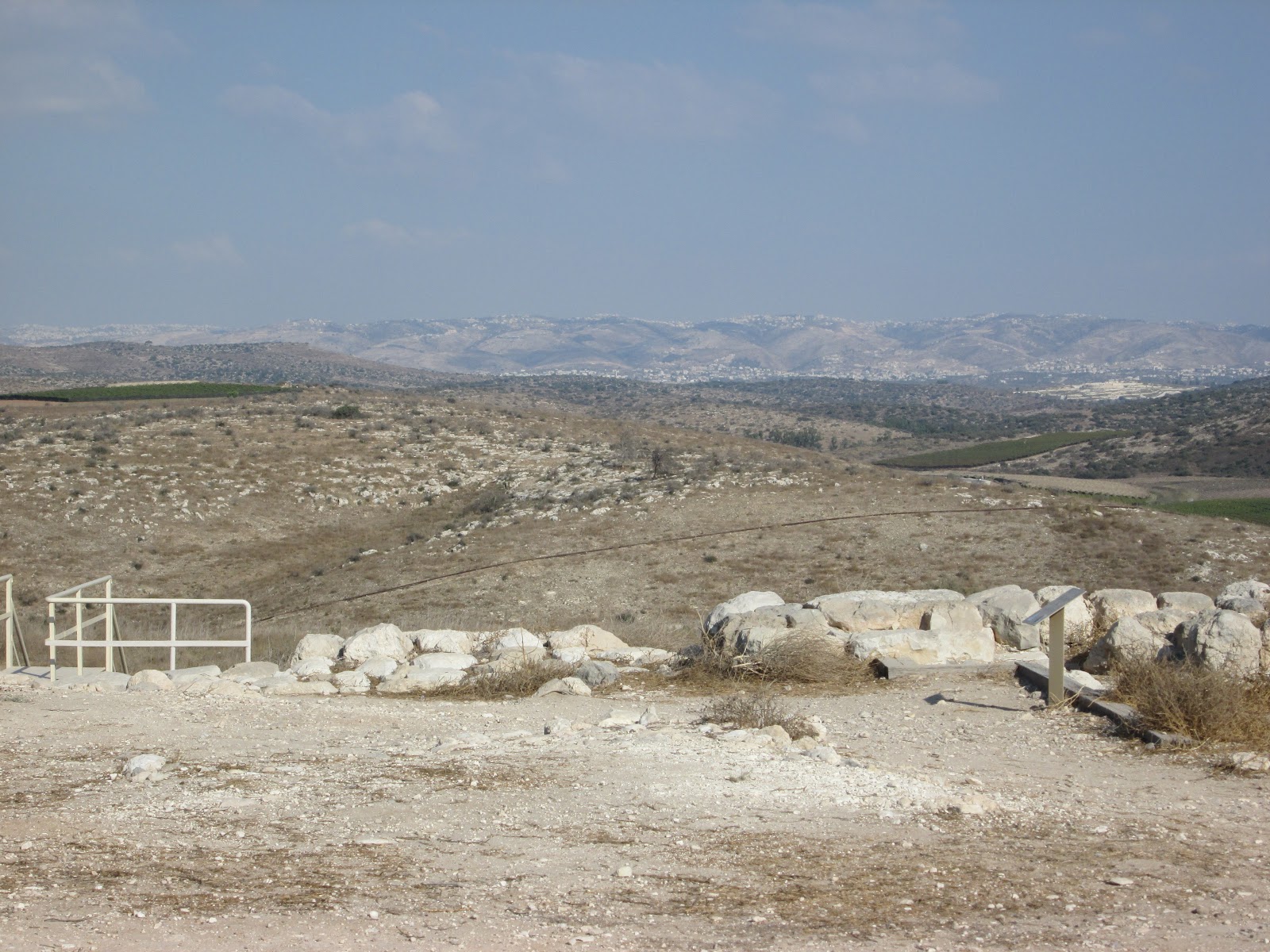
A view of the coast-land from Tel Gezer
But they did not rest too much, for a shepherd must always move on, and in this coastal plain while the animals grazed the shepherds kept watch, for a strong people in walled cities inhabited this land.  But Jesse and his sons did not fear the people, they only watched. They also sold sheep which they grew to the foreign people who occupied this land, for the people needed food, wool, milk and other products which the herd could provide. Jesse sold some sheep, and he thinned the flock, and by the time of the fruit it was time to move again. This time they would go up the hills and not down.
The day’s work was like this: find a place to graze, guide the sheep, set a boundary and watch. Protect the flock from humans and predators, from eagles, snakes, bears, lions and people. Jesse and his sons worked hard to make sure their sheep grew fat in order to be sold.  Each spring it was down the hill, each fall it was up the hill to return to Bethlehem before the fall rains. And then there was rest.

Wednesday, March 15, 2017

A Boy Named David

Today we’ll take a fresh look at an ageless story which has been told often, but is worth telling again. The story contains elements of self-preservation, protection of a people, and heroism which guides us in faith and also gives an understanding of the land where the epic events and teachings of the Bible took place.
Scrolls at the 5th Quarter in Jerusalem
The story begins in the fields outside a village called Bethlehem, or the House of Bread. Shepherds had passed through this village for more than a thousand years before our story occurred. Abraham, Isaac, and Jacob are known to have passed along the road, Rahab settled here after leaving Jericho, and Boaz lived in the village. Jesse and his eight sons (who are the subject of our story) also lived here.
Elah Valley in Jerusalem where David fought Goliath
The town of Bethlehem sat near an important junction where the Central Ridge Road meets the road which descends through the Elah Valley to the coast.
Road leading down to the Elah Valley from Ramat Rachel
In the days of King Saul, the Philistines (also called the Sea Peoples) were enemies of the new Kingdom of Israel. The Philistines lived along the coast in five major towns and surrounding villages. Throughout their history, they sought to expand their territory. One area of expansion was through the Elah Valley and up the hill to the Central Ridge Road.
Looking into Philistine territory from Gezer, Israel
The Bible tells us of one such war initiative of the Philistines. “Now the Philistines gathered their forces for war and assembled at Sokoh in Judah. They pitched camp at Ephes Dammim, between Sokoh and Azekah.” (1 Sam 17).
Information sign at Tel Azeka, Israel
King Saul responded by enrolling enlistees and sending an army down the road into the Elah Valley, and they camped near Azekah. “A champion named Goliath, who was from Gath, came out of the Philistine camp. His height was six cubits and a span. He had a bronze helmet on his head and wore a coat of scale armor of bronze weighing five thousand shekels; on his legs he wore bronze greaves, and a bronze javelin was slung on his back. His spear shaft was like a weaver’s rod, and its iron point weighed six hundred shekels. His shield bearer went ahead of him.”
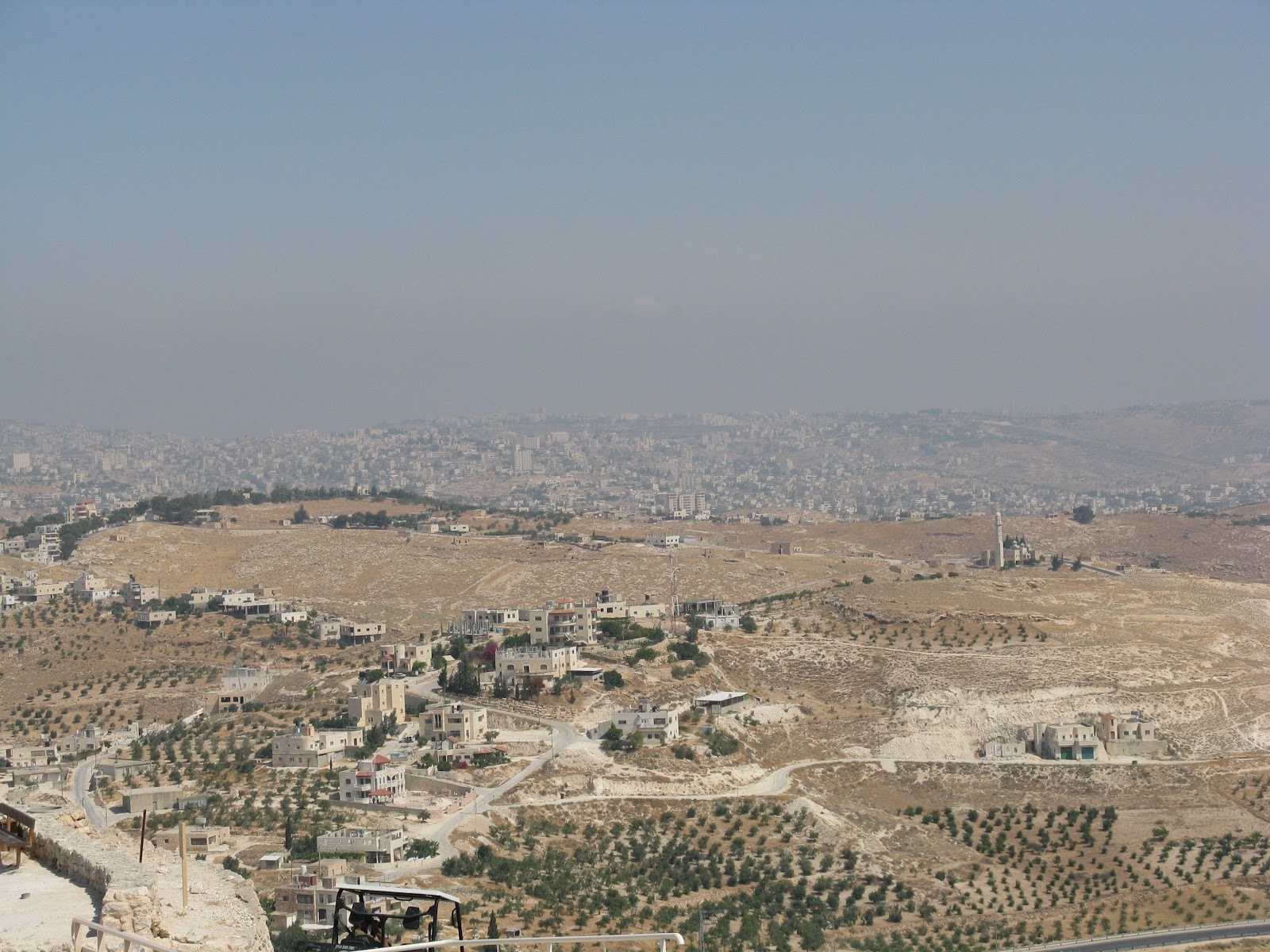
Looking into Elah Valley from Azekah
The Hebrews trembled when they saw the nine foot giant. In fear they froze and did not know what to do. For forty days the giant would come down from the Philistine camp and issue the challenge, “Why do you come out and line up for battle? Am I not a Philistine, and are you not the servants of Saul? Choose a man and have him come down to me. If he is able to fight and kill me, we will become your subjects; but if I overcome him and kill him, you will become our subjects and serve us. This day I defy the armies of Israel! Give me a man and let us fight each other.”
Looking into Elah Valley from Tel Azekah
For forty days the giant Goliath descended from his hometown of Gath in order to challenge the Hebrews. The standoff lasted so long that Jesse, who had three sons (Eliab, Abinadab, and Shimma) among the camp of Israel, decided to try to encourage his family. He sent his youngest son, David, to carry food from his home in Bethlehem to his sons who were camped in the Elah Valley.
Looking east from Tel Azekah
While David was delivering food to his brothers, Goliath descended to repeat his challenge before the army of Israel. David told his brothers that he would fight the Giant, and this was told to the King, but Saul thought the boy was too young.
Shepherd near Lachish in Israel
David told the King he was able to defend his sheep against lions and bears. He pushed his desire to fight the Giant against every objection the king could dish out his way. Because no one else was willing step forward, the king allowed a young shepherd to accept the challenge.
Sheep near Lachish in Israel
We all know the outcome - with one stone in a sling, David, the young shepherd, felled the nine foot giant. He also kept the giant’s brothers at bay with other smooth stones collected for ammunition.
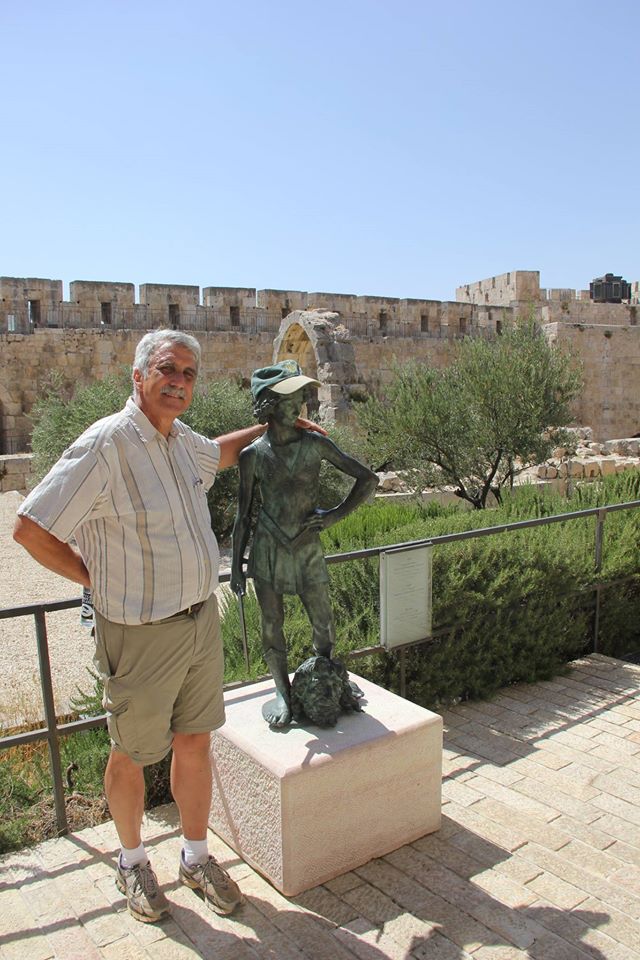
Two Davids at Tower of Israel Museum, Jerusalem

On our tour of Israel May 5-18 we will visit the Valley of Elah, we will see Azekah, and we will ascend Gath. We will retell the stories and relive the events which changed history so long ago. I invite you to join us on this trip in order to experience the stories of the Bible as they come to life.

Friday, March 3, 2017

Ancient Gezer

Many of the events recorded in the Bible took place in Israel. Not only the Bible, but many other layers of history reside in the same areas of Israel. Archaeologists have dug for a long time, but really have only scratched the surface of what exists to be uncovered.
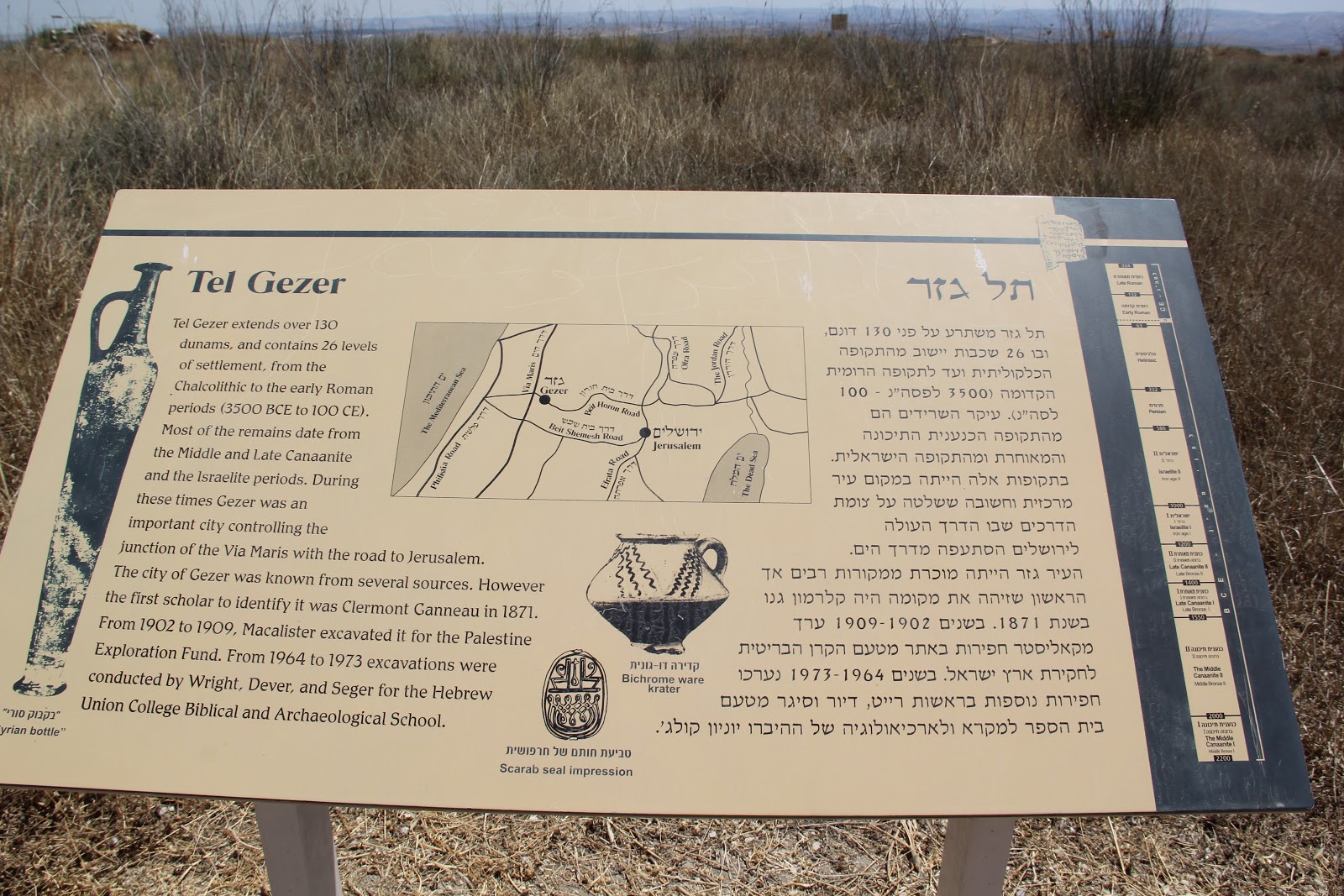
Signs document the importance of Gezer
Tel Gezer is a location that was extremely important in Biblical times, because of its prime trade location along the Via Maris. People would have traveled through this ancient Canaanite city regularly, and there was also a lot of protection due to other people who wanted the land. Gezer was given as a gift by Solomon to his Egyptian wife, among other Biblical references.
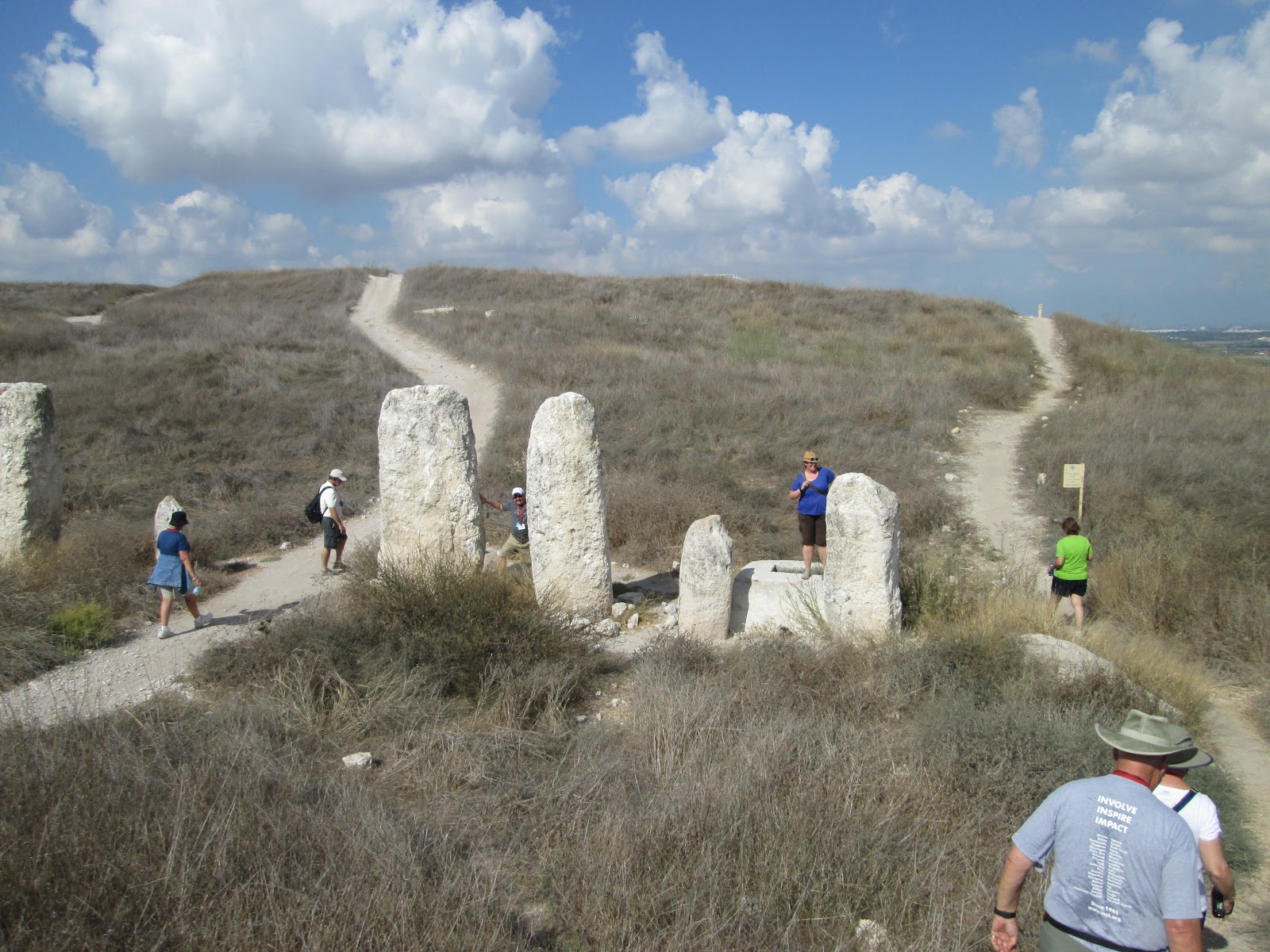
Solomon's gates and palace at Tel Gezer
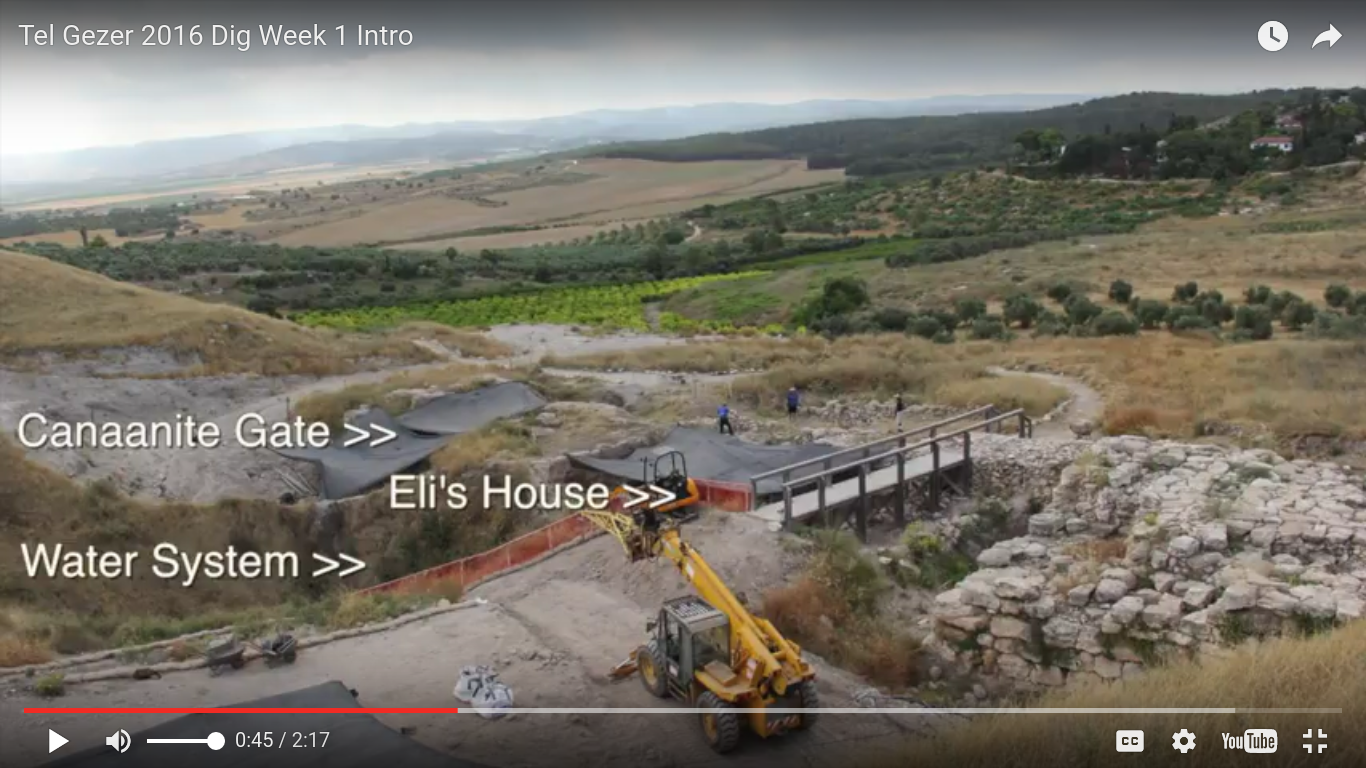
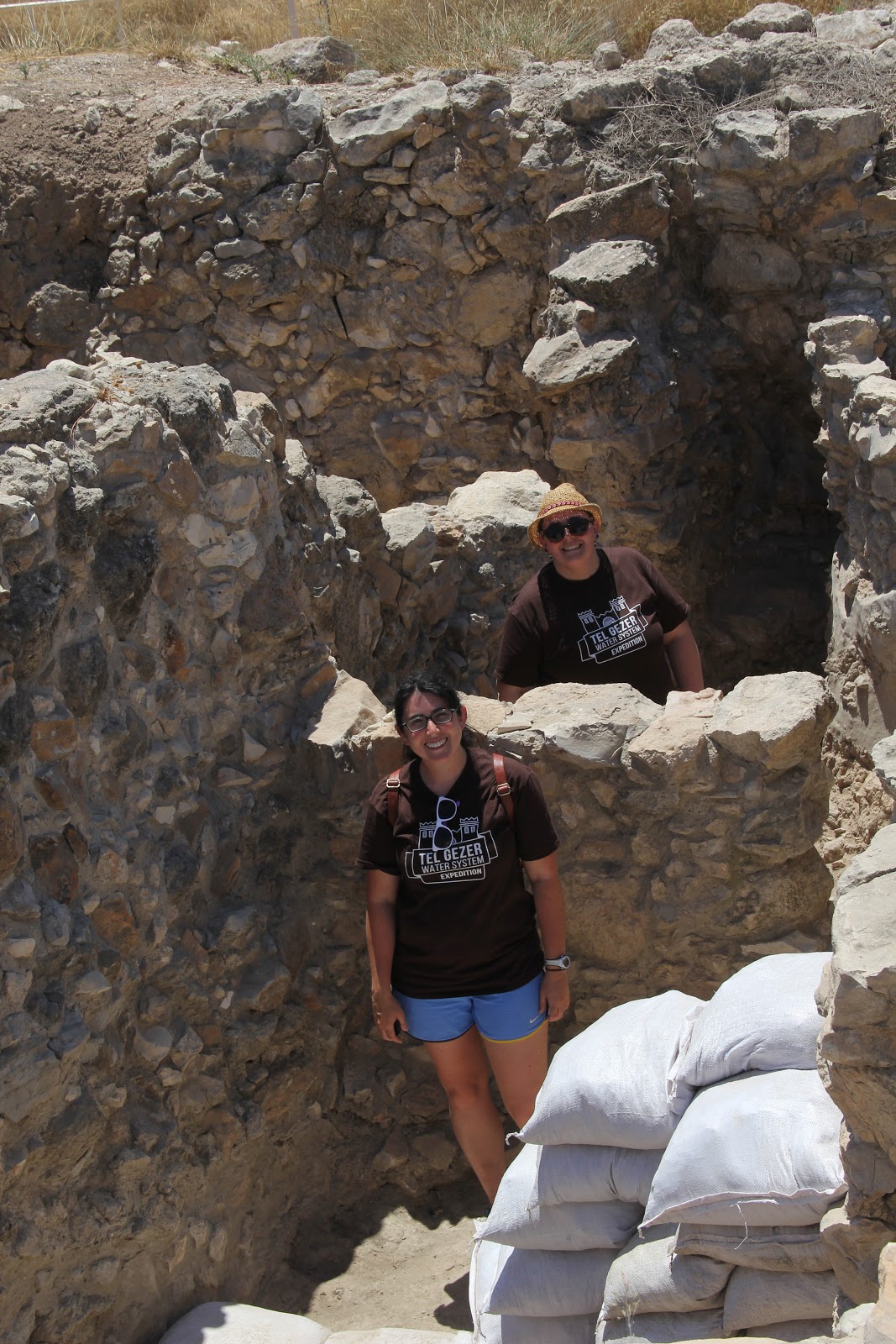
New Orleans Baptist Theological Seminary is one of a few schools that dig at the site. NOBTS began digging in 2007 in the gigantic water system, which is still a mystery. To help solve this mystery, the neighboring locations of a house (called "Eli's house") and a Canaanite gate are also being excavated.
Overlooking Eli's House and the Canaanite Gate at Tel Gezer
The water system is enormous and a special crane is used to lift bags of dirt out of the bottom.
NOBTS Dig sites from the video on their website
This video will take you on a tour of the tunnel. Take a quick walk down, look around and come back up.
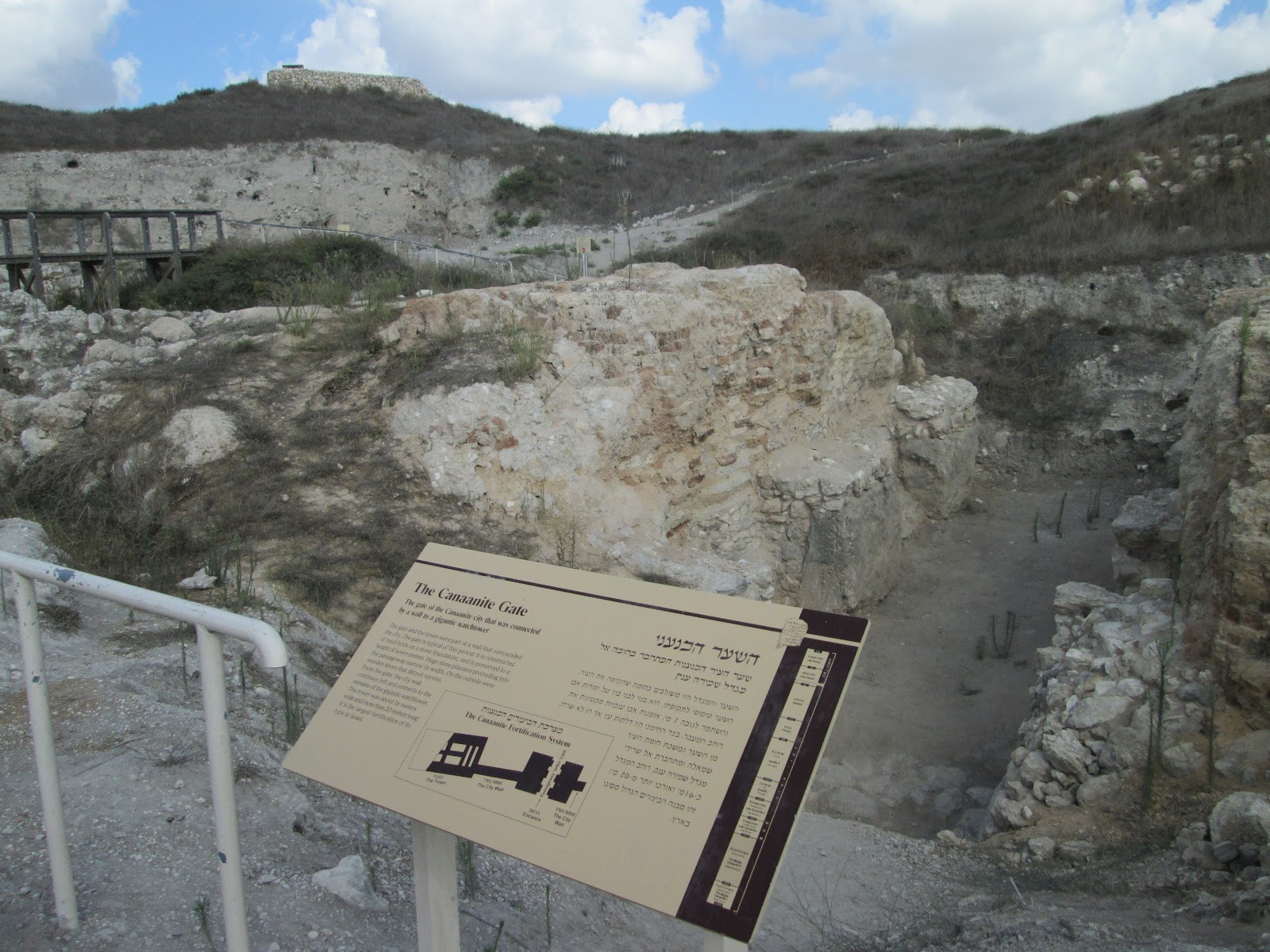
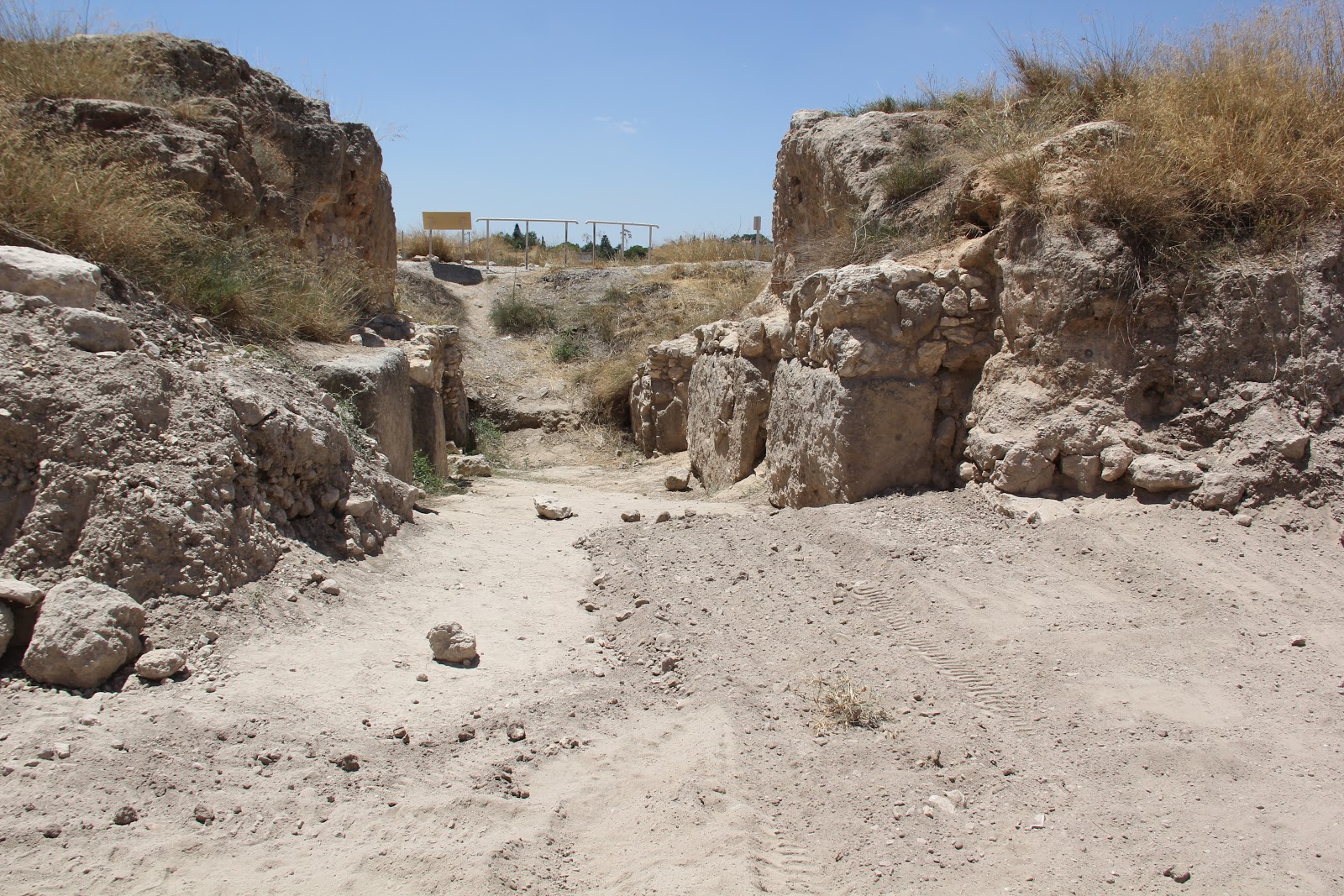
The Canaanite Gate at Tel Gezer
Eli's house has the tallest walls of any unearthed in Israel (that haven't been reconstructed) and is also the location where some really exciting finds came from this past summer.
The tall walls at Eli's House in Tel Gezer
Many articles have been written about the exciting finds this past summer. Here is one article.
Pottery investigations at Tel Gezer
The Canaanite gate was excavated by R.A.S. MacAllister in the early 1900s, who left "fill" that had to be removed until new layers were found underneath that have not been excavated yet. This coming summer, it will be exciting to see what is uncovered there!
The Canaanite Gate at Tel Gezer
To see and read more about the finds from this summer, visit the New Orleans Baptist Theological Seminary Archeology website.
Monoliths at Tel Gezer
You can also watch this 15-minute mini-documentary with interviews and footage of the dig
Join us on our May 2018 Tour of Israel
Get an insiders look at Tel Gezer and other sites
Many thanks to my daughter Sarah Simon who wrote this blog. Sarah dug and made videos of the dig last Summer, and will return again this year. Sarah and I invite you to visit Gezer on our May 2018 Israel Tour. To join us, click this link.

Friday, January 27, 2017

A trip to Israel, How hard will it be?

Many people fear overseas travel, lots of walking on tours, odd foods, strange customs, foreign languages, attacks, or various other types of hardships that will face them on foreign soil. They quote a line from the Wizard of Oz, “There’s no place like home,” and choose to remain at home.
A view of Jerusalem from the Mount of Olives
While there is nothing wrong with home (there are a lot of built in comforts created by the homeowner), the person who refuses to travel also robs themselves of great experiences. The person who chooses to stay at home will miss out on a fantastic opportunity offered through a 14 day trip to the Holy Land in May 2018. People who chooses to travel to Israel will enjoy a great adventure, will see where Abraham, Isaac, Jacob, Jesus, and almost every other person listed in the Bible walked and lived, and will come away with new understanding of what they hear at Church every Sunday.
The Synagogue at Migdal where Jesus taught
But will the trip be hard people ask. And I answer, except for a long flight across the Ocean and Europe, the trip will not be hard. And any hardship in the flight is well rewarded on the ground as we walk the Bible, hear history, and see the events of the Bible come to life.
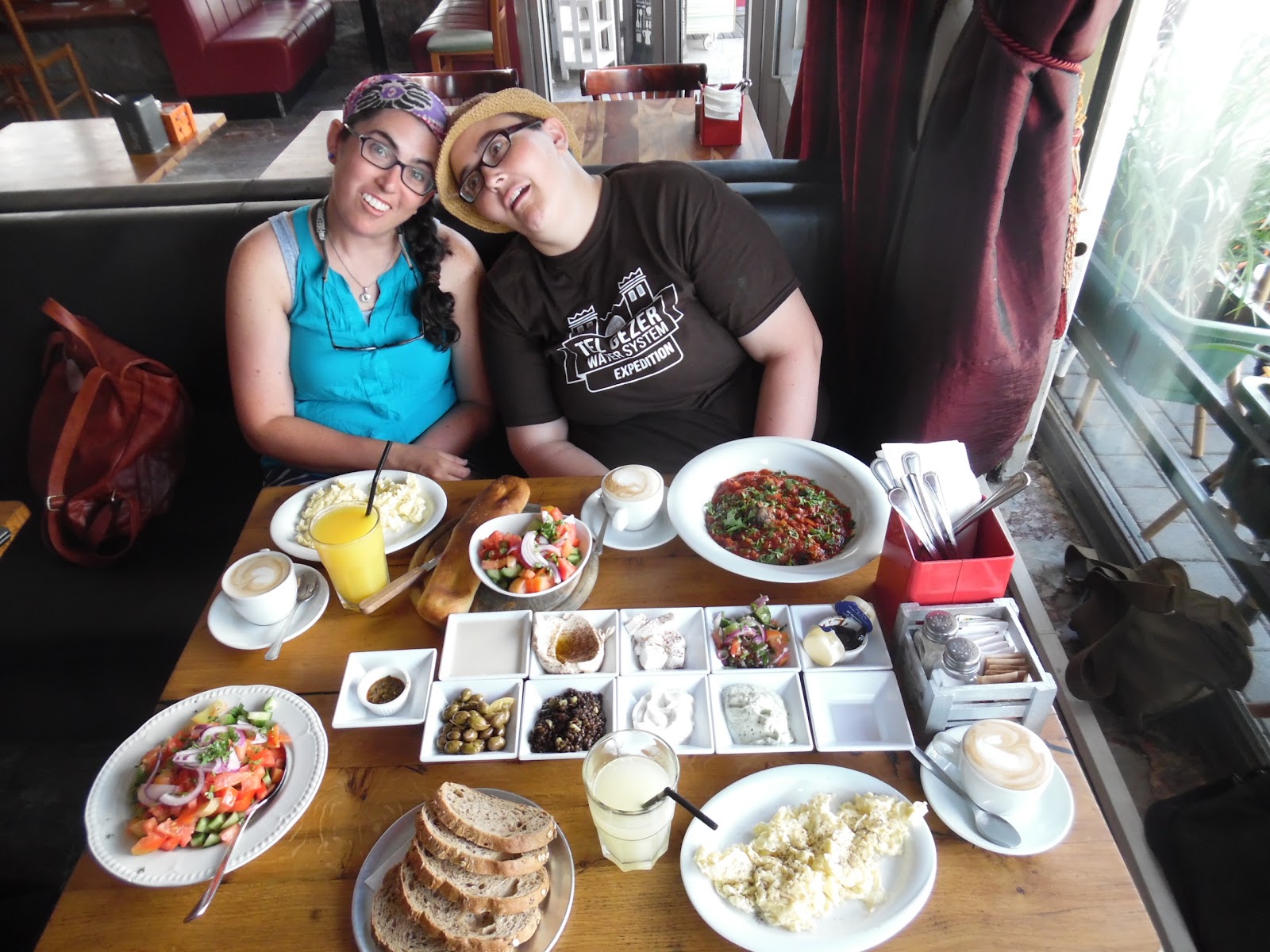
One choice on the Israeli Breakfast menu
Our daily schedule on our 14 day trip to Israel begins with a breakfast banquet with fruits, different egg dishes, cereal, cheeses and many other items. In some places we will discover new dishes like shakshuka. The one thing many people will note is that there are not many meats. Orthodox Jews who keep a kosher diet do not mix meat and milk. Breakfast is a dairy meal. We will have time to eat, and to talk with others around the breakfast table.
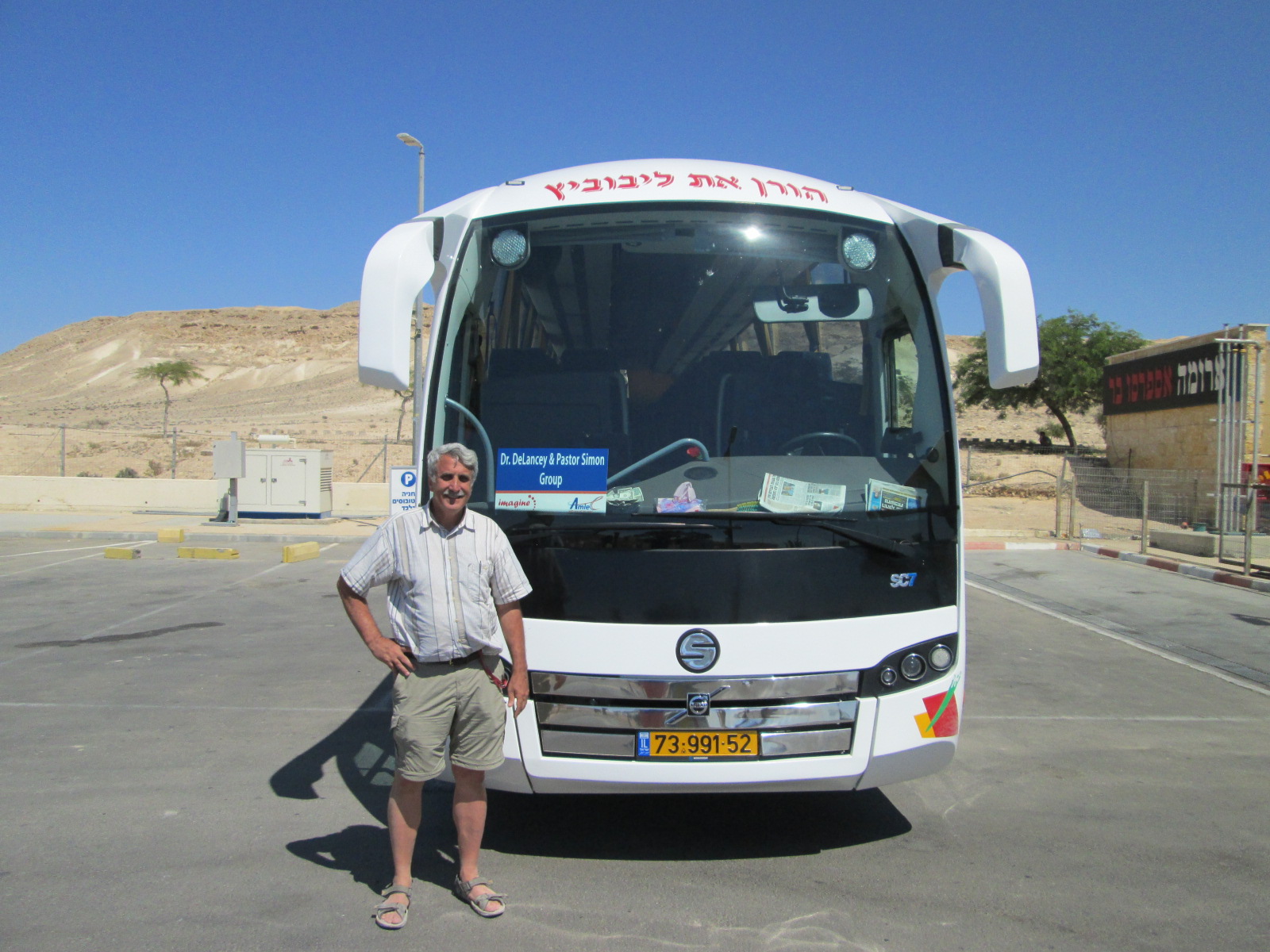
Comfortable buses for traveling
Following breakfast we will board the bus. Our trip is arranged in a way that many nights we stay in the same hotel for several nights. On days when we move to different lodgings, we will leave our luggage outside the door of our room, and porters will pick up the luggage and have it at the bus to load (and for us to check) before we board. Tips to the hotel workers are included in the trip payment.
Some people take naps while riding the bus between stops
The bus which we will enjoy during the entire length of our trip has comfortable seats which recline. On longer drives some people will go to sleep. The windows are large so we have good visibility as our driver navigates the smooth roads of Israel and the West Bank. There is a shelf above the seat to store any items (like water, hats and souvenirs) which we carry with us.
After the bus drops us off in Joppa, it parks here
We exit the bus close to most attractions. When there is a walk the tour is planned in a loop so those who tire can sit down and the group will return. Extra time is included on each stop so those who are more adventurous and can go further. Those who are limber will have a chance to climb into the caves in Qumran. On lengthier hikes, such as on Mount Arbel our through the Wilderness of Zin non-climbers can wake up a little later and meet us at the top of the mountain, or ride the bus to the end of the hike.
Hiking Zin Canyon where Moses and Israel camped
While on our trip we will see and hear the customs of the people in Israel. We will learn the differences between Secular Jews and the Orthodox. We will also learn and talk about different groups of Muslims, Palestinians, the devout, the secular and the Druze. We will talk about clothing, traditions, prayers and lifestyle. We will learn about the culture of the people historically, traditionally and currently. We will see and experience the people within the protective bubble of our tour group, which is large enough to prevent culture shock.
Shopping in Jerusalem - there are always people
We will hear and learn foreign languages of the people in Israel. We will gain new words in Hebrew and Arabic. We will learn greetings like “good morning” and words of appreciation like “thank you.” The new words are not required, just interesting.
These new friends in Joppa know how to speak our language
Many people fear violence while in Israel. On my tours to Israel, and the trips taken by millions of other pilgrims not one single incident of fear has occurred. Israel depends on the tourist industry, so we will find we are protected by the Israeli military in any area which could be high risk. We will find we are protected from areas where violence might occur. The nation of Israel sends out warnings and schedules which help us avoid any problems which could occur. Our Israeli tour guide and bus drivers are well acquainted with protocol and have been hired to keep us safe.
There is always protection around when you need it
While we are traveling we will be given time for lunch. The normal day will end with a generous supper banquet. At supper we will be able to choose between various salads, meats, vegetables and desserts. There will also be fruits, there are always locally grown fruits in Israel. I love the fresh dates.
Our lodging on the Sea of Galilee. Date Palms in background
In the evening people can go to bed early, or take a nighttime side trip.  In the desert or in Galilee these evening gatherings or often devotionals or teachings. There will be opportunities to meet interesting people at our kibbutz in rural areas. In Jerusalem we will walk to the Western Wall (Kotel), to overviews of the city, to interesting shops and to sights not seen by many tourists.
Travel brochure. Check it out on the link below!

Our trip to Israel will be taken in luxury. We will see the sites and sights but we will avoid most of the hardships people fear in a foreign land. We will be with people who are very familiar with customs of the people and American needs. Any issue will be navigated without difficulties faced by those who must go it alone. The customs and culture created for our tour group will result in an enjoyable and informative trip filled with many memorable experiences. The 14 day trip to the Holy Land in May 2018 is something you do not want to miss! Sign up today and receive a discount.