Showing posts with label Jewish. Show all posts

Monday, May 21, 2018

Art in Haifa

Today’s journey began with an Israeli Breakfast. The food here is different. We did have scrambled eggs and a farmer’s omelet, but because this is Israel our fare also included a morning salad, Israeli salad, tuna salad, cream cheese, feta, olives, labnah and chickpeas, eggplant cream, tomato salsa with tahini, guacamole, yogurt with granola and honey, halva spread, fruit jam, butter and two small loaves of fresh, warm, whole-grain bread. We also ordered a regular shakshouka, and received coffees, water and juice.
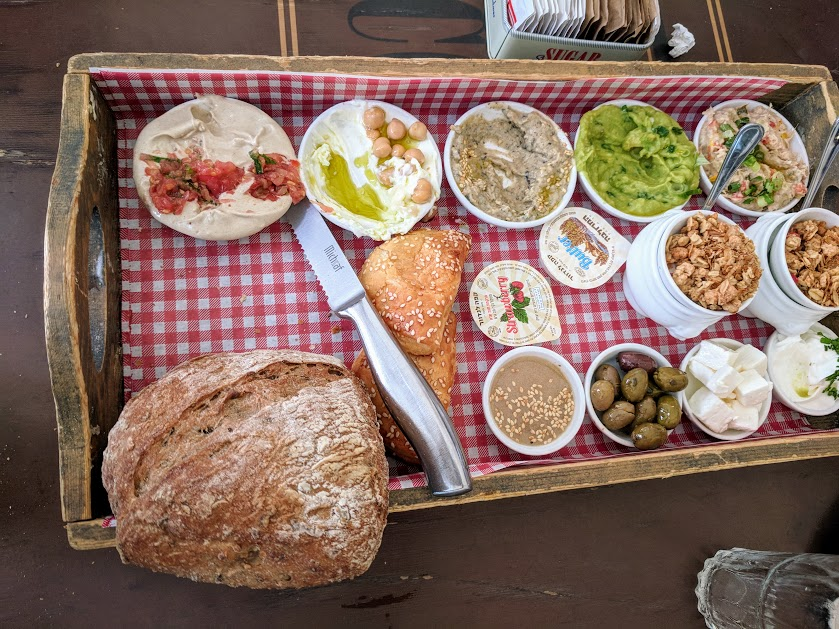
Breakfast for 2 includes a condiment tray
After breakfast we went to Ulpan, Hebrew lessons for new Israelis. Because this new nation desires to incorporate all people into society, these classes are provided by the government for all new immigrants who desire to learn the Hebrew language. Why the Hebrew language?? Because it is the language of the Bible, so who would not want to learn.
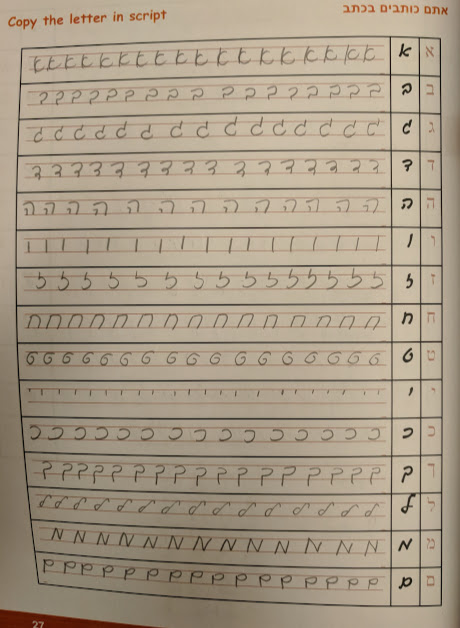
Ulpan teaches both block and cursive writing
In the afternoon we took a bus to the port area of Haifa to visit a museum (and cultural center), Beit Hagefen which sponsors an art project called Art Without Borders. The goal of the center is to develop good relations between Arabs, Jews and all other people.
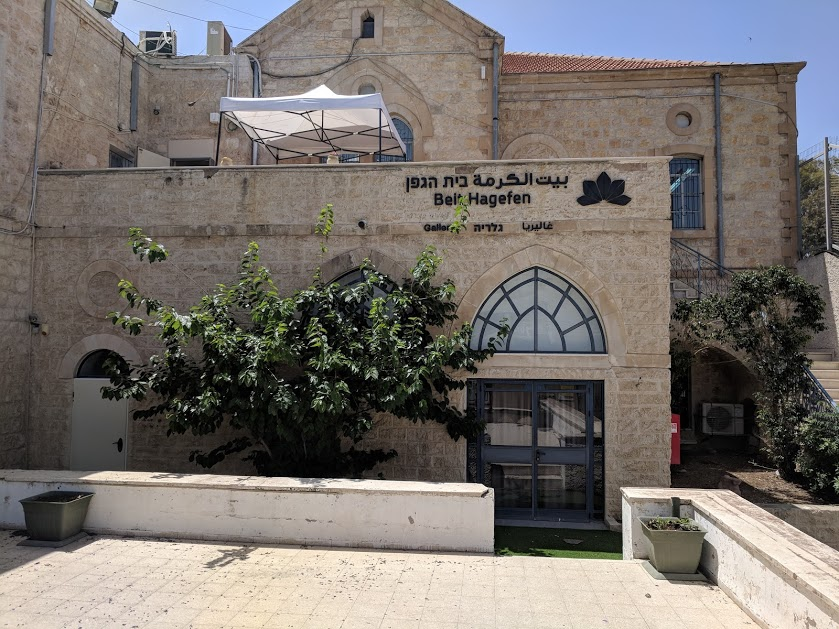
The cultural center includes two or three buildings
The organization uses the arts to bring people together. They have a theater where they produce dramas.
The mosaics were given during the 'Holiday of Holidays'
They also enable artists to place work throughout the neighborhood that surrounds the Beit Hagefen center.
An artist celebrates a family that lived in the neighborhood for several generations.
The area surrounding the cultural center is the oldest in Haifa. It contains a mixture of Arabs, Jews, Bahai and Christians.
This artist will return to close the Mediterranean shaped safety pin when there is peace!
The art museum is without borders because artwork is placed on homes in the neighborhood.
Artwork from all cultures to promote living together in peace
Each piece attempts to bring factions of people together and build peace.
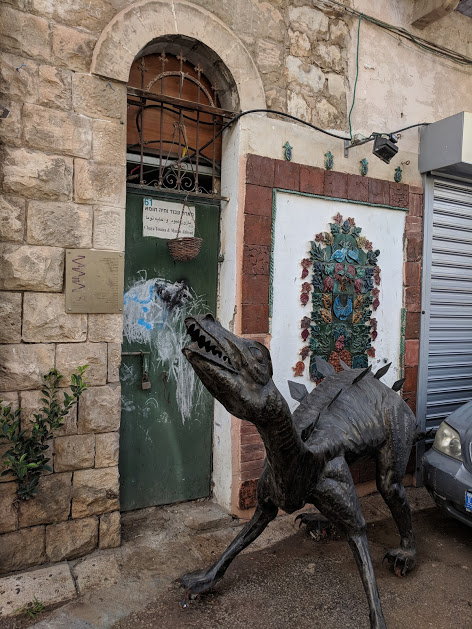
The Dinosaur is a moving exhibit
Horizon says in the exchange between the Hooves and Grass,
“The Hooves will not have the last word / Through the succession of the seasons,
Spring will always make the grass green,/ as generations come and go.”
Echo says, “I wish to be the hooves, not the forlorn grass./ I loathe the blessed lowliness / and the kindness of feeble sympathy / I wish to be the hooves / not the sturdy grass.”
Horizon says, “You realize that hooves are the shoes of horses!”
Echo says, “All the grass is the insole of the horses’ shoes”
Horizon adds: “Likewise, the spurs are the insoles of the knights / to be lunged into horses’ soft waist!”
Echo insists: “I would rather be the hooves than the sturdy grass!”
Horizon says: “And you would not mind the snake-like image of the victim's face eternally poised on your chest?”
Bewildered Echo fell silent! in the horses’
Many pieces of art are located throughout the neighborhood
The artwork is scattered around a vibrant neighborhood filled with people and small shops,
The vegetables are always fresh at these markets

Such as vegetable stands and bakery outlets.

Friday, March 17, 2017

Passover Glue

In today’s world Passover is perhaps the most celebrated observance of the Jewish people - and this is not surprising. The celebration takes place in the home, extended family is included, and the meal is a banquet. The worship element of Passover is so familiar to Jews that they can quote lines by heart, and some families have a lot of fun ad-libbing or adding their own twist to an old story. Over the years each family builds their own traditions, making Passover an occasion to which everyone looks forward.
Our Passover Haggadah with Explanations
The foundations of our modern family meal are recorded in Exodus 12-13, where Israel is commanded to select a lamb, care for the animal as a pet for three and a half days, then kill the lamb, place the blood on the doorpost, roast the animal, and eat it.
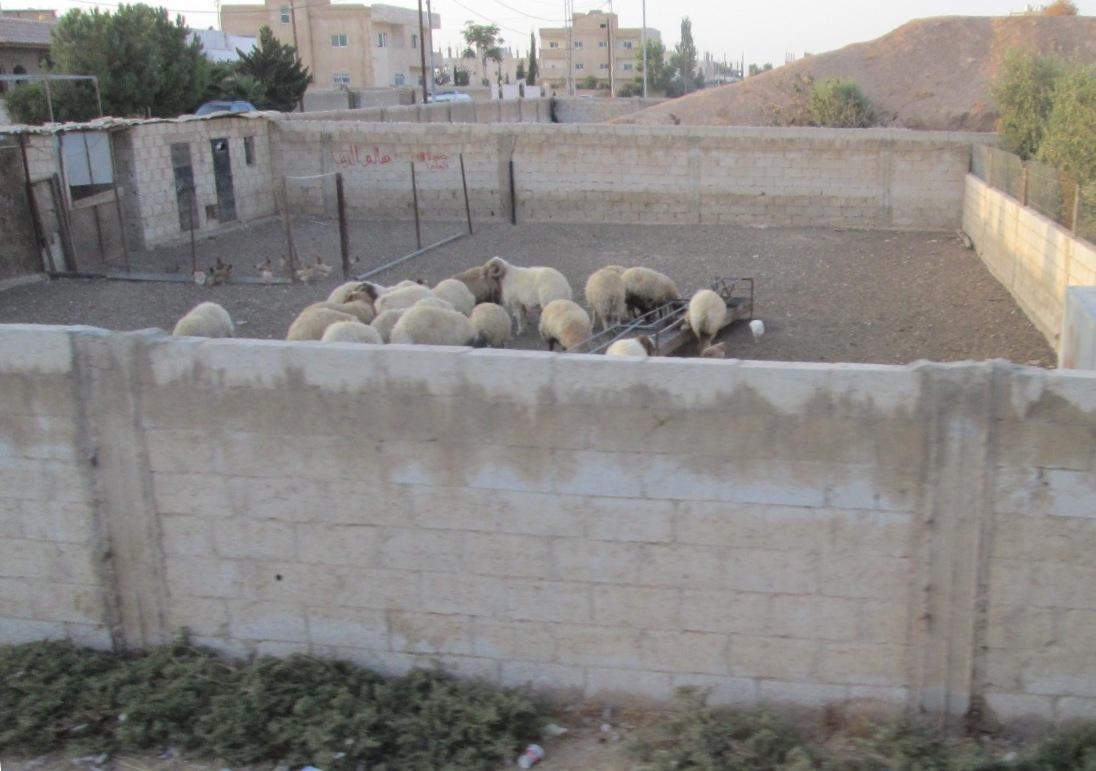
Sheep pen in Jordan
The holiday could have arisen from earlier spring harvest celebration where a thank offering was given to God with unleavened cakes cooked in oil (Lev. 7:12). The timing of the Hebrew Exodus would have called for an expansion of the event with added meaning.
Our book on Passover Backgrounds
In my book Spring: Connecting with God, I tell how the festival has been celebrated or avoided throughout Biblical times. What began as a home celebration became a Temple activity, for which tens of thousands of people each year made the pilgrimage to Jerusalem, after Solomon built the worship center. (By the time Jesus was alive, millions of people were visiting the Temple Herod had renovated.) During the Babylonian exile the practice returned to the home, and is part of what kept the Jewish faith alive. Ezra reinstituted the Temple practices, which continued to be observed, and eventually were held by Jesus and his family.
Great spot for a picnic on the Mount of Olives
The New Testament gives various hints that people looked forward to Passover as an annual event. Entire communities would travel together and camp inside or on the outskirts of Jerusalem. Jesus’ family probably camped near the base of the Mount of Olives, atop which he later prayed the night before he was crucified. Families from the Galilee were able to meet together with families who lived in Judea. This is why Mary was so familiar with her relative Elizabeth. People in Biblical times enjoyed the week-long opportunity to take a break from the regular routine of life and live in a different setting.
Dome of the Rock where the Temple once sat
After the Temple was destroyed in 70 A.D. many of the Jewish holidays lost meaning, yet Passover grew in importance. Holy days such as Yom Kippur (the Day of Atonement) and Shavuot (the Feast of Weeks, or Pentecost in Greek) are based on the existence of the Temple for sacrifice and receipt of an offering. Chanukah (the Feast of Dedication or Winter - if you’ve read your gospels well, you’ve seen this terminology there!) became a day of mourning because the Temple sat in ruins as it had been during the destruction of Antiochus Epiphanes. Sukkot (the Feast of Tabernacles) remembered the journey from Egypt toward Israel, particularly the long years living in booths in the desert. The festival of Pesach (Passover) took on added importance as the Jewish people prayed once again that an evil Pharaoh (ruler) would be removed and they would be granted another exodus to their homeland.
A Home Passover Celebration in Saluda, NC
The elements of families coming together and dining at a banquet, the prayer for the restoration of Jerusalem, and the retelling of the ancient story built Passover into a favorite holiday. During the Middle Ages, European Jews developed ornate Haggadot in order to aid the head of the household in remembering from year to year how to share the elements of faith and tell the story. These books also reminded a literate society of how they were to participate in the telling of the story. Rabbis reinforced family gatherings for Passover in order to bolster Jewish identity within the scattered communities of Europe.
My family getting ready for Passover
Today’s Jewish families still gather to remember the ancient story, to pray for Jerusalem, and to strengthen relationships with each other and with God. My family went to Uncle Stuart’s home for the holiday. I still remember fun activities with my cousins as our parents talked and cooked together. I also remember much of the liturgy shared from the Chase & Sanborn Coffee Haggadah. My cousins and I carry many memories from these times together.
Other memories have been created over the years as my sister and I created a spontaneous Passover from memory (because we were unprepared, the shankbone was a milkbone biscuit!), Seders I have put together to teach friends in college and seminary, meals of the Jewish community in Louisville, KY, and celebrations with my wife and daughters add to the yearly Seders I remember. Presentations of the Seder given to churches have also provided fun stories (like the time I wore one black and one brown shoe). These happy memories build faith and family.
Passover Seder Plate

The Passover celebration has provided a glue for Jewish society. The elements of faith celebrated in the home with extended family and a lot of fun could help Christians in today’s world. We live in an era where we are letting life (work and school) swamp our time at home. We are letting the “experts” at church direct our faith. Worship is becoming more and more leader-led and non-participatory. Children are separated from parents so they can have “fun,” which dilutes historic religious teachings because they are perceived as “boring.” In this process family memories have been displaced and the Christian faith becomes ever more secular…and lost.

Friday, September 16, 2016

Autumn on the Calendar

One look outside will tell us our world is changing. We have proceeded from the lush green world of spring through the productive days of summer into a time of drying out. Fall with its cooler temperatures, pumpkin harvest and leaf coloration is getting close.
Pumpkin Days are almost here
Days are getting noticeably shorter with the sun rising later and later each morning. Older people are asking when the time change occurs [and are suddenly interested in yard work … although they have only rarely performed a horticultural task during the course of their 85-90 years of life]. The procession of the autumn equinox, which is when the Sun crosses the Equator, occurs Thursday.
Man has for thousands of years taken note of the seasons out of interest and necessity. In the year when Cain planted his first crop it became necessary to know when spring would occur. For those with tomato plants it is important to know the timing of the first and final frosts. In the prehistoric times man first began to count days, and in time he wrote the counting of days down on a calendar.
The Gezer Calendar
The world’s oldest calendar is found at Gezer in Israel. It counts the days in this way: “Two months of harvest, Two months of sowing, Two months of late planting, One month of hoeing flax, One month of barley harvest, One month of harvest and measuring, two months of vine pruning, One month of summer.” The calendar is important so the farmer gets his timing correct.
Gezer Calendar Explained
The calendar of the Bible is based on agriculture, just as the calendar of Gezer. The Biblical calendar is a twelve month lunar calendar, adjusted with a leap month by the Mesopotamian astronomers to maintain a proper planting season. The months are named “Aviv” for spring, “Iyar” for blossom, “Sivan” for season, “Elul” for harvest, “Tishri” for beginning, “Ethanim” and “Bul” meaning brooks and rain. The Hebrew calendar looks to God as the provider.
The major events of the Hebrew people are agricultural. Passover is celebrated at the time of the first spring harvest. Shavuot or Pentecost is when the first fruits of the summer crop are given to God. The festivals of the seventh month are connected to the autumn ingathering. Rosh Hashanah and Yom Kippur involve cultivation and care for the soul. Sukkoth (Feast of Tabernacles) thanks God at the time the final harvest. Simchat Torah represents the beginning of a new cycle.
Calendar Comparison
Our current calendar when placed alongside the Biblical calendar will show some glaring, unthought-of differences. Under our current calendar and culture our holidays are civil and not agricultural. We think of people and not God. The names of the months (and even the days) honor Roman gods who’s sole ambition in life was to serve themselves, often at the expense of others.
In any study of the Bible it is important rise above our cultural biases in order to learn about the people of the book and the desires of the Lord God, the creator of all things.

Wednesday, December 23, 2015

Roman Cities, Jewish Cities - Hippodromes & Such

On our trip to Israel we learned there were Jewish cities and Hellenistic-Roman cities.  Jewish cities were places where monotheistic faith in God and obedience to the commands were important.  Jewish villages were generally smaller and poorer than Roman towns.  Elements of faith were also present, such as mezuzahs.
Roman cities contained places of worship for various gods.  They were also bastians of Hellenistic culture.  These cities contained centers of entertainment such as the Theaters which told stories of the gods, hippodromes where horse racing was part of the culture, and amphitheater where gladiators and animals fought. Excellent examples of these structures can be seen in Caesarea, Beit Guvrin and Beit Shean.  Other examples are known to have existed.
Roman towns were often governmental centers.  Caesarea-Maritima, Sipporis, Tiberias, and Beit Shean (Scythopolis) were known to be governmental centers.  Beit Shean is in the Jordan River valley, level ground, which is easy to travel, on the way to Jerusalem.  The ruins of this city are well preserved, with many standing columns on the cardo.  Pictures of Beit Shean today show up on pages 90 of Advent Journeys.
Both types of cities existed in the time of Jesus.  It is thought that Joseph lived in Nazareth, a small Jewish town, but walked 3 miles to Sipporis, the new government center in order to work.  Joseph was a carpenter, or a construction worker.  Homes in the area are built of stone. Buildings in Sipporis have elaborate mosaics on the floor.  Joseph could have been the artist who constructed these floors.
Jewish people stayed in their communities because they were careful not to get caught up in the ways of the gentiles.  Gentiles were interested in entertainment.  Jews were interested in observing the faith and in community.  People were more important than activities, and the Jews were known for their care for one another.
Putting this in perspective, the Gentiles would celebrate this season with giving (and getting) fo gifts; with elaborate decorations (lights and greenery), with their trees (which symbolized new life), parties, and entertainment.  Jews would have put the story before anything else.  Each day would open and close with a scripture.  Music would be important.  And they would make sure no one was alone this season.

Tuesday, November 17, 2015

Interfaith on the Holidays

Chanukah or Christmas, Chanumas or Christikah … that is the question.  In the olden days our faith was often more consistent and predictable, but in today’s world many families are interfaith.  How does a family celebrate the holidays when one parent is a Christian and the other is Jewish?  Families could choose to avoid, but with all the seasonal displays for a family not to celebrate something is like the ostrich which places its head in the ground.
As people we are created with  a desire to believe … something.  History teaches this: every culture which has ever existed has a faith component.  Absence of faith causes people to desire; weak faith causes people to look for something stronger.  In a world with radicalized faith options, it is important for parents to teach good faith in a strong way.  So, where should a family begin?
The discussion about the holiday season should start with one statement: Jesus was Jewish.  Jesus would have celebrated Chanukah.  This statement tells us not to battle and invites us to do something a little different.  Christianity grew out of Judaism, and to bring these two traditions together accentuating the great stories of each with their identical moral base can create an environment of peace rather than battles.
How does a family bring both holidays together?  The beginning point is to talk about what is important.  Both faith traditions should enjoy a presence in the month of december, and because there are differences each celebration can own a place of its own.  Unique elements of each season: the stories of Christmas and Chanukah should be told and retold all month.  The trim of the holidays such as the tree, the dreidels, latkes, candles and lights should co-exist and be enjoyed by all.
To make plans for seasonal harmony take a look at the calendar.  Chanukah occurs at a different time every year.  The lighting of the menorah should occupy its rightful place, and can lead to a discussion on how we got our calendar … and the differences between a lunar cycle and a solar calendar.
Christmas occupies December 24-25 each year.  Worship experiences on these days, as well as other special events should be honored in families.  Young children will enjoy the festivities.  As children grow they will ask questions.  Answering questions will bring growth for parents and learning to children.  Teenagers will begin to challenge each faith, and through the challenge the parent obtains the ability to show how the love and hope of each faith should bring people together rather than split them apart.
How can this work, and how can a parent fill in some perceived gaps?  The new book Advent Journeys can serve as a guide.  This book not only shares the stories and traditions of both holidays; it also shares Jewish cultural backgrounds which are many times remain unseen as we read the New Testament.  As we see and understand the unique culture into which Jesus was born we can begin the discussion which will help us live together and celebrate both faith traditions.
The Christian faith and the Jewish faith should fit together.  Across the centuries these two religions have drifted apart, forged individual identifications and set up battle zones.  And in so doing each group has obliterated the fact that Christianity was born out of Judaism.  Judaism contains the foundation and some important keys to really understanding the world and teachings of Jesus.

Wednesday, November 4, 2015

Finding Jesus of the First Century

   I was destined to be different.  I could not help it, for you see I was born into a Jewish home.  And while Heinrich Heine said, "The Jews are like everybody else only more so," we all know this is not exactly true.  While I was raised in a home of faith I was always taught to question and examine the beliefs of my people in order to fully understand each concept.  In this way I learned my faith.
   One point in my faith which escaped me was how to know 100% for sure that my name was written in the book of life.  I learned a process of seeking to be right with man and with God, but still, assurance was lacking.  Christian friends tried to tell me of how Jesus died for my sins, but I pushed them away ... until ... I read Psalm 22.  Within the words of this Psalm I saw Jesus on the cross in my scriptures.  Then I understood His sacrificial death and resurrection were the assurance of forgiveness and acceptance by God that I sought.
   At the age of 17 I condemned myself to really be different: I joined (and remained in) the Baptist church.  It should be fairly obvious that Reform Jews and Southern Baptists are both different.  And while on the surface I created an image to seem like a Southern Baptist, I continued to follow in the pattern developed in me since childhood: question and examine to fully understand each concept.
   It is not that I lived two lives, I simply learned to fit into the culture of the people with whom I lived, whether Jewish or Baptist, or Floridian, or Midwestern, or Western or Southern.  Even when I go on mission assignments, I seek to relate to people according to their preferred style so as not to create barriers.  I listen a lot (in order to learn), and seek to communicate so people can understand.
   In matters of faith I sought to put together the parts of my old faith and my new faith.  I learned from the people I was around, so I could share in a relevant way as a Baptist, and understand both Old and New Testament against the background of my Jewish heritage.  I met many people along the way who sought to break out of their faith by destroying all they had learned in order to come to something new.  I continued in my faith, never really finding a reason to destroy the faith because it worked for me.  Both Jewish and Baptist where they agree and disagree, I continued to question and examine and learn.
   In the process of my learning I checked a book out of the library called the Mishnah.  This volume could be called a preservation of Jewish tradition from the times in which Jesus lived.  The book contains quotes of the Rabbis and detailed instructions for carrying out the rituals and traditions of the Jews. 
   I began to explore, for my faith is a twenty-first century faith, and their faith was a first century faith.  Some things from both parts of my faith practices I took for granted, like dreidels and latkes at Chanukah did not exist in the first century; neither did yarmulkes, or the hymns in the Baptist hymn book.  I saw in the pages of the Mishnah details I had never seen about the faith of Jesus.  I was fascinated.
   Through reading about the practices of the Levites in the Temple and the Pharisees in the Synagogues I began to enter the world where Jesus lived.  Jesus was Jewish, and the foundation of the Christian faith.  To Him they were not different, but the same.  Jesus came to provide the path of salvation and to lead us to become closer to God.  The words of our New Testament had their origins in the first century faith of Jesus.  As I questioned and examined the words of the New Testament against the culture traditions in which Jesus lived they became even more real.
   I write books to help people understand the world of the first century, and the faith of Jesus.  I want Jesus to become alive for people so they can share in the reality of His love.

Saturday, October 31, 2015

Book Ideas

   I talk to many people who ask, "where do you get your ideas for books?"
   The answer is fairly simple, from two sources: ideas come out of my heritage and also out of my curiosity.  There could be some other areas from which I have drawn ideas, but those are the starting point thus far for my books (which I have written including Advent Journeys, Spring; Connecting with God, and A Christian Passover in the Jewish Tradition.
     My most recent book began with a family tradition: Advent.  When my children were young, in order to teach them the faith (in a rather Jewish way) I came up with weekly themes, daily scripture readings and connected activities (soon to be listed at our website) which would be fun and hold interest from day to day.  Such as on Shepherds week we read Luke 2 and send Christmas cards announcing the birth of Jesus ... just as the angels announced Christ's birth long ago.
   My family followed this tradition (changing as my daughters grew older) for more than twenty-five years.  I put this tradition in writing as pamphlets for others, but when I decided to put it in book form, it did not seem to be interesting enough.   So I asked myself, what would make it interesting enough: And Advent Journeys was born.
   With this idea I could have written the standard Biblical exegesis book and described the Bible passages in my own words, related how the birth of Jesus tied into Old Testament prophecy, or told about theology or tradition ... but my curiosity led me another way.  I thought "I wonder what the trip was like from Nazareth to Bethlehem."  Simple question, or so I thought!
   There are three or four roads from Nazareth to Bethlehem.  People most often describe the road from Nazareth trough Jezreel Valley down the Jordan River and up the wadi of the Good Samaritan to Jerusalem and Bethlehem.  Many travelers took that road, especially Pharisees who wanted to avoid contact with the Samaritans.  But this road is longer and more difficult than the other two.
   An easier route is south through Megeddo Pass to the via maris then up the Beit Horon pass to Jerusalem and Bethlehem.  This route is much easier than the road through the Jordan Valley, also avoids contact with the Samaritans, and is almost never in consideration as the road Joseph and Mary traveled.  This road is also longer than the third option:
   I feel Joseph and Mary traveled almost due south, between the two other routes on the shortest route possible.  I found this route on the internet listed today as Israel route 60, in one place listed as the Joseph and Mary Highway.  I feel this route is most likely because as an adult Jesus still traveled this road on the way home (as evidenced in John 4).  So I followed this highway.
   The first problem of the route today is that it journeys through the West Bank, an area which is described as risky.  The second problem is some parts of route 60 are worse than risky and have been bulldozed in order to contain violent areas.  In spite of difficulties my curiosity told me to travel the route and see what the road was like.
   Fortunately I was able to travel the route without getting shot at or putting my life in danger through the internet. Google Maps, Facebook pages, Wikipedia information and other sources were consulted, along with books and 19th century journals (when the land was safer) to learn about the route.  And it was interesting.  Thus came into being week 2 of my latest book Advent Journeys.

Saturday, March 21, 2015

The Real Topic "Connecting with God" (A Great Study!)

     Many years ago, while I was still in Seminary, I was asked to help put together a Passover Hagaddah for the Messianic Jewish Community in Louisville, KY. Across the years I have enjoyed sharing the Passover, and recently I have put this Seder into print: A Christian Passover in the Jewish Tradition. And in the process of producing this Hagaddah, God did something wonderful.
     As I tried to put the Hagaddah into presentable form, God spoke to me. This occurred while I was on a trip to see my father. As I drove, the Lord brought ideas and chapters to my mind which I had studied in the past. These realizations came from the time I assembled the first Passover Hagaddah for our group in Louisville.
     In my book Spring: Connecting with God I follow the development of the Seder, from the Garden of Eden (when Adam used to walk with God in the cool of the day); to the Communion of Abram and Melchezedek (Genesis 14:18); to the instructions of the first Passover in Exodus 12 (and its observance in Exodus 13); all the way to it’s history during time of the Kings of Judea. I teach on how the Passover has ties to the Peace offering of Leviticus 3-4 (and 7). I also examine four Passover Seders observed by Jesus in the New Testament (at 12 years of age, and each year of his ministry). I show how the agape feast of the early church is tied to the Passover, and how we will enjoy fellowship meals in heaven.
     I thought I wrote a good book, until God showed me something else. I was asked to share an outline of Spring: Connecting with God in a local Senior Adult group, and put the outline into presentation format. As I shared, I realized the book is more about our relationship with God than it is about the Passover.
     Spring: Connecting with God shows how our love for God goes from passionate to cool; and from churchy to forgotten. The book is a call for us to fan to flame the love which is in our hearts for God, and shows us how to avoid the things which cool us off. I would encourage people to take the book, and use it as a 10 week study (but then as the author I am biased). But I know study groups could be enriched through this study.

Whispers

A Whisper
Coming softly to my ears
Murmuring something
That I cannot understand
Unless I listen
With my whole being

What is it saying?
I wonder
Is it telling me
Something important
That will change
My entire life ...

(Poem © Chelsea Simon) ...
It’s completion & more poems can be found in the book.

Friday, March 20, 2015

Passover Preparation - Day 7 - Final Touches

Observe the month of Abib and celebrate the Passover of the LORD your God, because in the month of Abib he brought you out of Egypt by night. Sacrifice as the Passover to the LORD your God an animal from your flock or herd at the place the LORD will choose as a dwelling for his Name. Do not eat it with bread made with yeast, but for seven days eat unleavened bread, the bread of affliction, because you left Egypt in haste--so that all the days of your life you may remember the time of your departure from Egypt. (Deut 16:1-3)
     It is now time to approach the Pesach Table, hopefully not with a heart which calls this a ritual, or even worse: a relic of the past; but we are to approach the evening of our Seder with an attitude of expectancy.
     As you read the previous six blogs I hope you clearly see the love and provisions of God which give us cause to seek the Lord, to celebrate His merciful acts and to honor His Name. Know that God desires us to attend this celebration so we can hear of His mighty acts of love and care.
     The scripture above shows it is God who invites us individually to come to His meal and to be His people. Our God is a living God. The scripture says God is the same yesterday, today and forever; who is still able to do the mighty acts which were shown to us in the past. I hope the Passover experience breeds expectancy and the desire to discover how God will bring us into a land flowing with milk and honey.
     The Hagaddah teaches we have a choice in our spiritual approach to the evening. Within the Seder we meet four sons: the wise son, the wicked son, the simple son and they young son. How will you approach the evening: with a desire to learn, as a participant, with eager ears and a desire to understand, or to be enveloped for the first time in this production.
     The order of the meal is designed to change us. Many come to the table ill prepared. They go through the motions, mouth the prayers, read responsively, listen respectfully - and hopefully God does something during the course of the evening: He breaks through and changes us from dutiful participants to desirous people who experience intimately our departure from the land of Egypt.
      The discussions of the Seder are designed to give us a desire to share its actions and truths through the year. We have already observed the call to charity as we are to make sure that all can attend and participate in this service and its teachings. We are also called to share a spirit of understanding; for through the lesson we experience how we were once aliens and slaves who were forced to serve others and to live according to their whims. With this understanding we celebrate our freedom by caring for others who are not yet free.
     We share because Passover is a story of hope. God with mighty acts of judgment saved an enslaved people. If God can bring that generation out of slavery, God can and will free any person from enslavement when they cry out and seek Him.
     We share because the next generation needs to hear (and there is always a next generation and beyond). The act of sharing has kept the Jewish nation vibrant and alive for over 3,500 years: even though we were scattered across the globe and had no land to call our own for most of their history (Not only was our father a wandering Aramean, but through the years most of the Jewish people were forced to survived in lands not their own).
     The story and its truths are worthy, and because of this they have endured. Let’s keep sharing their truths and living their actions.