Showing posts with label Elah Valley. Show all posts

Saturday, April 1, 2017

Jesse’s Sons: Part 2

Eliab and his father Jesse spent the month descending the steep slopes below Bethlehem and then another month guiding their herd through the rich agricultural lands along the Elah river allowing the sheep to graze on the barley stubble. The valley was greener and the trees were taller than around Bethlehem, which he called home. The people of this region were odd, not like his friends in Bethlehem. They spoke with a different accent, ate unclean foods and paid homage to strange gods.
Early picture of the tel at Gath
As the shepherds and their sheep rounded the bend past Azekah the Valley began to widen and Eliab was amazed at the large city and the fortress which appeared before him. The hill was at least 300 feet tall with a white coloration, and even from what would normally be a two hour walk (if he and his dad were not slowed by the pace of the sheep) he could see high walls along the ridge upon which the city sat. His father told him this was the powerful city of Gath (Tell es-Safi), a stronghold of the Philistines and the sons of Anak. Jesse saw the look of amazement on his son’s face and stopped him to explain.
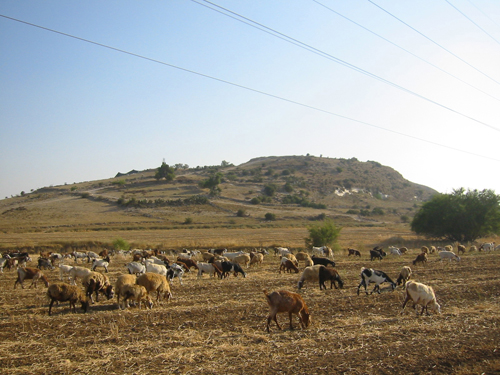
Sheep below Gath - Aren Maeir, Bar-Ilan University
“You will find these people different than our people, and they are unlike the Canaanites we have seen in the valley. These are the Sea Peoples, a strong civilization of warriors who feel that they should own the world. The Philistines rule their territory from five strong cities, Ekron is five miles north. Ashdod, Ashkelon and Gaza are to the south and closer to the coast. Gath ruled by King Achish who is the guardian of the Valley of Elah and the coastal plain below his city. He will allow us to graze our sheep in his territory because the people need meat and wool which comes from our animals. But do not trust anyone, and do not go out of your way to talk with them. Answer when spoken to, but keep your conversations short.”
Gath from the air - from Ferrell Travel Blog
Jesse explained to Eliab, and to his other sons when they first beheld this city, that the people were as strong as their city walls. They had developed a metal called iron, which was far greater in strength than any material which the Hebrews could use. If confronted in a fair face to face, hand to hand, strength to strength battle the Philistines would probably win because their weapons and training were superior to anything Jesse or his people possessed. There were giants in the city, which Jesse had seen. Several were at least eight feet tall, and probably larger. Eliab was to keep his distance from these people, and he was to let his father deal with them as they sold food and cloth.
Jesse had been in the city which was very large, loud and cosmopolitan. The gates of Gath were formidable. The ramparts atop the wall were expansive, and the King’s palace was elaborate. The market was several times larger than any village in the Judean highlands and the dwellings were several stories tall. The city was a busy place in which a person could easily get lost, and if not careful a man could get hurt or killed by these warrior people.
Area F staff and the Early Bronze fortification wall at Tell es-Safi/Gath
The people were especially proud of their great temple to dagon, a god of grain. Jesse told the story of how the Hebrew people battled with them during the settlement of the land and how at one time they captured the Ark of the Covenant. He said, “It was only by the strength of our God that we got it back.”
Jesse told the story of Samuel who was called a judge by the Hebrew people. “In the end,” he said, “Samson was betrayed by Delilah and taken captive by the Philistines who put his eyes out and made him tread grain like an oxen before their god dagon.”
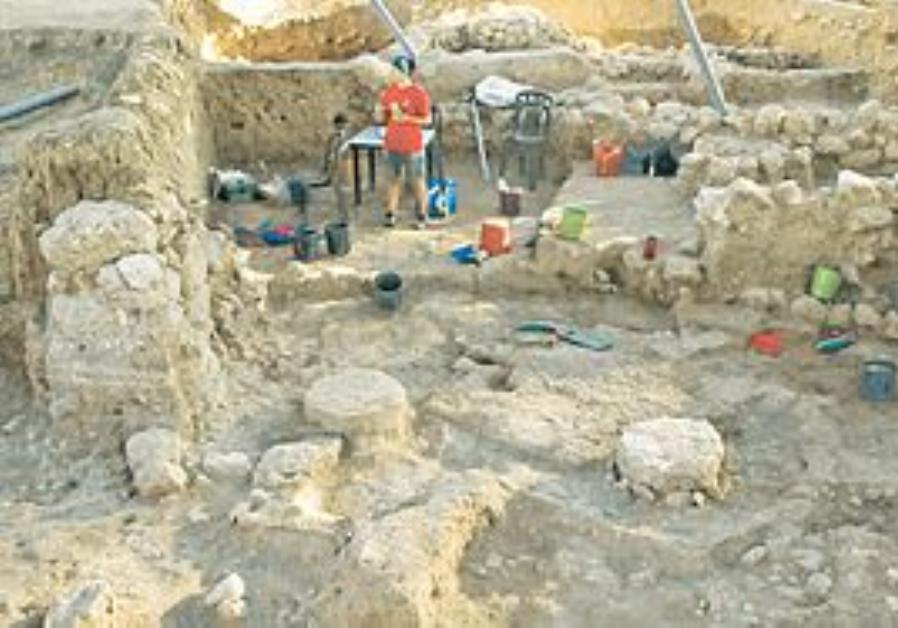
Temple of dagon with its two pillars
Eliab remembered the story and added, “But when the Philistines tried to show the power of their god over our people by chaining Samson to the twin pillars in their temple this strong man was able to shove the supports apart and crush the heathen through the destruction of their temple and their god.

Wednesday, March 15, 2017

A Boy Named David

Today we’ll take a fresh look at an ageless story which has been told often, but is worth telling again. The story contains elements of self-preservation, protection of a people, and heroism which guides us in faith and also gives an understanding of the land where the epic events and teachings of the Bible took place.
Scrolls at the 5th Quarter in Jerusalem
The story begins in the fields outside a village called Bethlehem, or the House of Bread. Shepherds had passed through this village for more than a thousand years before our story occurred. Abraham, Isaac, and Jacob are known to have passed along the road, Rahab settled here after leaving Jericho, and Boaz lived in the village. Jesse and his eight sons (who are the subject of our story) also lived here.
Elah Valley in Jerusalem where David fought Goliath
The town of Bethlehem sat near an important junction where the Central Ridge Road meets the road which descends through the Elah Valley to the coast.
Road leading down to the Elah Valley from Ramat Rachel
In the days of King Saul, the Philistines (also called the Sea Peoples) were enemies of the new Kingdom of Israel. The Philistines lived along the coast in five major towns and surrounding villages. Throughout their history, they sought to expand their territory. One area of expansion was through the Elah Valley and up the hill to the Central Ridge Road.
Looking into Philistine territory from Gezer, Israel
The Bible tells us of one such war initiative of the Philistines. “Now the Philistines gathered their forces for war and assembled at Sokoh in Judah. They pitched camp at Ephes Dammim, between Sokoh and Azekah.” (1 Sam 17).
Information sign at Tel Azeka, Israel
King Saul responded by enrolling enlistees and sending an army down the road into the Elah Valley, and they camped near Azekah. “A champion named Goliath, who was from Gath, came out of the Philistine camp. His height was six cubits and a span. He had a bronze helmet on his head and wore a coat of scale armor of bronze weighing five thousand shekels; on his legs he wore bronze greaves, and a bronze javelin was slung on his back. His spear shaft was like a weaver’s rod, and its iron point weighed six hundred shekels. His shield bearer went ahead of him.”
Looking into Elah Valley from Azekah
The Hebrews trembled when they saw the nine foot giant. In fear they froze and did not know what to do. For forty days the giant would come down from the Philistine camp and issue the challenge, “Why do you come out and line up for battle? Am I not a Philistine, and are you not the servants of Saul? Choose a man and have him come down to me. If he is able to fight and kill me, we will become your subjects; but if I overcome him and kill him, you will become our subjects and serve us. This day I defy the armies of Israel! Give me a man and let us fight each other.”
Looking into Elah Valley from Tel Azekah
For forty days the giant Goliath descended from his hometown of Gath in order to challenge the Hebrews. The standoff lasted so long that Jesse, who had three sons (Eliab, Abinadab, and Shimma) among the camp of Israel, decided to try to encourage his family. He sent his youngest son, David, to carry food from his home in Bethlehem to his sons who were camped in the Elah Valley.
Looking east from Tel Azekah
While David was delivering food to his brothers, Goliath descended to repeat his challenge before the army of Israel. David told his brothers that he would fight the Giant, and this was told to the King, but Saul thought the boy was too young.
Shepherd near Lachish in Israel
David told the King he was able to defend his sheep against lions and bears. He pushed his desire to fight the Giant against every objection the king could dish out his way. Because no one else was willing step forward, the king allowed a young shepherd to accept the challenge.
Sheep near Lachish in Israel
We all know the outcome - with one stone in a sling, David, the young shepherd, felled the nine foot giant. He also kept the giant’s brothers at bay with other smooth stones collected for ammunition.
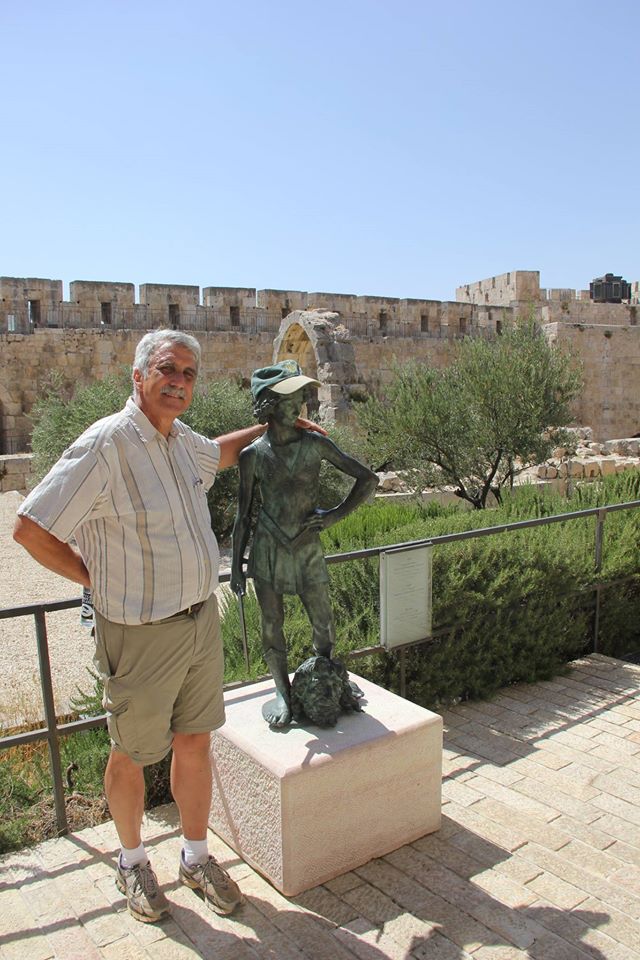
Two Davids at Tower of Israel Museum, Jerusalem

On our tour of Israel May 5-18 we will visit the Valley of Elah, we will see Azekah, and we will ascend Gath. We will retell the stories and relive the events which changed history so long ago. I invite you to join us on this trip in order to experience the stories of the Bible as they come to life.

Saturday, December 12, 2015

The Christmas Stories and the book Advent Journeys takes us to Bethlehem. Bethlehem is at the crest of a hill along the Central Ridge Road traversed by countless travelers over the years.  Patriarchs Abraham, Isaac and Jacob would have passed this way as they journeyed from the north to Hebron and Beer-Sheva. Rachel, the wife of Jacob died at Bethlehem (Ge 35:16-18) giving birth to Benjamin.  
Bethlehem, because of location was a strong point along the road.  One of the Judges, Ibzan (Judges 12:8-10) is from Bethlehem. (In the Talmud [Bava Batra 91a] Rabbah teaches Ibzan was Boaz of the book of Ruth.)  The Philistines at one point maintained a garrison here (2 Sam. 23:14).  The city was a prize to be fought for as the People of Israel claimed this important town.
The area around Bethlehem (as many places in Israel) was a place to pasture sheep.  Boaz, a wealthy landowner was from this town, as well as Elimelech.  The book of Ruth recounts how Boaz comes to marry Ruth, the daughter-in-law of Elimelech.  To this couple was born a son named Obed, who was the father of Jesse, who was the father of David.
The area through history remained, as it had been: a rural community at a crossroads.  David protected his home town.  Sorek Valley (of Samson & Delilah fame) and Elah Valley (where David fought Goliath).  Bethlehem is located close to Tekoa, the village Amos called home.  Tekoa was also the location for King Herod’s favorite fortress, Herodium.  From the top of Herodium one can see Bethlehem, Jerusalem, Masada and other fortresses.
The town of Bethlehem, known as “the house of bread,” gained prominence and importance as the birthplace of King David.  Although the population did not increase, the town earned a place in history.  Micah says of Bethlehem: “Now gather yourself in troops, O daughter of troops; He has laid siege against us; They will strike the judge of Israel with a rod on the cheek.  But you, Bethlehem Ephrathah, Though you are little among the thousands of Judah, yet out of you shall come forth to Me the One to be Ruler in Israel, whose goings forth are from of old, from everlasting.  Therefore He shall give them up, until the time that she who is in labor has given birth; then the remnant of His brethren shall return to the children of Israel.  And He shall stand and feed His flock In the strength of the Lord, in the majesty of the name of the Lord His God; and they shall abide, for now He shall be great to the ends of the earth; And this One shall be peace.” (5:1-5)