Showing posts with label King David. Show all posts

Wednesday, February 7, 2018

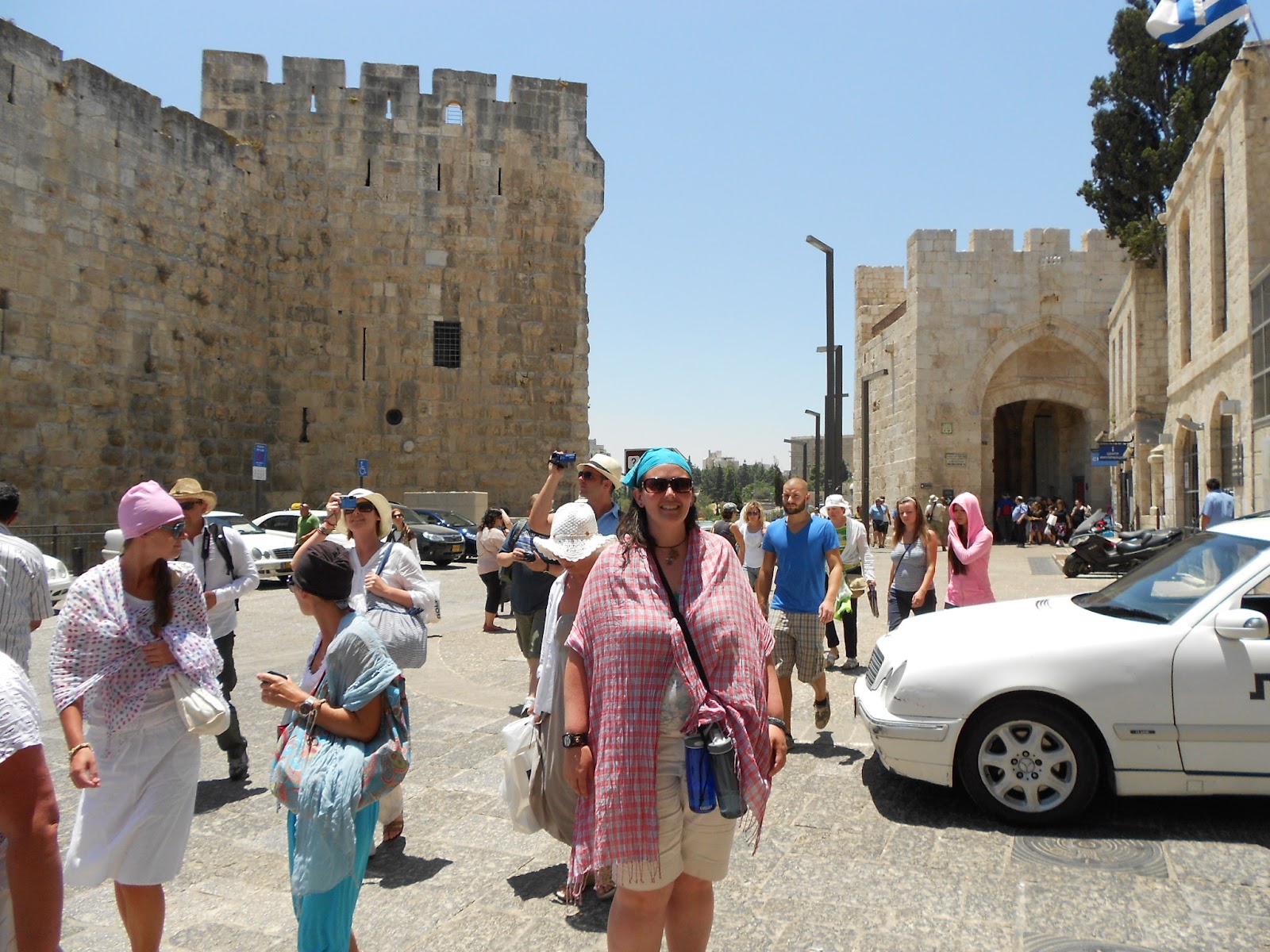
Joppa Gate

Pass through, pass through the gates! Prepare the way for the people. Build up, build up the highway! Remove the stones. Raise a banner for the nations. (Isaiah 62:10)
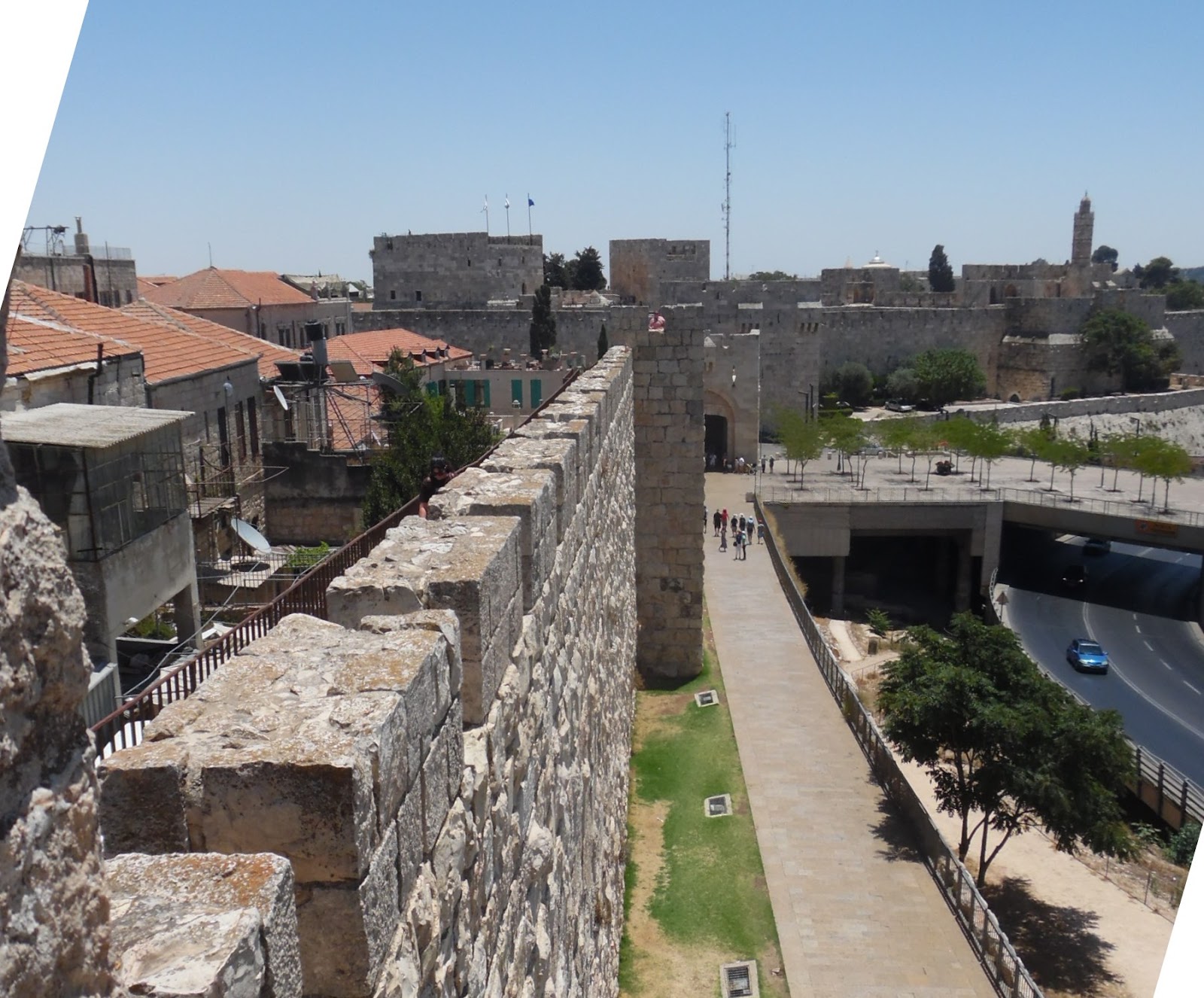
Jaffa Gate from inside the walls of Jerusalem
The Jaffa Gate is, in a way, the international gate of Jerusalem. The name shared most often today motions away from the city to the port city of Jaffa (and beyond that to Caesarea), from which travelers arrive into Eretz Yisrael from all over the world. From the days of King David, when King Hiram of Phoenicia passed by this gate, even until today travelers and others have written about the beautiful Jaffa Gate.
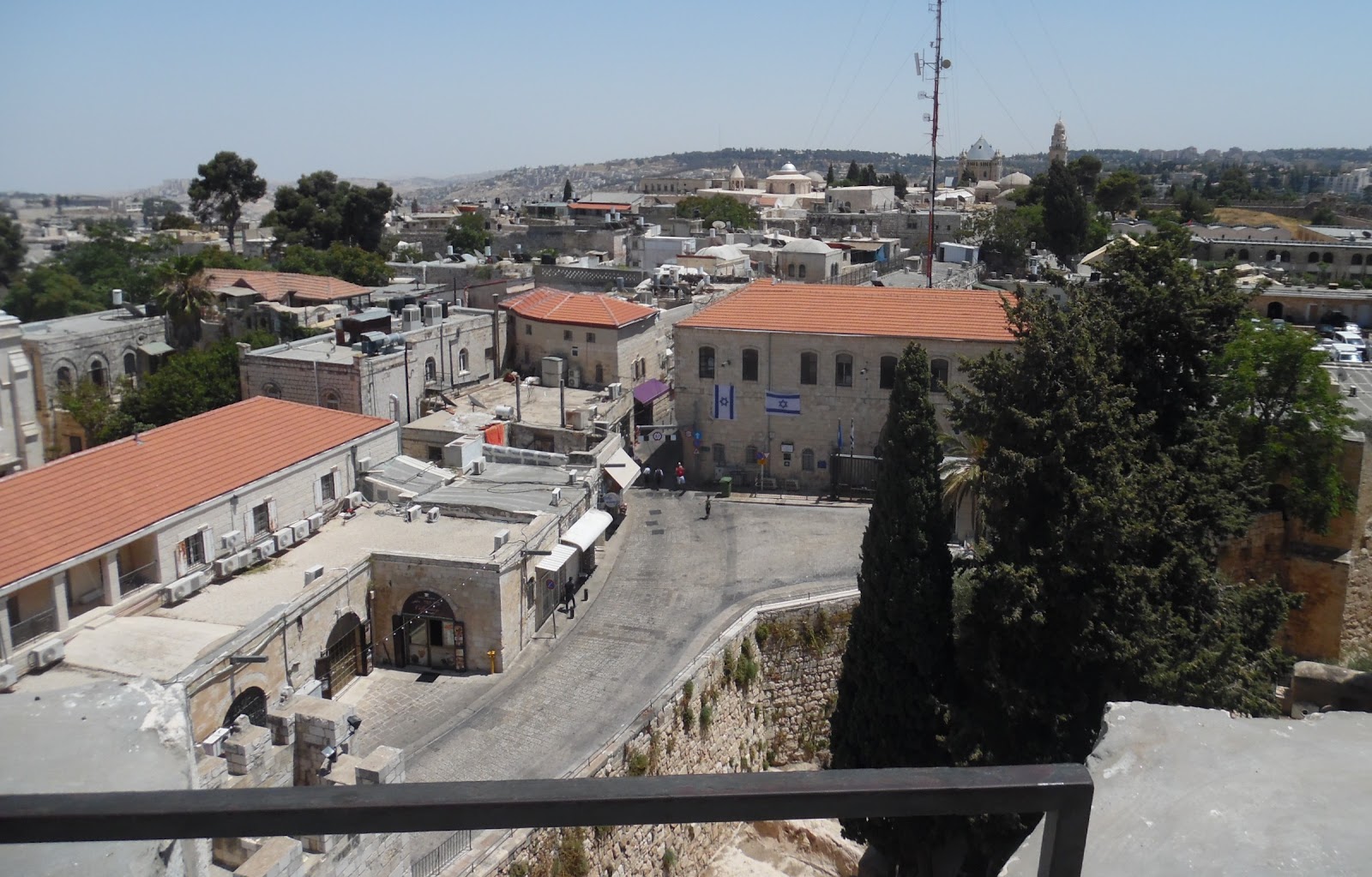
Looking down from the top of the Rampart Walls
At one time the gate was heavily guarded, with a double entry and heavy wooden doors which sat upon bronze hinges. Towers guarded this entrance, portions of which still stand today. King Herod named these towers Phasael (145’ high), Hippicus (132’) and Mariamne (74’) after his brother, a friend, and his favorite wife. Of these, only a portion of the Phasael tower stands today, and the gates were removed to allow Kaiser Wilhelm II easier access to the city in 1898. (More in my book, Israel: Stories for Your Journey)
A must for tourists to Israel
Most of the walls and gates of Jerusalem, which we see today, were ordered to be constructed by Sultan Suleiman the Magnificent who ruled the Ottoman Empire in the sixteenth century. A story is told of how he found the walls of Jerusalem in ruins after being visited by four lions in a dream. He sent two architects to build a wall following the original course of the city’s protective enclosure. When completed the Sultan visited the city, and when inspecting the work found it satisfactory with one exception. The Tomb of King David was left outside the walls. The two architects were hanged and put to rest in graves outside the Jaffa Gate.
The outside of Jaffa Gate from the top of the walls
Most people pass in and out of the wide Jaffa Gate with no notice of these two graves, for this international gate is the portal into Jerusalem’s oldest and one of it’s newest marketplaces. The walls of Jerusalem contain a vast marketplace spreading out from David Street which leads toward Temple Mount. An entrance to the Mamilla Mall can be found when exiting the old city through the Jaffa Gate. Below the mall visitors will enjoy the fountains, shops and sights of Teddy Park.
Join me for a great tour of Israel

Jerusalem with its gates and holy sites is worth a visit. Please join me on my next trip May 5-18, 2018 (click this link for more details). If you can not go, please order my $2 book, Israel: Stories for Your Journey.

Thursday, May 11, 2017

En Gedi

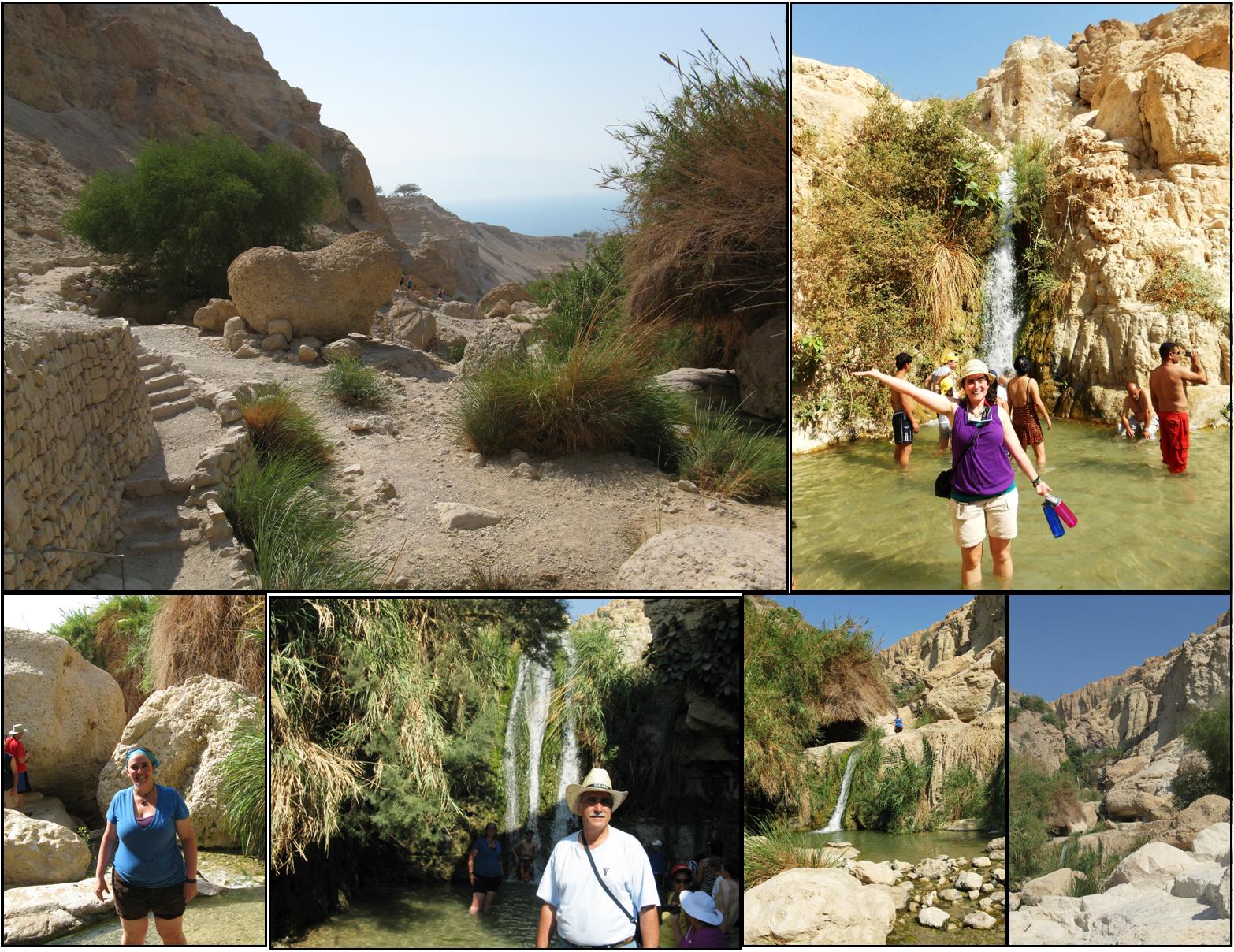
What is more fun than floating in the Dead Sea? A walk up the creek at En Gedi in order to take a dip in the pool at the waterfall. We will take this great walk during a 14 day trip to the Holy Land in May 2018.
The oasis at En Gedi is very ancient. Settlements have been documented along the freshwater streams since the Chalcolithic era or Copper age in Israel. Remains can be found for rich farming communities, Essene schools, Temples, Synagogues, and Roman Villas. It is written that King David used this region as a hide-out, living in caves and partaking of the rich foods found along the cool streams in the area. En Gedi was famous for its Balsam, Date Palms, Henna, and aromatic resins. Solomon wrote, “My beloved is to me a cluster of henna blossoms in the vineyards of Engedi.”
“David went up from there and lived in the strongholds of En Gedi. After Saul returned from pursuing the Philistines, he was told, ‘David is in the Desert of En Gedi.’ So Saul took three thousand able young men from all Israel and set out to look for David and his men near the Crags of the Wild Goats.” (1 Sam. 24) We will walk up Wadi David during our visit at En Gedi.
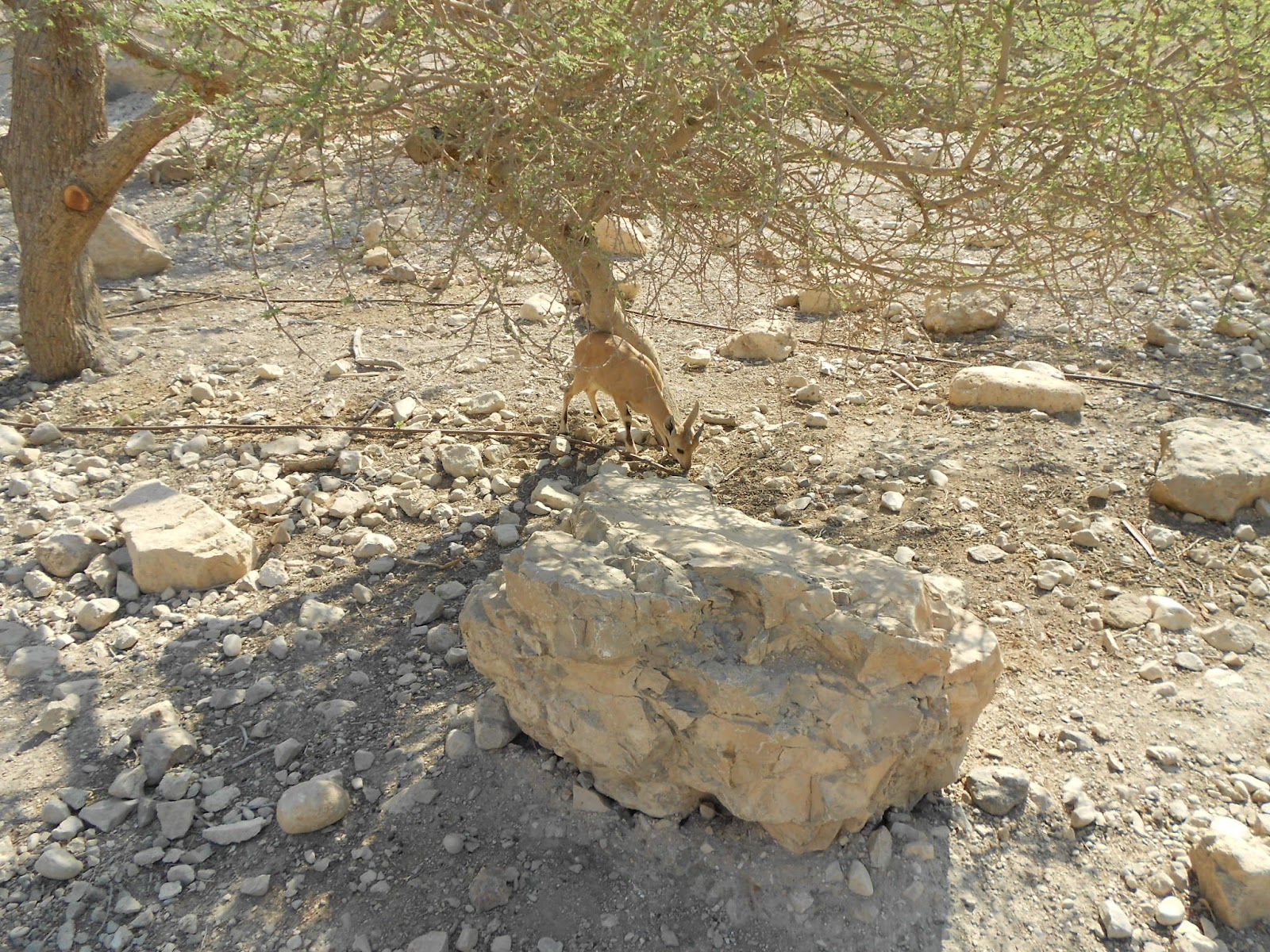
We will begin our walk in a picnic area shaded by acacia trees and Christ-thorn jujube. Because of the water there is an abundance of plants and animals along the wadi. We will observe small antelope and Rock Hyrax or Conies under and in the trees.
After taking time to look at and take photos of the animals we will walk a well laid out trail along the stream. The trail crosses the stream on bridges giving us a closer look at the valley, the plants and the water flowing through shallow pools and  trickling over rocks. We will see the caves in which David camped and trails leading to the Judean heights.
There are many trails which traverse this Ein Gedi National Park which are well laid out and cover the various wadis in the area. The hike for our group will not be difficult, and there are benches along the way. Climbers who have time and are able can ascend along the Zetuya, Ha issiyyim, B ‘nei Hamoshavim, EnGedi or Yishay ascents to Mt. Zenuya on the desert plateau.
We will ascend at a much more moderate path along the creek, taking time as we desire to look back along the trail we have traveled. The views are different as we look up the hill toward the waterfall and look downwards toward the Dead Sea in the distance. Those who desire can wander a little and rock climb on marked trails. The rest of us will easily navigate a gradual ascent.
Our climb will end at David’s waterfall below Dodim’s Cave. We will have time to put or feet in the water, or if prepared we will be able to get into the water and refresh ourselves. From the pool we will be able to stand under the waterfall and look down the canyon to the Dead Sea.

On the completion of our time at En Gedi we will prepare for a swim in the Dead Sea and possibly a visit to Jericho. Fun times are in store for those who join us on our 14 day trip to the Holy Land in May 2018. To sign up, use the link to find more information at www.KosherCopy.com. You will also find links to the trip itinerary and for trip registration.

Sunday, April 2, 2017

Jesse’s Sons: Part 3

Eliab was back in the valley he had grown to love, but this time it was not to herd sheep, it was for war. And the conflict was not going well, for an evil spirit tormented King Saul and apparently his people had fallen out of favor with God. The Philistines were successfully expanding their kingdom into Benjamin and were on their way to raid and loot the Judean highlands. King Saul and his generals decided to stand against them in the Elah Valley. This is a place where they had been successful before. In the days of Joshua God helped His people to win a decisive victory over the Amorites by sending a hail storm (Joshua 10:10-11). Samson, the Judge of Israel had killed Philistines in the area with the jawbone of an ass.
When King Saul called out his army Eliab with two of his brothers, Abinadab and Shammah responded. They were camped below the town of Azekah, an ancient village set at a strategic vantage point where the Elah Valley wraps around a hill.  From the top of the hill the entire valley could be observed from end to end. The high position also enabled communication with fire signals which could be seen in the south at Lachish to the east in Judah and to the north in Benjamin. The Assyrians at a later date said the the place was like the nest of an eagle located on a mountain ridge. Simon bar Kocba set a fort in this area in the early second century and his trademark tunnels still run just below the surface. This defendable position was easily accessible for King Saul from his capital at Gibeah through Beit Shemesh.
Satellite View of Azekah
The army of the Philistines was camped on the south side of the valley near the village of Socoh. The Elah River stood between the two armies and was nicknamed in anticipation of the battle to come “Ephes Dammim” or the boundary of blood.
Socoh Hill
But the battle did not come as anticipated, for the Philistines from Gath had a powerful diversion with them, and after a time of acting out and noise making by both armies in order to bring fear to the opposition the Philistines revealed a secret weapon. His name was Goliath, which means splendor. And he was magnificent. He stood nine feet tall and carried a spear like a weaver's beam. He issued a challenge which according to the rules of war in that day must be accepted, “Choose one man and let him fight me. If he is able to kill me, then the Philistines will become your servants: but if I prevail against him, and kill him, then you shall be our servants.”
View from the top of Azekah
The army of Israel trembled, for no one was willing to fight Goliath. He was tall, he sounded mean, he wore a coat of iron and carried a large spear with a sharp tip. By arm length alone a Hebrew was bound to lose, and Israel did not yet possess either iron armor or iron tipped spears.
King Saul called for volunteers, but no one stepped forward. He promised riches to the man who won, but no one was willing. The King even said he would give his daughter as a wife to the successful soldier, but they would not be enticed. The challenge was made each morning and evening for forty days with taunting and ridicule, and every man of the Hebrew army feared for his life.
View from the top of Azekah
Eliab’s elderly father Jesse grew concerned, for he was in Bethlehem and had not seen or heard from his oldest three sons for more than a month. He decided to send provisions by way of his youngest son David because he served the king and knew where the army was camped. David found a substitute to take his place with the sheep, and rushed to the camp of the Hebrews.
As David arrived the Hebrews were gathering to hear Goliath make one of his evening rants. The Lord filled David with grief because no one trusted God enough to step forward. David told his brothers that he would go to the king and volunteer for the battle. Anger flashed in Eliab’s heart, and he told David he was as spoiled as Jacob’s son Joseph who pulled stunts like this to embarrass his brothers.
But discouragement from his brothers did not stop David from going to King Saul. He said, “Let no one lose heart on account of this Philistine; your servant will go and fight him.”
David fighting Goliath
Saul was concerned because of David’s small size and his lack of experience, but David said to the King, “Your servant has been keeping his father’s sheep. When a lion or a bear came and carried off a sheep from the flock, I went after it, struck it and rescued the sheep from its mouth. When it turned on me, I seized it by its hair, struck it and killed it. Your servant has killed both the lion and the bear; this uncircumcised Philistine will be like one of them, because he has defied the armies of the living God. The Lord who rescued me from the paw of the lion and the paw of the bear will rescue me from the hand of this Philistine.”
Saul knew there were no other options, and that time was short before the Philistine’s patience would run out. He agreed that the young shepherd could accept the challenge. The rest is history. Antigonus of Socoh, a voice from the Mishnah who lived 700 years after this event said, perhaps remembering this story, "Be not like servants who serve the master on condition that they receive a reward. Rather be like servants who serve the master irrespective of any reward.  And let the fear of heaven be upon you."
Sign at the entrance to Azekah site
The Elah Valley is quiet now. Azekah and Socoh are now part of British Park, a Jewish National Fund nature sanctuary. Blue Turmus (Lupin) flowers sprout around Socoh rather than Philistines.  Farmers raise crops in the valleys and tourists visit historic sites without fear of being taunted by the giant.

Wednesday, March 15, 2017

A Boy Named David

Today we’ll take a fresh look at an ageless story which has been told often, but is worth telling again. The story contains elements of self-preservation, protection of a people, and heroism which guides us in faith and also gives an understanding of the land where the epic events and teachings of the Bible took place.
Scrolls at the 5th Quarter in Jerusalem
The story begins in the fields outside a village called Bethlehem, or the House of Bread. Shepherds had passed through this village for more than a thousand years before our story occurred. Abraham, Isaac, and Jacob are known to have passed along the road, Rahab settled here after leaving Jericho, and Boaz lived in the village. Jesse and his eight sons (who are the subject of our story) also lived here.
Elah Valley in Jerusalem where David fought Goliath
The town of Bethlehem sat near an important junction where the Central Ridge Road meets the road which descends through the Elah Valley to the coast.
Road leading down to the Elah Valley from Ramat Rachel
In the days of King Saul, the Philistines (also called the Sea Peoples) were enemies of the new Kingdom of Israel. The Philistines lived along the coast in five major towns and surrounding villages. Throughout their history, they sought to expand their territory. One area of expansion was through the Elah Valley and up the hill to the Central Ridge Road.
Looking into Philistine territory from Gezer, Israel
The Bible tells us of one such war initiative of the Philistines. “Now the Philistines gathered their forces for war and assembled at Sokoh in Judah. They pitched camp at Ephes Dammim, between Sokoh and Azekah.” (1 Sam 17).
Information sign at Tel Azeka, Israel
King Saul responded by enrolling enlistees and sending an army down the road into the Elah Valley, and they camped near Azekah. “A champion named Goliath, who was from Gath, came out of the Philistine camp. His height was six cubits and a span. He had a bronze helmet on his head and wore a coat of scale armor of bronze weighing five thousand shekels; on his legs he wore bronze greaves, and a bronze javelin was slung on his back. His spear shaft was like a weaver’s rod, and its iron point weighed six hundred shekels. His shield bearer went ahead of him.”
Looking into Elah Valley from Azekah
The Hebrews trembled when they saw the nine foot giant. In fear they froze and did not know what to do. For forty days the giant would come down from the Philistine camp and issue the challenge, “Why do you come out and line up for battle? Am I not a Philistine, and are you not the servants of Saul? Choose a man and have him come down to me. If he is able to fight and kill me, we will become your subjects; but if I overcome him and kill him, you will become our subjects and serve us. This day I defy the armies of Israel! Give me a man and let us fight each other.”
Looking into Elah Valley from Tel Azekah
For forty days the giant Goliath descended from his hometown of Gath in order to challenge the Hebrews. The standoff lasted so long that Jesse, who had three sons (Eliab, Abinadab, and Shimma) among the camp of Israel, decided to try to encourage his family. He sent his youngest son, David, to carry food from his home in Bethlehem to his sons who were camped in the Elah Valley.
Looking east from Tel Azekah
While David was delivering food to his brothers, Goliath descended to repeat his challenge before the army of Israel. David told his brothers that he would fight the Giant, and this was told to the King, but Saul thought the boy was too young.
Shepherd near Lachish in Israel
David told the King he was able to defend his sheep against lions and bears. He pushed his desire to fight the Giant against every objection the king could dish out his way. Because no one else was willing step forward, the king allowed a young shepherd to accept the challenge.
Sheep near Lachish in Israel
We all know the outcome - with one stone in a sling, David, the young shepherd, felled the nine foot giant. He also kept the giant’s brothers at bay with other smooth stones collected for ammunition.
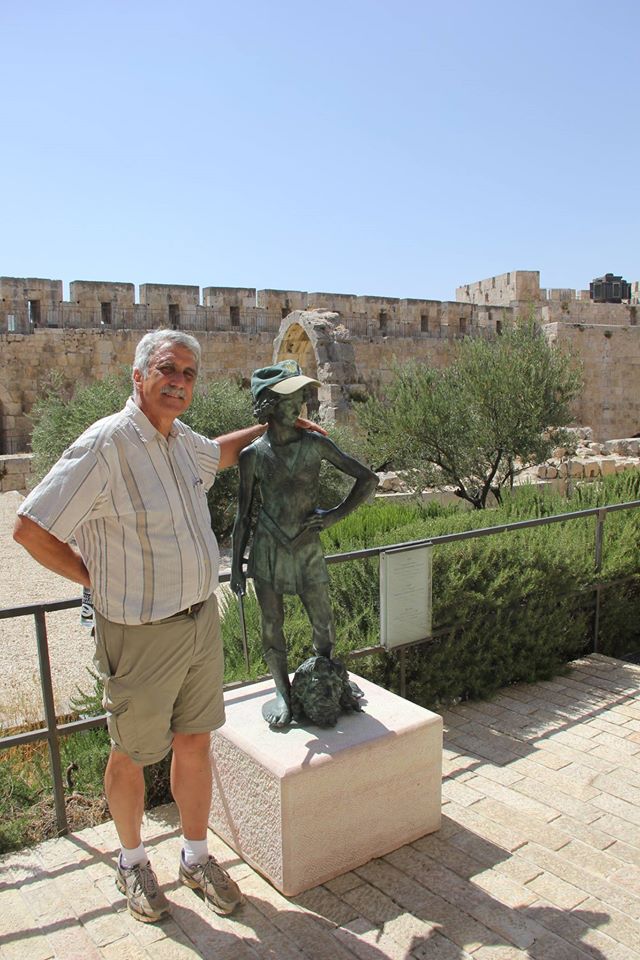
Two Davids at Tower of Israel Museum, Jerusalem

On our tour of Israel May 5-18 we will visit the Valley of Elah, we will see Azekah, and we will ascend Gath. We will retell the stories and relive the events which changed history so long ago. I invite you to join us on this trip in order to experience the stories of the Bible as they come to life.

Monday, June 20, 2016

Israel Adventure - Day 11

This morning we started with an early fast breakfast from Aroma Coffee, and then a quick departure to the Old City. We began our tour with a walk around the perimeter of the walls to the south. Dr. Ilan showed us the different levels of the walls from the bedrock up. He showed us where the walls were at different places in different time periods. They were not as they appear today.
In the picture above bedrock can be seen below the walls (above the grass). There are tombs chiseled into the soft chalk bedrock, showing that at one time this area was outside of the city. There are rocks above the tombs from the Roman Period (130-443 AD). Above those rocks, and slightly inside, are walls built by Sultan Suleiman the Magnificent (1535 AD).
While we were standing by the wall, we looked across the Hinnom Valley. At the bottom of the valley is Sultan’s Pool, perhaps the Serpent Pool of Jesus’ time. This was part of the irrigation system for farms which lay below the city. Just above the pool is the old aqueduct which snakes around and into the city. Above that are homes built in 1860 - in a sense, Jerusalem’s first suburb.
We then walked south to the Zion Gate. This was on the Green Line in 1948 and several fierce battles were fought here. The walls are pocketed with the bullet holes from shelling and battle.
Continuing on the south wall, we passed a dig being done by UNCC (University of North Carolina Charlotte).
Further along our walk we saw this dig. Dr. Ilan told us this was originally a parking area which was to be developed as a five story parking garage. Israeli law requires that an archeological survey must be done before anything new can be built in Israel. When the survey was done, ruins were discovered from the Turkish period, then by digging, the Roman, Greek, Hasmonean, and earlier. This is not surprising because this area is near the Tyropoeon Valley or Cheesemaker’s Valley, which runs through the center of the city. Four years into the dig, the garage was cancelled and the archeological find was placed along a walking path which leads to the Temple.
Further along the walls we saw more tombs cut into the bedrock. During the time of King David this area was inside the city, so the tombs must have come later. Jewish law forbids burial (except for kings) inside the city walls where people live. As the city walls move in and out and people necessarily come to live near the tombs, the Rabbis developed ways of ritually cleansing the tombs. Bones are removed and blessings are spoken so people can build on top of the tombs. That is what happened with these tombs, and they were refitted as cisterns with plaster on top, and houses above the plaster. The wall above the tombs is late period Ottoman.
Along the way we saw these concrete road barriers (like are being installed on I-77). I wonder why we can’t make them look this good in America?
We came to the Old City of David (currently outside the walls of the city) where the Gihon spring is located. One objective of the day was to descend to the spring and see the ancient fortifications.
We walked through the upper ruins, where the excavator thinks King David’s palace is located.
This is Silwan, a neighborhood across the Kidron Valley from the City of David. In Biblical times Jerusalem looked much like this with the palace at the top (which is why David could look down and see Bathsheba on the rooftop).
Today the hillside looks like this, with remains of structures at the bottom. Some of the residents at the bottom of the hill are listed in the book of Jeremiah. The houses on this hillside go back to the time of King David, so people lived on this hillside for 500 years. Dr. Ilan talked about how difficult archeology and dating become when people can live in peace in an area for so long, without destruction levels to help date the civilization.
This blurred picture is what the city of David probably looked like. The Temple is at the top of the hill, the palace (Solomon’s) at the mid-section. The path to the Temple can be seen winding up the hill. The Gihon Spring can be seen just below the shine on the bottom left of the picture. This spring was fortified behind strong walls in order to protect the city’s water source.  We walked down to Gihon Spring.
Here is one wall protecting the spring as it appears today. The wall extends to the second floor and beyond. It is wide and built of large stones. The group continued through Hezekiah’s Tunnel. Because Sarah was there last week but had not traveled through the Canaanite Tunnel, the three of us traveled that path. We saw the Canaanite wall (when Melchizedek was king) and other ruins. We walked down to Siloam Spring.
As we returned we saw an area the Romans used to quarry stone. They removed a lot of rock, so no archaeological work can be done. There appears to be two large tombs (behind me) on the hill. This could be the tomb of King David.
Following the tour we saw the Skirball Museum, Hebrew Union’s archeological museum. They have displays from Dan (where they are currently digging), Gezer (a past dig), and other sites. They have models of different gates at Dan, pictures from their digs, pottery, and other finds. We ate a Syrian hummus lunch with Dr. Ilan after seeing the Museum.

On the way home we visited the Jerusalem YMCA, a beautiful art deco building. We also saw a Herodian Tomb. We ate a dinner of Potato Kreplach and Spinach Tarte.
Saturday, December 12, 2015

The Christmas Stories and the book Advent Journeys takes us to Bethlehem. Bethlehem is at the crest of a hill along the Central Ridge Road traversed by countless travelers over the years.  Patriarchs Abraham, Isaac and Jacob would have passed this way as they journeyed from the north to Hebron and Beer-Sheva. Rachel, the wife of Jacob died at Bethlehem (Ge 35:16-18) giving birth to Benjamin.  
Bethlehem, because of location was a strong point along the road.  One of the Judges, Ibzan (Judges 12:8-10) is from Bethlehem. (In the Talmud [Bava Batra 91a] Rabbah teaches Ibzan was Boaz of the book of Ruth.)  The Philistines at one point maintained a garrison here (2 Sam. 23:14).  The city was a prize to be fought for as the People of Israel claimed this important town.
The area around Bethlehem (as many places in Israel) was a place to pasture sheep.  Boaz, a wealthy landowner was from this town, as well as Elimelech.  The book of Ruth recounts how Boaz comes to marry Ruth, the daughter-in-law of Elimelech.  To this couple was born a son named Obed, who was the father of Jesse, who was the father of David.
The area through history remained, as it had been: a rural community at a crossroads.  David protected his home town.  Sorek Valley (of Samson & Delilah fame) and Elah Valley (where David fought Goliath).  Bethlehem is located close to Tekoa, the village Amos called home.  Tekoa was also the location for King Herod’s favorite fortress, Herodium.  From the top of Herodium one can see Bethlehem, Jerusalem, Masada and other fortresses.
The town of Bethlehem, known as “the house of bread,” gained prominence and importance as the birthplace of King David.  Although the population did not increase, the town earned a place in history.  Micah says of Bethlehem: “Now gather yourself in troops, O daughter of troops; He has laid siege against us; They will strike the judge of Israel with a rod on the cheek.  But you, Bethlehem Ephrathah, Though you are little among the thousands of Judah, yet out of you shall come forth to Me the One to be Ruler in Israel, whose goings forth are from of old, from everlasting.  Therefore He shall give them up, until the time that she who is in labor has given birth; then the remnant of His brethren shall return to the children of Israel.  And He shall stand and feed His flock In the strength of the Lord, in the majesty of the name of the Lord His God; and they shall abide, for now He shall be great to the ends of the earth; And this One shall be peace.” (5:1-5)