Adventure as we hike in some of the most beautiful terrain is on tap for us on the fourth day of a 14 day trip to the Holy Land in May 2018. As we visit En Avedat National Park we will be walking on the edge of the Desert of Zin where Moses and the Israelites journeyed as they exited Egypt. We will traverse Wadi Zin from a wide valley below Sde Boker through the ravine to the Avadat heights.
 |
| Views from a hike through the lower Wadi Avedat |
The Bible tells us the spies, “went up and explored the land from the Desert of Zin as far as Rehob, toward Lebo Hamath. They went up through the Negev and came to Hebron … When they reached the Valley of Eshkol, they cut off a branch bearing a single cluster of grapes. Two of them carried it on a pole between them, along with some pomegranates and figs.” (Nu 13) Ein Avedat is on a major road which leads from the south to the Judean hill country.
 |
| There are many modes of transportation in the Negev including Trains and Camels |
We will follow the return route of the twelve spies as we travel from Beer Sheba to Sde Boker and Avadat. The road continues to Eilat on the Red Sea and then to the west (traditional site of Mt. Sinai) and to the east (south to Arabia and Midian). The road runs through the desert. Our stopping point is an oasis where surely the spies stopped to drink some water.
 |
| This is a picture and a map of ruins at Avadat |
The Nabateans traversed this area in the first centuries BC and AD. They carried various types of merchandise along what is known as the incense route including myrrh and frankincense. Abdah or Obodat was built by the Nabateans and became their second most important city after Petra. Springs in the area allowed agricultural development which included diversion streams and dams. With the demise of the Nabateans other people continued to live and farm the area through the Roman and Byzantine eras. It is said Nabataean King Obodas I (96 to 85 BC) after whom the town is named was buried in the area.
 |
| This is the view of Wadi Zin from Sde Boker |
We will approach Wadi Avadat by way of Sde Boker. The Kibbutz here is famous for carrying out the Zionist dream of making the desert bloom. David Ben Gurion, Israel’s first Prime Minister lived and was buried here in a grave that overlooks the wide valley through which the stream flows. From the gravesite we will look down on Wadi Zin where our hike will begin.
 |
| Ibex at Sde Boker with Wadi Zin in the background |
We will also see Ibex and other wildlife native to the area. Psalm 104:18 could speak of animals in the area. It says, “The high mountains belong to the wild goats; the crags are a refuge for the hyrax.” We will see lizards, fish and some birds. Swifts, wheatears, partridges, chukars, babblers, desert swallows, rock doves and vultures fly above the valley. Vols and the desert dormouse wander the trail by night.
 |
| A lizard near En Avodot Springs |
When we enter the valley for our hike we will see a topographic map. We will be taken by the chalk, white eocene limestone and thin seams of brown-black flint. We will walk along Avadot stream which is fed by En Mor, En Avadot and En Ma’arif springs.
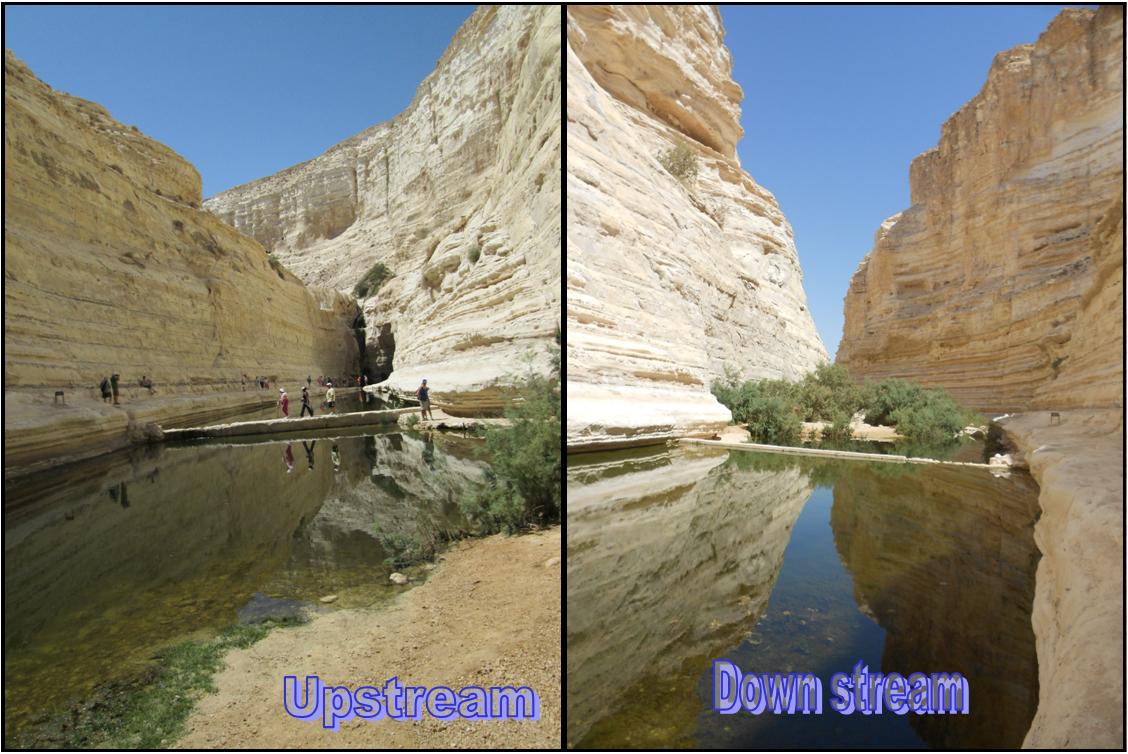 |
| Looking upstream to the water fall and down stream at dam along Wadi Avodat |
We will cross an agricultural earthen dam designed to contain water for irrigation purposes. At the end of the valley there is a waterfall where we will stop to take in the beauty. Then we will continue up a stairway hewn in stone and follow the creek on the upper level.
 |
| Getting ready to rest beneath the tamarask trees along Ein Avodat |
We will admire the salt grass, reeds, bulrushes and nitraria retusa with its white flowers, red fruit and edible leaves with a salt taste. As we ascend the slopes to the top we will rest under tamarisk or salt cedar trees in order to see the route of our ascent.
 |
| Ruins at the top of En Avedat |
We will come upon old buildings used by Bedouins who drew water from En Ma’arif springs when the village of Avedat ceased to be inhabited. Our bus will be waiting to pick us up as we continue our trip into the Judean desert.
 |
| Join us on a trip to the Holy Land by clicking the link below |
Please join us on our 14 day trip to the Holy Land in May 2018. More information can be found at http://www.koshercopy.com/tour-of-israel/ . Links on this page lead to our itinerary and a page where you can sign up to join us on our journey. Our 14 day trip to the Holy Land in May 2018 will be an unforgettable experience, well worth the time and cost which is published.


