Showing posts with label Western Wall. Show all posts

Wednesday, February 21, 2018

The Dung Gate of Jerusalem

By night I went out through the Valley Gate toward the Jackal Well and the Dung Gate, examining the walls of Jerusalem, which had been broken down, and its gates, which had been destroyed by fire. (Nehemiah 2:13)
A Bar Mitzvah near the Dung Gate
The Dung Gate could also be considered the trash gate because it was the most common place to dump the city’s refuse. One reason for this is that the Dung Gate was at the lowest point in Jerusalem. Beyond the gate was a steep drop-off into the Hinnom Valley. People in the city threw their trash over the cliff and down to the bottom of the valley so the people of Jerusalem would never see their trash anymore.
Exiting Buses near the Dung Gate
The dung gate of Jerusalem received its name because a cattle market existed at this place in the past. Livestock were brought in through the gate and sold in a market. When the animals were sold, butchers were available to process the meat and tanners were available to receive the skins which were turned into leather products Dung from the cattle and chemicals from the tanners were disposed of out the gate and over the hill in Hinnom Valley.
View of the Dung Gate walkway facing to the east
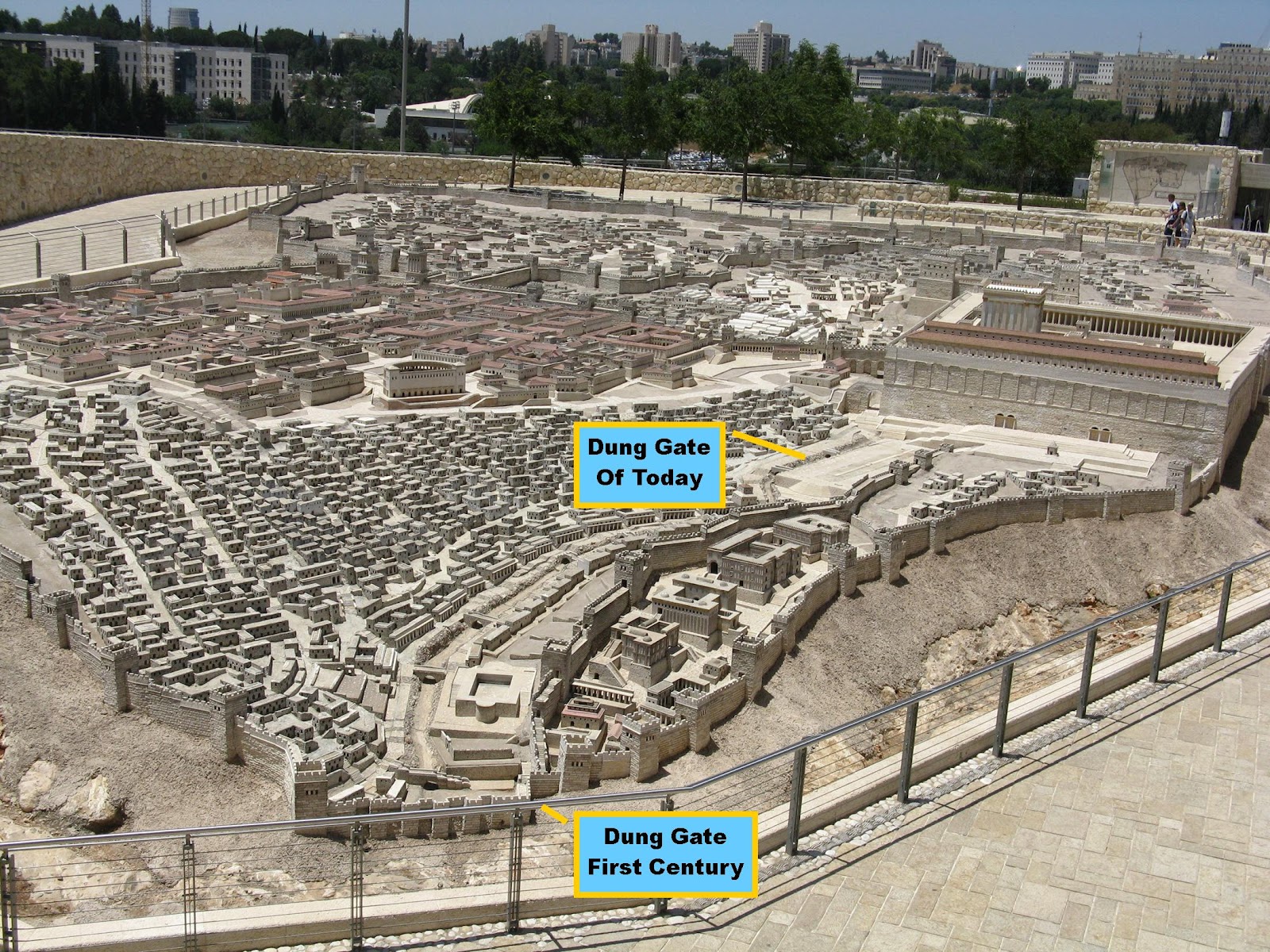
Across the course of history there were actually two Dung Gates. The older gate existed below the Pool of Siloam in the days of the First and Second Temple. The other Dung Gate, that exists today, is about three-tenths of a mile uphill from the old location in the city of Jebus. Both gates were known in the time of Nehemiah, the older gate was called the Dung Gate, the upper location was known as the Valley Gate. Both gates were located in the Tyropoeon Valley, which intersects Jerusalem.
Old and New Dung Gate sites
The Dung Gate today is an entry point for those wanting visit the Western Wall (Kotel). The gate is very busy today, and was a commercial center in antiquity. Close to the area are several archaeological sites. The Western Wall excavations are north of the Dung Gate and to the south of the gate the Israel Antiquities Authority is digging at what used to be the Giv'ati Parking Lot. They have found the home of Queen Helena of Adiabene (read more in my book - Israel: Stories for Your Journey) as well as other artifacts.
Experience Israel through its stories

I invite you to join me as I lead a group to explore the land of Israel or read my book to learn more.

Wednesday, February 22, 2017

Stories in Israel

I have visited Israel three times. The first two visits were with a tour group (please join us for a great experience!), and my most recent trip to Israel was with just my two daughters. Every visit was unique and a great experience. I could share many stories from each visit, but in order not to bore you, I am only sharing a few in today’s blog.
Find details at www.KosherCopy.com
First: A trip to Israel is a multi-day event. We will spend ten to fourteen days with several other people, several we have never met before. We will eat with them, tour with them, and talk to them. The result will hopefully be new friends. On my first trip to Israel, I traveled with my family and two couples I knew from my church. I met many other new friends. In the four years since the trip ended, several friends have visited us as they passed through the area in which we live. I have also communicated via Facebook and other means with new friends.
Jerusalem from the Mount of Olives
Second: For many the trip starts as a tour, a simple excursion. They may think that this journey will be just like any other, but it will not. During the trip sometime and somewhere, travelers will realize, “It was here!”
First view of Jerusalem from the East
I remember two distinct times when I realized a biblical event had occurred exactly where I was standing . On the sixth day of the first trip, we ascended in altitude four thousand feet from the Jordan River along several miles to the district of Jerusalem. We rounded a curve in the road and the site of the Temple came into view before us. It was then I realized, “It was here!” This is the place! This is Mount Moriah where God saved the life of Isaac, the place where Solomon built the first Temple, and the site of the second Temple where Jesus worshipped and taught! The reality sunk in as we approached closer to the Temple. This trip to Israel helped me to understand the Bible in a deeper and different way. A love for God’s word and acts which was surface before grew much deeper.
Western Wall in Jerusalem
On the second trip I had a similar realization atop Mount Nebo. A round stone marked the spot where Moses might have stood, but the realization went beyond the innuendo “might have” to the conclusion, “It was here!” I stood at the site and saw the same land envisioned through God by Moses 3,500 years before. The story is true and beyond words. I can be assured that the events of the Bible are true.
Top of Mount Nebo where Moses stood
I do not know where, I do not know how, but I do know in all probability that when you travel to Israel it will happen when least expected, and you will realize, “It was here!” Please join me on this trip.
Pool in Ein Gedi where King David stood by waterfalls
Third: On day five of my upcoming trip to Israel my daughter and I will return to Ein Gedi. On our first two tours the brochure said we would “hike in the valley, enjoy the waterfalls and soaking our feet in the cool waters.” On the first trip we soaked our feet and observed the swimmers in the clear pool where King David swam. On the second trip we wore swimsuits and stood under the waterfall where we were supposedly only going to “dip our feet.” We will do the same on our upcoming trip. I hope you will also bring your swimsuit along to Ein Gedi!
Western Wall of Jerusalem at Night
Fourth: Trips with John Delancey are unique because we do not only tour during the day, as is normal and the expected for organized tours. But during our past trips, and on this future trip, we will also take night walks. We will take an early walk to the Western Wall (Kotel) and we will visit overlooks to gain a panoramic view of Jerusalem.
Mamilla Mall in Jerusalem
When a night walk on our first trip repeated a place where we had been the day before, my daughters and I walked on Ha-Nevi’im Street (Street of the Prophets) to the downtown pedestrian mall, Ben Yehudah. We saw traditional neighborhoods alive with life in the middle of the night as well as modern Jerusalem. We stopped in modern shops to bargain with merchants and purchase souvenirs at a very reasonable price, we ate ice cream, and we saw young dancers spontaneously dancing and celebrating life (l’chaim!).
Dancers on Ben Yehudah Mall in Jerusalem
The night walk was fun, full of life, and we became one with the people who live in Jerusalem.
Mamilla Mall in Jerusalem
Fifth: During our non-tour trip this past summer, we took a detourto the village of Yavneh, the site where the great council of the Jewish Sanhedrin met after Jerusalem fell. It is said that the canon of the Jewish scripture was formed here. A nineteenth prayer was added to the traditional Amidah (the Standing Prayer, also known as the Shmoneh Esreh, or Eighteen Benedictions - this is one of the main prayers recited daily) and the Rabbis debated and set forth an idea to solve the dilemma of the destroyed altar and missing High Priesthood.
Yavneh, Israel
The historic site was nothing but a mound of dirt called a Tel. It had not been excavated and trails which went to the top were filled with briars, but we did see the place and knew what it once was.
Finding lunch at Yavneh, Israel
I asked my daughters if they wanted to eat in town and we decided to find a place in town. Only one man, a customer, spoke English. He spent his time with us amazed that tourists would come there. He was honored. Chelsea was able to practice her Hebrew and ordered dinner - and we were rewarded with an excellent meal. We ordered Kabobs, and they turned out to be the best shawarma in all of Israel.
More stories will be made in May 2018. Please sign up for this trip. The details can be found at this link.

Tuesday, June 21, 2016

Israel Adventure - Day 12

Each morning on the way to breakfast I walk through the oldest modern Jerusalem subdivision. These homes were built in about 1860 to alleviate overcrowding in the walled city. Now they are an exclusive housing division located very close to the Old City.
After breakfast at Aroma Coffee we joined our tour group this morning at Hebrew Union for a walk to the Jewish Quarter. We began the day with a tour under the Old City by the Western Wall of the Temple.
The tour began with a brief orientation by our tour guide, who recounted for us the history of Mount Moriah. During the time of Jesus the western side of Temple Mount faced a valley. Most of the priests lived on the other side, so they built a causeway over the valley. During the tour, we looked up at vaulted ceilings which are the bottom of that elevated path.
After the destruction of the Temple the entire valley was filled with stone. After that the Arabs raised the city so they would not have to traverse a valley getting to the Dome of the Rock.
We approached the Western Wall at the largest block in the wall construction, which weighs 570 tons (45’ x 11” x 15’). Herod figured out how to move this block into place when he was building the Temple - an impressive task. The block was so heavy that when Titus gave the order to tear down the Western Wall, the Roman army could not move this massive piece of stone, so they started chipping away to try to decrease the size and weight. The progress of the Roman army’s attempts to knock down the walls can be see along the top and right side of the block, but they could not move the massive stone.
We walked along the wall to the north, which continued for about 150 meters. We saw typical Herodian stones along the wall. Each level of block was stepped back so the wall would not appear to be falling on the people as they looked upward toward the top. The pathway led downhill until we hit the bedrock. Because the Temple was built on bedrock that has a natural incline, the bedrock was cut down and became part of the stones - King Herod had the bedrock carved like the stone for consistency and quality. We reached the original street level and saw how roads were paved. Eventually we hit a spot along the path where we could see the other side of the street as it existed 2,000 years ago.
The path extended into the aqueduct and ended at a cistern developed for the Antonion fortress. Pictured in the cistern is our guide. Above is a block which is under homes and in the streets.
At the end of the tour we walked to the Jewish Quarter. The entrance of the tunnel is located at the Western Wall Plaza, so we walked past the Western Wall (although we did not go to the public part of the wall). The picture below shows the Western Wall as we are climbing. The Dome of the Rock is visible in this picture.
At the top of the stairs we stopped at a church and inn managed by the Teutonic Templar Knights. The church’s architecture was made in gothic style.
Next we went to the Wohl Museum of Herodian Archaeology which contains six homes from the time of Jesus. These are not normal homes, but the homes of the wealthy on top of new Mount Zion. This can be seen in the jars found at the site;
The mosaics seen in the houses;
And the large mansion which may have belonged to the High Priest:
Dr. Ilan then took us outside and onto the Cardo which ran through Jerusalem from the Damascus Gate to the Zion Gate. This road is shown on the map at Madaba, Jordan. The street was wide with shops on each side. As we walked, we saw where the ruins were uncovered and could imagine where shops were set along the street according to the ancient style. As we walked further along the Cardo, Dr. Ilan pointed out where shop spaces became more modern and the street was not as wide. Eventually we came to the Muslim Quarter, where the streets are even narrower and more crowded.
At this point we were released to see the city. The group went to eat lunch at a shawarma place (Kosher). We sat down and I met a man who went to school with Denise, proving that the world is a small place.
We then went shopping, first stopping into Moshe Shorashim’s Shop, which we visited on our trips with John Delancey. (Please plan to go on a trip to Israel in 2018 with me, and see this shop. The trip will cost about $5,000 per person … let me know if you have any interest [no obligation] so I can put you on the mailing list.)
As we left the city we saw the “traditional” Upper Room site and King David’s tomb.
Our day finished with a great dinner of Salmon, sweet potato latkes, rice, and green beans at Caffit, a restaurant about a block from our apartment.