Showing posts with label Shavuot. Show all posts

Monday, May 21, 2018

Shavuot, A Summer Festival

Today is Shavuot, the summer harvest festival celebrated in Israel from antiquity. God told Moses to command the Hebrews, “Count off seven weeks from the time you begin to put the sickle to the standing grain. Then celebrate the Festival of Weeks to the Lord your God by giving a freewill offering in proportion to the blessings the Lord your God has given you. And rejoice before the Lord your God at the place he will choose as a dwelling for his Name.” (Deut. 16:9-11)
Flowers in the Golan

The Jews have taken this celebration as a time as an opportunity for thanksgiving, remembering that God is the provider of all good things. Children wear wreaths of flowers around their heads to celebrate the beauty of nature during the days leading up to the festival of weeks. Christians, without realizing it, count the omer and call the day of first fruits Pentecost.
Pomegranate Tree with flowers and young fruit

The Mishnah relates that before the destruction of the Temple in 70 AD, the Festival of First Fruits was a community gala when people of Eretz Yisrael (the land of Israel) would make a pilgrimage to the Temple in Jerusalem bringing an offering from their agricultural produce at the time of their local harvest.
Banana Plantation in Galilee
A local official would cry out on the day after the first harvest in each local community, “Rise and let us go up to Zion, to the House of the Lord our God.”
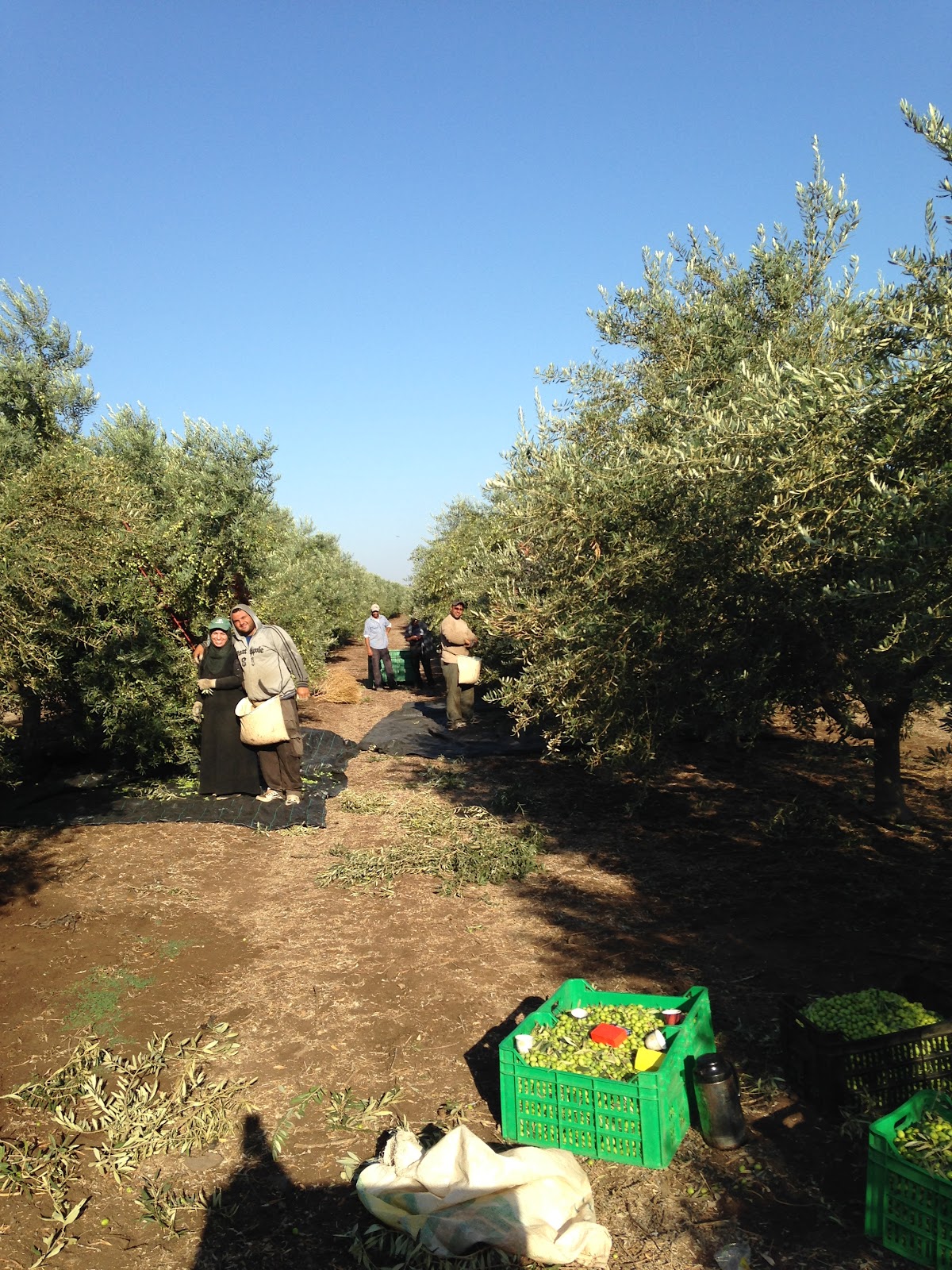
Olive Harvest in Israel
The offering of first fruits would be placed on a cart, drawn by an ox which was decorated for the occasion. Its horns were covered with gold, an olive crown was placed on its head, and fruits and wreaths adorned its back and the cart.
Flowers in Golan
The local official and a musician who played the halil (flute) would lead a procession, followed by the decorated ox who pulled the cart, which was followed by the people of the community until they reached the vicinity of Jerusalem. Along the road a team of greeters would join the procession and enlarge the music and joy of the celebration until the entire procession reached the gates of the city.
Damascus Gate, a main entry into Jerusalem from the north
At the gates of Jerusalem an important official met the procession and led them to Temple Mount. Along the streets of the city tradesmen would greet them with a welcome of peace, with singing, and probably with encouragement to examine their wares as the procession left town.
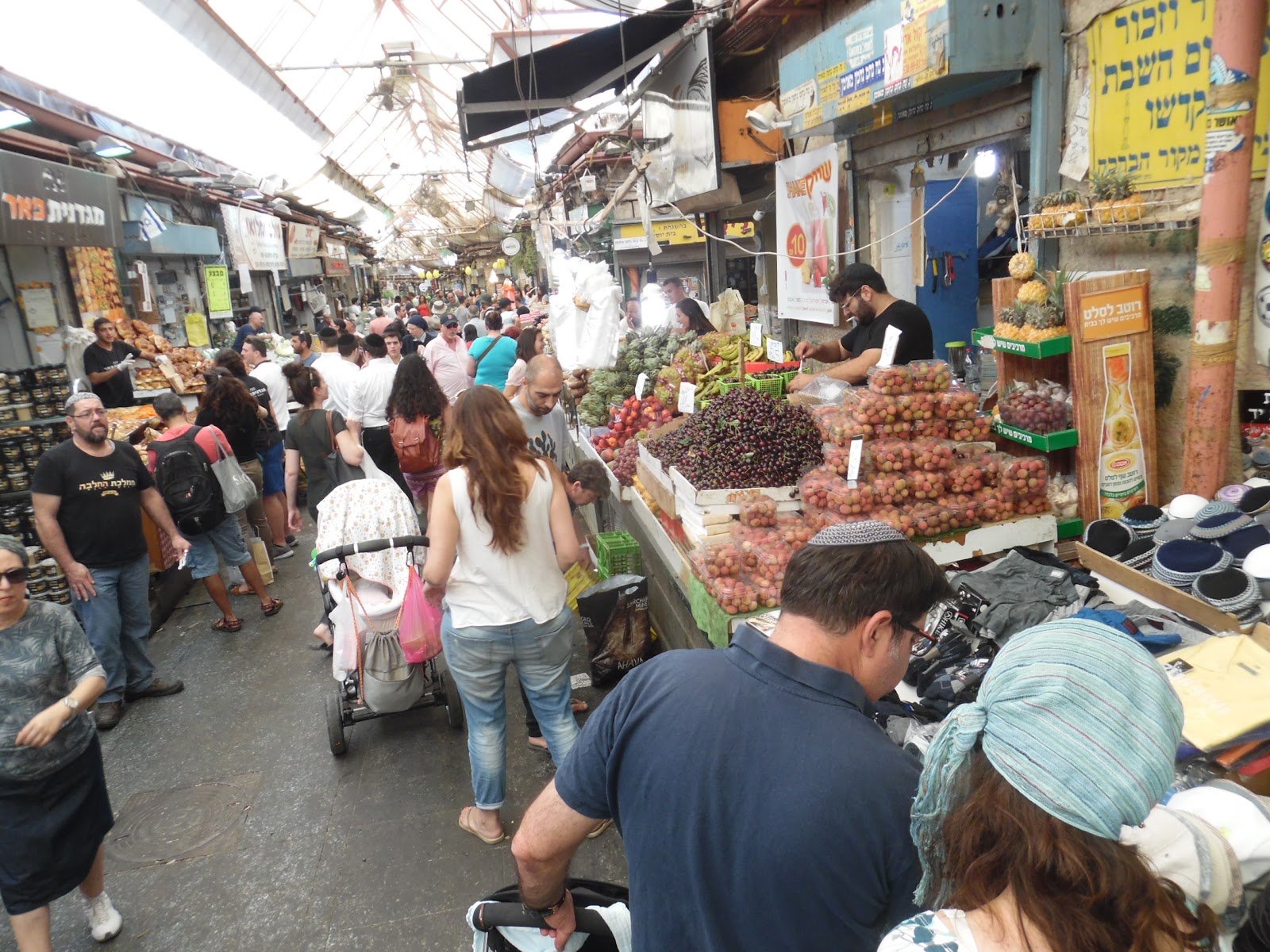
The Shuk, Mahane Yehuda Market
Following the destruction of the Temple, the Jewish people were faced with the dilemma as to how God should be honored without a designated meeting place to honor The Name. Rabbi Meir suggested (Exodus Rabbah, chapter 31) that the festival should be celebrated as the day the Torah was given on Mount Sinai. It has been noted that this event occurred about three months after Passover, which preceded the exodus from Egypt.
Shavuot Program in Haifa
In response, many Jews have added an all night study of Torah to the celebration of Shavuot. They also encourage partaking of dairy products (such as ice cream and cheesecake) to enhance the celebration.

Sunday, June 12, 2016

Israel Adventure - Day 4

My day started with coffee, learning about Tel-Aviv and a Bible study with Pam Herman, with whom we are staying on the first part of our trip. We had a chance this morning to sleep in some, and begin getting over jet-lag and work.
After getting ourselves up and around we ate breakfast at Finnegan Kitchen & Cafe near our apartment. We had Aig’h, an Arabic omelet with herbs, cauliflower, onion, eggplant and roasted peppers served alongside bread, cream cheese, feta cheese, tuna salad, olives, tahini, jam and butter. We also had Shakshuka and coffee.  While we were at breakfast Sarah finished the videos from the Tel Gezer dig and began to upload them. The videos are available here and here.
After breakfast we went to the Eretz Israel Museum which is on the campus of Tel-Aviv University. The museum has many exhibits of the land including an archeological dig from Tel Qasile, Mosaics from the 6th and 8th centuries, a museum of ethnography which holds exhibits on Jewish holidays and the Rothschild Center, a museum dedicated to the efforts of Baron Rothschild to settle the land. We saw a special exhibit on the Bar Kochba rebellion and how it inspired future strength of the Jewish people.
We stopped for lunch at the Italian cafe at Eretz Israel Museum. We ate pizza (which is Mediterranean, but not necessarily Jewish … but it was in Israel in Jewish surroundings).
Afterwards we drove around Tel Aviv-University and the areas around the museum. We ended up at Yarkon Park. We took a walk in the park, enjoying the zoo, the river and people in the park. The park follows the Yarkon River from the western edge of the city to the sea. This park is like the Central Park of Tel-Aviv with multiple ball fields, an amusement park, and other amenities. We took some pictures along the river. Chelsea and Sarah laughed at how I was dressed, like an old Gezer waiting for people to talk to him. I told them the socks with a mountain and animals represented Mount Sinai, for this day is Shavuot in Israel, a holiday.
Following our walk we drove downtown to see Independence Hall and passed the Haganah Museum, which we will see on Tuesday, when it is opened. We enjoyed walking along Rothschild Blvd., and stopped for a drink at…
No, not there … at Aroma Coffee. The Israeli Coffee was a great end to our night. We might have to stop there again on Tuesday, when we return to the area.

Wednesday, May 13, 2015

Forty Days

Today is forty days, which is five weeks and five days of the Omer.
Forty is a significant number.  In the days of Noah it rained for forty days and forty nights.  Moses was on Mount Sinai forty days and nights; twice.  The twelve spies sent by Moses explored the Promised Land for forty days and nights.  Goliath tested the army of Israel for forty days.  Elijah traveled forty days in order to reach Mt. Horeb.  Jonah warned Nineveh their city would be destroyed in forty days unless they repented.
Jesus fasted in the wilderness for forty days and then he was tested by Satan.
And so it was that Jesus walked the earth for forty days following his resurrection.  That is forty days while the Jews counted the omer.
What is an omer you might ask ... it is a measure for grain.  And because it is a measure, its meaning can also be applied to a measure of days.  According to Exodus 16, it was the measure for manna.  In Leviticus 23:16 God tells the Hebrews to count count fifty days from Passover to Shavuot.  These same fifty days are traditionally the number of days it took Israel to travel from Egypt to Mt. Sinai, where Moses ascended to receive the law.  Fifty is the number of days from the resurrection to the giving of the Holy Spirit.
So, what about forty?  It is the number of days from the time Israel left Egypt until they camped at the foot of Mt. Sinai.  It is also the number of days from the resurrection until Jesus ascended into heaven.  The nation of Israel, and the twelve disciples (times ten) waited ten more days to receive God's promise.