Showing posts with label Israeli-Palestinian Conflict. Show all posts

Monday, June 12, 2017

Traveling the West Bank

On this year’s 14 day trip to the Holy Land in May 2018, we will visit areas and sites not included on many tours. One of these areas is the West Bank north of Jerusalem. Our objective on the day we enter the West Bank is to see Tel Shiloh where the Tabernacle of Moses once stood. Along the way we will talk about the hill country of Judea, Benjamin and Ephraim.
We will travel the Central Ridge Highway (Israel Route 60) which goes through the heart of the land where the people lived, not along the coast or through the Jordan River Valley. We will be in proximity of GIlbeah, Rama, Mizpah, Bethel, Michmash, Ophrah on our journey to visit Shiloh, about 25 miles north of Jerusalem.
In the days of the Judges this area was the seat of government. Samuel traveled from Rama to “Bethel and Gilgal and Mizpah, and he judged Israel in all these places.” (1 Sam 7:16) Judges Ehud, Deborah, Gideon, Jair, Jephtah and Abdon were from the West Bank tribes of Benjamin, Ephraim and Manasseh. We will visit the land they protected and called home.
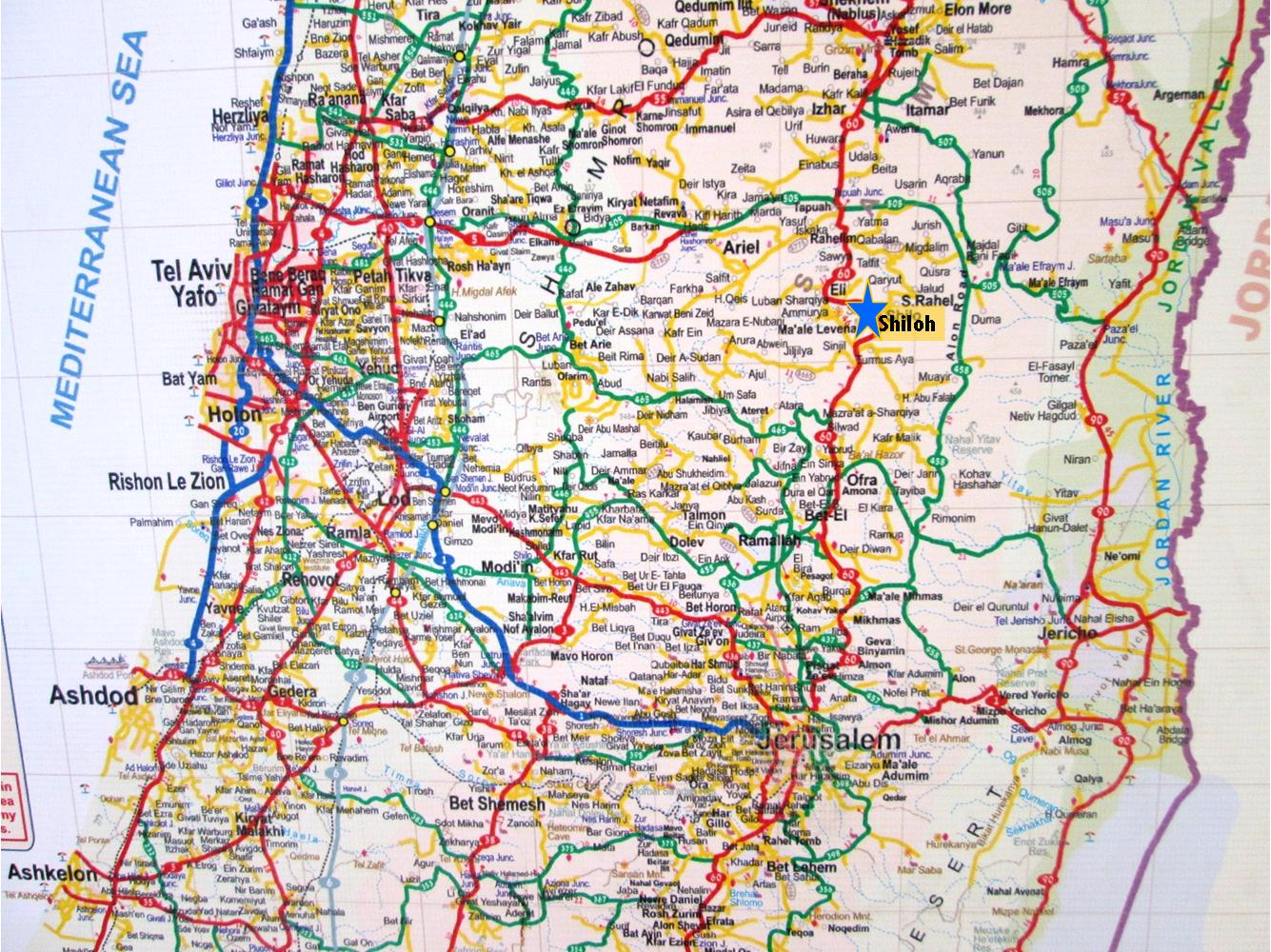
The road is called “the way of the Patriarchs” because it was traveled by Abraham, Isaac and Jacob. We know that Jesus used this road as he traveled from Jerusalem to Galilee, stopping at Jacob’s well in Shechem. For Joseph and Mary this route provided the shortest route to Bethlehem. I wrote Joseph’s travel journal in the book Advent Journeys. As our tour bus takes us along this route I will be interested in seeing the road for myself.
The trip from Jerusalem to Shiloh requires a group to go north. The first part of the journey will go through areas which were formerly independent towns, but became suburbs with the growth of Jerusalem. The first town of note is Gibeah which served for 38 years as the capital of Israel during the reign of King Saul. Today the town is called Pisgat Ze'ev and contains the unfinished Royal Palace at Tell el-ful which was to serve King Hussein of Jordan as his summer residence.
Israel Highway 60 goes around a curve to head north. Contained in or near this curve are two of the Levitical towns named in scripture Geba (modern Jeba’) and Anathoth (modern Anatot or Almon). The Bible tells how Jonathan freed Gaba from the Philistines. Later King Asa enlarged the city. Anathoth was the hometown of Jeremiah the prophet.
Continuing north we will pass Mizpah, a place translated “watchtower,” which is the first place on the Central Ridge Highway where Jerusalem can be viewed. Then we pass close to Ramallah, Bet-el and Et-Tel. Ramallah is a Palestinian administrative capital with a population close to 30,000. Beit-el is an Orthodox Jewish settlement placed at this location to honor Jacob, the grandson of Abraham who slept at this spot when he left home. Et-Tel is thought to be the site of the Biblical village of Ai which was destroyed by Joshua after the walls fell around Jericho.
Further north we pass Michmash (modern Mukhmas) where Saul and Jonathan fought the Philistines. Continuing north we pass Ophrah (modern Taybeh), a Christian village in the West Bank. It was near this village that Jesus spent time in hiding after he raised Lazarus from the dead.
Before reaching Shiloh we pass Mazra'a e-Sharkiya, an ancient farming community known as a farming community known for olive orchards, grape vineyards, fig trees and almond trees. As we travel we will learn the history past and present of these villages and the political situation of the West Bank. We will learn many interesting things to take home.

One of our objectives during our 14 day trip to the Holy Land in May 2018 is to see the West Bank and Shiloh. We will hear many stories from the Old Testament, the New Testament, Palestine and modern Israel as we travel this region. This trip to Israel will be unforgettable! Make sure you are included on this trip. For more details visit our our Israel Tour page at www.KosheCopy.com. Sign up today for a discount!

Friday, January 6, 2017

Israel Settlement Worries

Winds in the east, there’s a mist coming in, like something is brewin’ and ’bout to begin,” a popular quote from the movie Mary Poppins, can be used to speak about potential changes and results which could occur this year within the boundaries of Israel and the West Bank. Long-standing policies which have been in place from the 1970s and before could be overturned and reversed. Will the results be good or disastrous? - That remains to be seen.
Many have asked me for my opinion on Israeli politics and United States policies concerning Israel because I was raised in a Jewish home. To be sure, there is a love for the land and the nation which goes back to the fact that I was inculturated with the pride bursting forth from my people during the early years of Israel’s new-found independence. I learned about the land in Temple, I planted trees every year, and I heard glowing testimonies from people who visited the new nation.
As an adult I have studied and taught stories from the Bible and researched the associated geography, history, and current events. In 2012, 2014, and 2016 I visited Israel.  My love for the land has grown.  And as my love and learning have grown, I have come to recognize that Israeli-Palestinian relations are intricate and complex. Too many people think solutions are easy, but history should teach us otherwise.
I have watched and prayed during many of the hardships Israel faced in its early years. There were wars in 1948, 1956, 1967, and 1973. The nation has faced many other threats beyond the actual wars including shelling from the Golan Heights, Intifada, Palestinian uprisings, Lebanese and Syrian civil wars, and shellings from the Gaza Strip and from Iraq. The hostilities seem to be endless and continuing.
As I studied the journey of Joseph and Mary through Israel and the Palestinian territories by virtually traveling Israeli Highway 60, I listened to the voices of many people. One was a Palestinian reporter leading a donkey from Jenin to Bethlehem. He reported the trials of each border crossing. Second were the voices of Orthodox Jews and other Hebrew settlers in the occupied territory. I heard their voices of pride and commitment advocating their right to live on the land. I also heard the fear they feel by living within fenced compounds which can be attacked at any time. I read West Bank community blogs, Facebook groups, and municipal pages conveying the animosity they felt toward the perceived occupiers of their land. Proponents from each side are openly speaking their feelings toward each other and the outside intruders who are attempting to sway the politics of the region.
Peace and harmony will not come easily to Israel or the Palestinian territories.
And I keep getting asked, “Do you think” Obama, or Trump, or someone else “has the solution.” I do not think any of the “solutions” offered today by politicians will solve the problem. I think some forced solutions will make things worse.
In my studies I have read journals from pilgrims who traversed the “Promised Land” during the eighteenth and nineteenth centuries. The hostilities which we see today were either nonexistent or minimal during these former times. I wish we could return to more peaceful times when a traveler could visit the land. But during my lifetime, I am sure that we will not.
Some of the problems are racial or cultural. Other problems are political, created when artificial lines have been drawn giving this group or that group primary rights over a region of the land. The problems are compounded when outsiders pit the people of the land against one another.
Can peace come to Israel? I believe it can. But it will not come quickly.
Peace between groups with differences comes through the passing of time, often many years, decades, or generations. It comes when opposing parties begin to talk, learn names, listen to and comprehend the other party's ideas, and when they begin to see the other side as actual people rather than faceless and nameless opponents. During the first stage of interaction, solutions are not put forth. The agenda is for opposing parties to begin talking and then to understand that they are talking to people who have families, desires, and emotions just like them.
We experimented with such a solution to similar problems within the United States during the Civil Rights era. Racial groups met and worked alongside members of another race. Their children went to school together, and in time they moved into communities together. Change did not come easily, but it did come. Today people of different races are friends with one another and care for each other.
The same model can be used in Israel. As Palestinians, Orthodox Jews, secular Jews, and other interested parties begin to communicate and know and respect one another, they can open the “can of worms” and talk about problems. They can take baby steps and then bigger steps until harmony appears between groups. Then they can teach others and repeat the process.
The process takes a generation or two, because animosity and hatred are not easily removed. Over time, however, people can be intentionally moved and acceptance of the other can come.

We must always be vigilant because peace is easily shaken. Animosities can surface whether it is the result of racial tensions in the United States or distrust overseas.