Showing posts with label Shepherds. Show all posts

Friday, December 16, 2016

Do Angels Sing?

A consistent theme of the Christmas story is the appearance of Angels to people. The story begins with an Angel who comes to Abraham on Mount Moriah and tells him, “through your offspring all nations on earth will be blessed.” (Ge. 22:18, repeating the promise given by God in Ge. 12:3) The Angel also visits Zechariah (Luke 1), Mary (Luke 2), Joseph (Matthew 1), and shepherds in the fields outside Bethlehem (Luke 2). These Angels are a major part of the Christmas story; they bring the good news and promises of God to earth.
This week in Advent Journeys we are experiencing Christmas through the journal of a shepherd. In Saturday’s journal this shepherd wrote how “an angel of the Lord appeared … and the glory of the Lord shone around them.” The angel said to the shepherd and his co-workers, “Do not be afraid. I bring you good news that will cause great joy for all the people. Today in the town of David a Savior has been born to you; he is the Messiah, the Lord. This will be a sign to you: You will find a baby wrapped in cloths and lying in a manger.”
Then the Bible tells us, “a great company of the heavenly host appeared with the angel, praising God and saying, ‘Glory to God in the highest heaven, and on earth peace to those on whom his favor rests.’”
There are many who tell us that Angels do not sing, because the Greek word used for the communication of the Angels in this passage is λέγω (legō), which means “to say or to speak.” The dictionary also tells us this word covers every kind of speaking: to bid, boast, call, describe, name, tell, utter. When this word is used in scripture (and in other places) most often it describes someone speaking or talking. But in a wider sense, this word conveys communication. What many ignore is that singing is a form of communication.
The truth which many scholars (who study this passage in a very narrow way) miss is that when multitudes of angels come together in communication it is most often through the medium of singing. The pattern of speaking which we see in this passage is a basis for the way we worship. Mary led Israel to worship through singing in Exodus 15. They continued singing as they traveled in the wilderness (Numbers 21:17) and as they settled in the land of Israel (1 Chronicles 6:31). God commanded Moses (Dt. 31:19), David (1 Chronicles 15:8) and others to write music.
The Bible tells us of the true songs of pure worship which are sung in heaven. These include ‘a new song’ which is sung in Revelation 5:9-10 “You are worthy to take the scroll and to open its seals, because you were slain, and with your blood you purchased for God persons from every tribe and language and people and nation. You have made them to be a kingdom and priests to serve our God, and they will reign on the earth.” The angels also sang the new song of Moses, ““Great and marvelous are your deeds, Lord God Almighty. Just and true are your ways, King of the nations. Who will not fear you, Lord, and bring glory to your name? For you alone are holy. All nations will come and worship before you, for your righteous acts have been revealed.” (Revelation 15:3-4)
The song of the angels to shepherds in fields outside of Bethlehem was a vibrant means of communication. “Fear not,” should explain to us we should fear neither hearing, speaking or singing the message of God. “Behold, I bring you Good News of Great Joy,” gives an example of how we should communicate the Gospel (good news) to those who have not heard. “Glory to God in the highest heaven, and on earth peace to those on whom his favor rests.” gives us the example that all of our music should be pointed to God (and not to we ourselves). This song also teaches (as does the song previously mentioned from Revelation 5) that as a result of our worship (and like the shepherds who “spread the word concerning what had been told them about this child”) we should “be a kingdom and priests to serve our God.”
The Apostle Paul tells us to be like the angels, “Let the peace of Christ rule in your hearts, since as members of one body you were called to peace. And be thankful. Let the message of Christ dwell among you richly as you teach and admonish one another with all wisdom through psalms, hymns, and songs from the Spirit, singing to God with gratitude in your hearts” (Colossians 3:15-16). Never let anyone tell you not to sing the joyous message of Christ, especially at Christmas!

Wednesday, December 14, 2016

Shepherds of Greatness

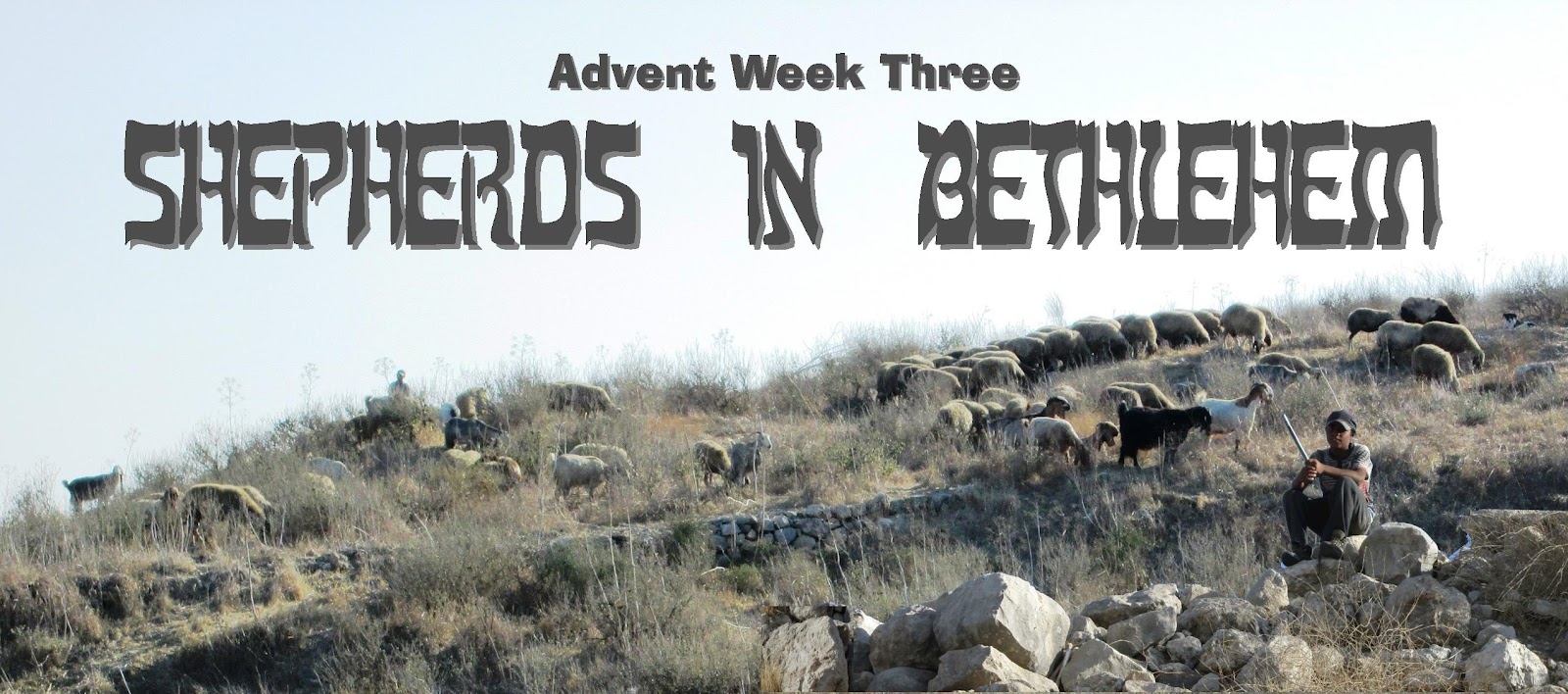
This week in the devotional Advent Journeys we move to the fields outside Bethlehem. Have you ever wondered what it would be like to live as a shepherd? There is more to the life than just following sheep. Take a look at the devotions this week, you can explore for free if you are an Amazon Prime member. I think you will enjoy the adventures of the Shepherds.
The Bible has a lot to say about shepherds. The first shepherd in the Bible (and we can assume the man who domesticated sheep) was Abel. His work, his heart of faith, and his offering pleased God. God’s love for Abel was seen by all (but there were not many people in the world at that time), and was displeasing to Abel’s brother Cain.
The Patriarchs: Abraham, Isaac, Jacob and Jacob’s sons were all shepherds. They developed large flocks, enjoyed great prosperity and developed quite a reputation as businessmen. Some of their neighbors were not too keen on their success. The Philistines stopped up their wells and attempted to get them to move, but God protected the Hebrew people.
Moses took up shepherding at the age of forty after a tragedy made a move necessary to sof ha’olam smola (סוף העולם שמאלה). Moses possibly learned the basics of shepherding through leadership training in Egypt in the school of Pharaoh. On the back side of the desert Moses met his wife, saw a burning bush and received his call to lead the people of Israel out of Egypt. (Who ever said Shepherding is boring?)
In an opposite way a shepherd boy named David received training to become King of all Israel through his leadership of sheep. (I wonder if there is a similarity between dumb sheep and a nation full of people). David learned bravery through protecting his sheep. He learned to sing and compose music either through necessity because of the vastness and emptiness of the Judean wilderness or through the constant bleating of the sheep. The solitude of the desert also taught David to worship God.
Shepherds are a unique group of people who carry a huge responsibility. This week we will join the shepherds as they live out their responsibilities and carry out their duties. Please, join the reading!

.

Saturday, December 19, 2015

Angelic Messages

“Behold, an angel of the Lord stood before them, and the glory of the Lord shone around them.” (Luke 2:9) Today, in the book Advent Journeys we talk about angels, angels who came and made an announcement to the shepherds.  For this Blog, I decided to start with a questionnaire to see how much you know about angels.
  1. What is the translation for the word “angel”?
  2. Where is the first use of the word angel in the Bible?
  3. Who are the two named angels of the Bible?
  4. What is the name of the angel who told Daniel the meaning of the 70 weeks?
  5. What is the name of the angel who spoke to Zechariah, father of John the Baptist?
  6. What is the name of the angel who spoke to Mary telling her she was pregnant?
  7. What angel spoke to Joseph concerning the birth of Jesus and the anger of Herod?
  8. What was the message spoken by the first angel which appeared to the shepherds?
  9. What message was spoken by the multitudes of angels to the shepherds?
  10. What do angels tell us about Christmas?


Here are the answers to the above questions:
  1. The words מַלְאָךְ (mal'ak - Hebrew) and ἄγγελος (aggelos - Greek) mean “messenger.”  Angels serve God and do His bidding.  One of the areas of service is to bear messages.
  2. The first use of the word מַלְאָךְ is found in Genesis 16:7, telling Hagar to go back to Sarah.  Some people see the angels gathering with God in Genesis 1:26, which says, “Let us make man in our own image...”  In Midrash Rabbah Rabbi Yochanan taught angels were created on the second day with the heavens (Psalm 104:3-4), but Rabbi Chanina argues it was the fifth day when God made the winged creatures.  Another early reference to angels is found in the first chapter of Job.
  3. Gabriel (warrior of God) and Michael (who is like God).  There is also the mysterious “man clothed in linen”
  4. Gabriel
  5. Gabriel
  6. Gabriel
  7. This angel is identified as “the angel of the Lord”  … possibly Gabriel
  8. “Do not be afraid, for behold, I bring you good tidings of great joy which will be to all people. For there is born to you this day in the city of David a Savior, who is Christ the Lord. And this will be the sign to you: You will find a Babe wrapped in swaddling cloths, lying in a manger.” (Luke 2:10-12)
  9. “Glory to God in the highest, and on earth peace, goodwill toward men!” (Luke 2:14)
  10. The angels tell us Christmas is about Christ.  They are looking to Christ in Luke 2:14; and also in Psalm 103:21; 148:2; Mt 18:10; 25:31; Luke 15:10; Hebrews 1:6; 12:22; Revelation 5:11-147:11
The angels worship God and serve Him.  There are many wonderful passages about angels in the scripture.  There are also some not so wonderful passages: such as Ezekiel 28, which displays what happens when we place the focus on ourselves rather than heaven.
May this Christmas be for you, as it was for the angels of Heaven, who, when the great news was shared, said, “Glory to God in the highest, and on earth peace, goodwill toward men!” (Luke 2:14)